
By Israel Centeno and translated by Ezra Fitz.
Illustrated by Camila Centeno Bonnet.
Voice: Rachel Ann Cook
Venezuela 2018
By Israel Centeno and translated by Ezra Fitz.
Illustrated by Camila Centeno Bonnet.
Voice: Rachel Ann Cook
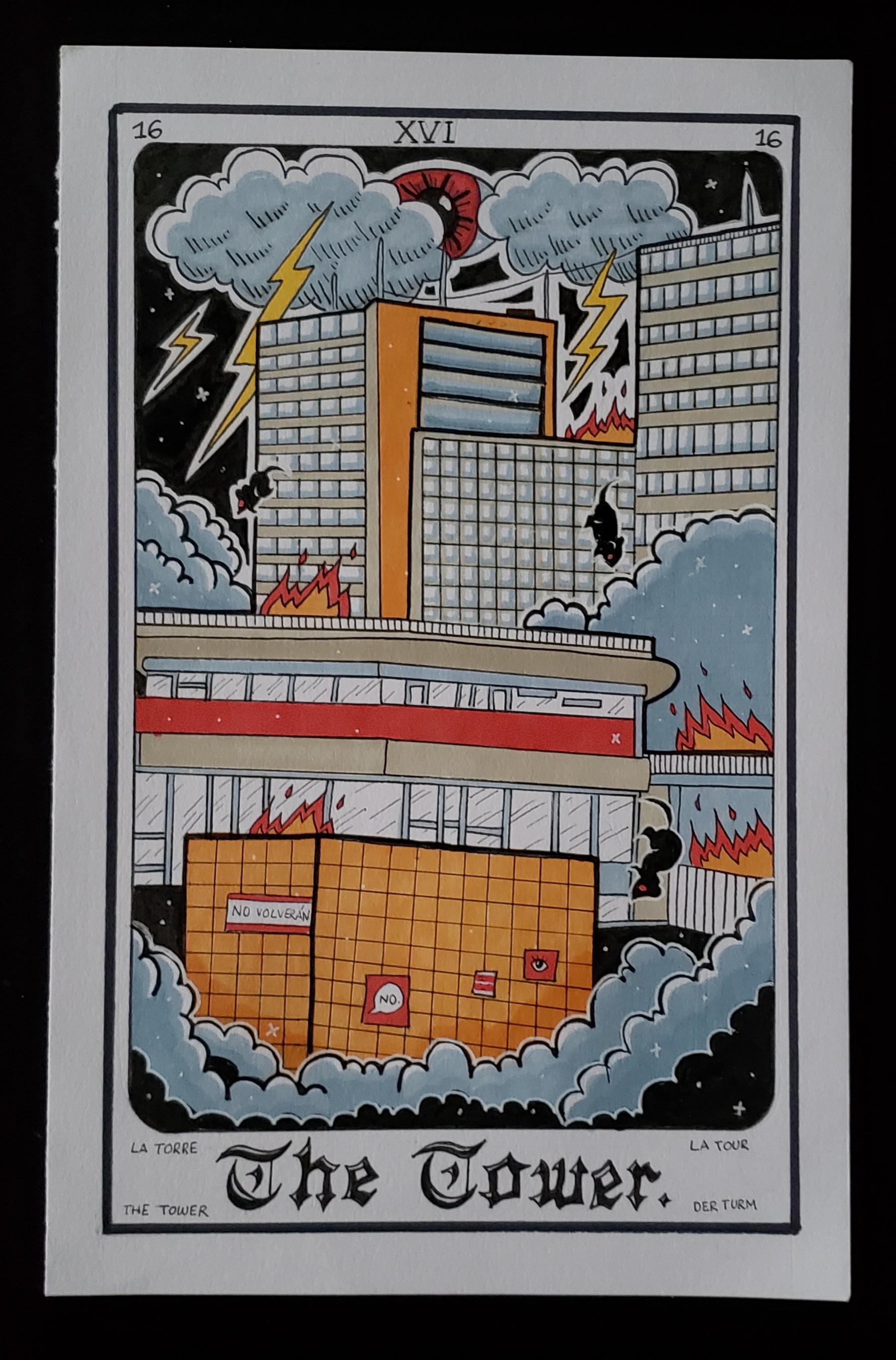
The towers, they say, were built atop a sphere, the sphere moves when the earth does, but beneath the towers a labyrinthine parking garage had been built, and upon that some galleries, the basements, intended for business, shops with large display windows, restaurants and bars for a privileged bureaucracy. Tailors, barbers, jewelers, stylists, bookstores, shoeshine stands, to the good nuyoricanair, kiosks exhibiting magazines from across the world. The mosaic murals, exposing the timid virility of a remote and national past. It showcased the best, the select, and the discretely sordid, almost related to the Zingg pass and the principal churches, theaters, plazas and the old colonial neighborhood; it was conceived thusly, the center, the vortex of modernity, though it power bustled from one concourse to another confounded by the great diversity of the passers-by, going in Silence, shopping at their stores, it meant walking through place where the faces of the world walk, searching for a suit or a lunch spot, beautiful people. Could it be? The morning smells were the smells of good breakfasts, and through the air in the corridors flowed the aroma of lavender, the sweet perfume of a woman, and verbena; the downtown parks and plazas were immersed with the sunshine or with the serene warmth of night in a place, as Hemingway said, that was clean and well-lighted.
In the vortex was a convergence of women and prostitutes, honest men and swindlers, troupes of actors and cabaret entertainers, time went, or was superimposed like layers of asphalt, hot and black, the sphere began to on and its axis which produced those drastic changes of that era, it came to be a place of diversity, of variety, of the avant-garde and later it would morph into dark, tumultuous chambers, the bathrooms with their marble walls the color of copper or perhaps travertine, and the brass fixtures morphed into prison bedpans, arcades open to all the city’s spaces, a transformation began, subtle at first then suddenly vertiginous to the point where it became the mouth of a terrible God devouring spaces, in the rotten, ravenous jaws of Baal. That was more or less how the balance was broken, with dramatic scenes, those arcades became ducts, then redoubts, and finally the place where the first man-rat was born, the father of the other rats with the eyes and brows of men, vampire rats, dismembering demons, thirsting for entrails, rats from the Caracas Stock Exchange, rats from the surrounding institutions, they all gnawed the canals and ducts, each and every space was left to the care of the largest rodents and eventually they didn’t want to share even the trash with the hordes of migratory collectors. They tried to understand, learned the language and were just as ravenous as any rodent or vampire, they sought to negotiate for time and space, but for all their good and civilized intentions they were just sitting down at the negotiating staircase, at the entrances to the underworld, when they were ripped to pieces and their entrails displayed on the balustrades of the interior plazas. The statues, the monuments, the murals and the frescoes were stained with the color and the light’s corrosive urine, the moldy dark military green, and the pitch black of the expanding leaks which, along with the fungus, gave the place the stench of sewers, latrines, and dungeons. And from the foundations of the towers to their highest floors, the entrails and urine, the lichens and the shadows, the confinement and humidity, the Minister of Closure granting the territory to the rodents and to the devils in the pipes. For through those spaces they could reach the plaza — Roberto Morel, Santiago, and Merlinda — and after them, those who still held hopes of escaping the cloisters of decaying files. Alenka, the Gilded Lady, seated on a desk, her gaze fixed on a window covered in black paint and plastic.
A meaning must have meaning; the absurd has logic. Having been a witch at one time and a person deprived of their rights in a section of the walled city, a quarry hunted by people, crossbows at hand, riding vehicles with varying engine displacement, lording over the canton, seen from a rusty desk in a damp, dark, bricked-up office is — despite the current nightmare — one of those composures of the subconscious mind, the oneiric world reigning over the real one. And hiding her head in her arms, not knowing her place, her city, her country… trying to comprehend the sense of having been — being? — an Amazon, a witch, or an old hag in Dahomey. She thought about Mama Zawe and her understanding of reality, she told her and Merlinda, before facing them in one of those fights in which warriors are formed: between the world of the living and the world of the dead, there is a universe of both living and dead, and rebirth exists in metamorphosis. She told her in her language, she said it with her mouth reeking of dried blood, metamorphosis, she now thought, is being reborn in forms, and the forms make me the Gilded Lady, Ludmilla, or Alenka. Which is why she stopped to examine the cauldron. A dead man? Dead men. For there was a confrontation, they lost the crescent moon where she reclined and upon passing by them she dissolved and could have gone first to the Altamira canton, repeating the history of witches or being reborn even more flexible, ready to walk along the cornices and face the abyss on the other side of the doorjamb, upon turning one of the corners of the tower.
And Morel’s forms? Roberto Morel was the same and yet he had changed into oblivion, his memories, his relationship with the navigated realities, or by the act of sailing itself, his forms changed. As Alberto would say, it’s the Wheel of Fortune. Who is Alberto, why see the man tearing at his beard in another space, tranquil like the houses in Bahia where, in one of his transitions, he was raised facing the crashing waves of the Atlantic, later having an epiphany, if we reach the open ocean we will return to them, to the life of men and women with their logic of war, of peace, and of progress, their high stone walls covered in pansies, their fruiting gardens, and their stucco bedrooms. Alberto was in this other place, she can see him, looking out over a garden where seven cacti grew. His image and his name returned. And then, the image of Julio and Lola. Of Julio and Carola, of Julio before being bitten by a serpent on a terraced road in Ávila, his downfall the result of reality laid bare, Julio is another traveler and arrives here riding a migratory wave, concerned. And then, Alenka added to the tranquility of his thought, I can be all men and all women, all realities and all things in a fraction of a second, an epiphany to write a voluminous novel laden with pages, a fragment of a fragment in which each and every life can fit, superimposed on one another. She understood Morel’s oblivion. Since when had Roberto Morel transcended the fragment of a second of an epiphany? It’s subtraction. She said it time and again. It’s subtraction. We die in order to be subtracted and we are reborn in order to continue subtracting and in the remaindering, in the stripping, we arrive at a denuded reality and do not change further.
That’s part of the truth, Morel would say, without comprehending the other part, only perceiving it. He, along with the others, began searching the elevator shafts and the devastated, lichen-covered ductwork for a space open enough for you to fit your hand, a place in front of which Santiago could wave his cape, fragmenting the material until it becomes penetrable.
Morel was up against an air duct, then he began to pound on the wall in search of false columns, and the Queen of Swords, Merlinda now with her cauldron, Which among the dead?he thought about the return of his power, he felt a strong pain in his stomach, the weakness born of his deficiencies, he felt dry and parched and asked Santiago, can you do something to quench my thirst? And Santiago dispelled the darkness for a moment, abstaining. Are you conscious? That was the question, the obvious, and Merlinda recalled the word metamorphosis, he is looking to change forms in order to exit his undead state: the epiphany. Then she exchanged glances with the Dwarf of the guava tree and he smiled at her, she feared his smile, the Dwarf’s mischief weighed heavily, she took her time, Merlinda didn’t think so as not to be heard, deciding to conserve her powers and calm the dead in her cauldron, which had to be attended to in order to observe the fast, and the change of forms which Santiago had sought was being induced. A smile of, you’re screwed, you little witch. She raised her hand to her face, over the cheekbone and just below her right eye, and cast a spell, her eyes darting and wide: this one and that one covered in molasses. The Dwarf winced and was lost among those waiting for them at the passageway to the basement.

 Israel Centeno Author
Leave a comment