
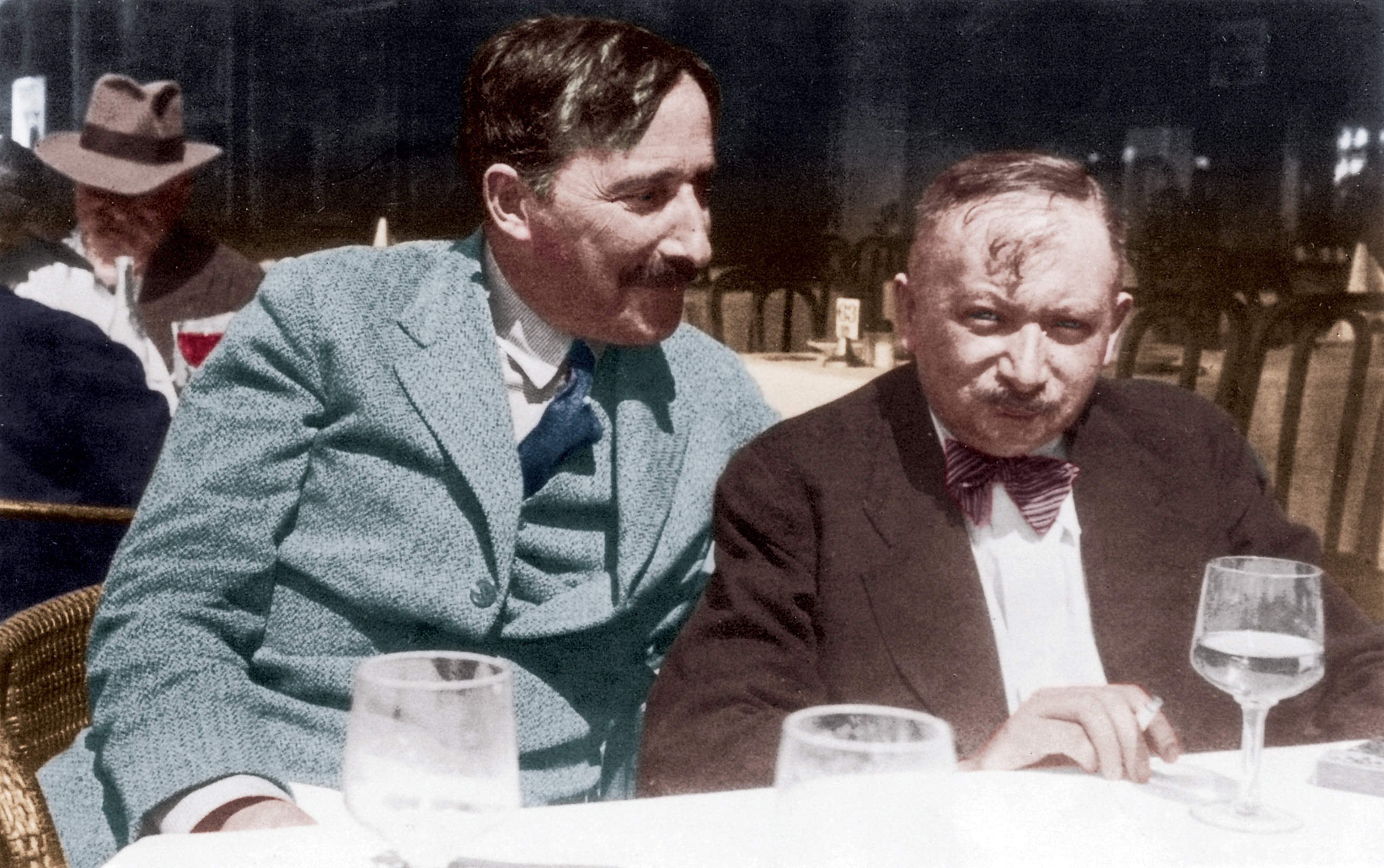
In times of crisis, everyone turns to the stories, authors and poetry in which they find most resonance. I have been working on a theory. You cannot translate a poem without knowing the semantics of colours and sounds — besides, the dynamics of the ineffable spirit in front of a vision. To translate a story, you have to know the semantics of the atmospheres it recreates, the semantics of the actions and above all the semantics of the contexts, etc. If it is good prose, some and in many cases, all the semantics are attributable to the unraveling of the poetry.
Yesterday I stood in front of Joseph Roth, again. I am very interested in finding The Wandering Jew and the Search for Joseph Roth, written by Denys Marks, who travels to the frontiers of the East in search of Roth’s lost world. I don’t have it handy — I’ll have to order it from the City of Asylum Bookstore, though I do have The March of Redetzky. For some time now, I have been convinced that to understand the world today, we must go back to the collapse of the Austro-Hungarian Empire. Stefan Sweig’s World of Yesterday is in a way an evocation of the future, in Austria’s past and in which I thought I had found the keys to this moment.
A few years ago, Horacio Castellanos Moya, on one of his visits to Sampsonia Way, told me that he was immersed in Roth’s readings, commenting on his inquiries with the passion that is characteristic of him. Rejoicing in the life of the author and in the clues he found in his literature. I searched my library and found The Silent Prophet. I remember that I bought it in Caracas, I was interested in reading this particular novel, because of the figure of Trotsky. His first reading was amazing. In it the author returns to a proposal already developed by Dostoyevsky The Possessed: revolutionary idealism turned into cynicism and all the paraphernalia of the higher good, which in the end are the personal motivations of those who lead revolutions. Today I am opening a flank, with Journy to Armenia unfinished in my anxiety to interpret everything that was prefigured then, in the years of the First World War, and the Spanish flu. The Redezky’s March is a total work. Every total work transcends the spatial-temporal framework, lives in the present and in all its contexts, as if it were a fulfilled oracle, and it is not. It is only a comprehensive vision of the human condition always on the edge of the abyss, about to fall, juggling its dilemmas. The sword and the wall, and in the middle every era that debates between greatness and decadence, honesty and cynicism. Dostoyevsky, Roth and Musil converge in the semantics of irony, horror and hope as the last and inexplicable alternative, to defeat cynicism. There have been many plagues and wars in the world, and behind them, all the good intentions of those who wish to change it more for hatred of the very condition that makes us human, than for the good of humanity itself.
I cannot allow myself to quote Roth, “the history of life has demonstrated the eternal truth that the individual is always defeated in the end.”
Today many have decided to bury their heads in the sand, others are stunned by the noise of binary confrontations and a few try to translate the signs by deciphering a literary text. Because every literary text that reaches a epiphany is a Bible, a sacred book in itself.
After reading the terrible epilogue of Crime and Punishment and having begun again my march with The Wandering Jew in Roth’s work, I continue to take refuge in the warmth of the colors that Osip Maldestan discovered in Armena “in the solemnities of Ararat” In the dark chamber of the fatalities, where the temper of the air, the light and the glory of Eduard and Claudet Monet appear.
 Israel Centeno Author
Leave a comment