
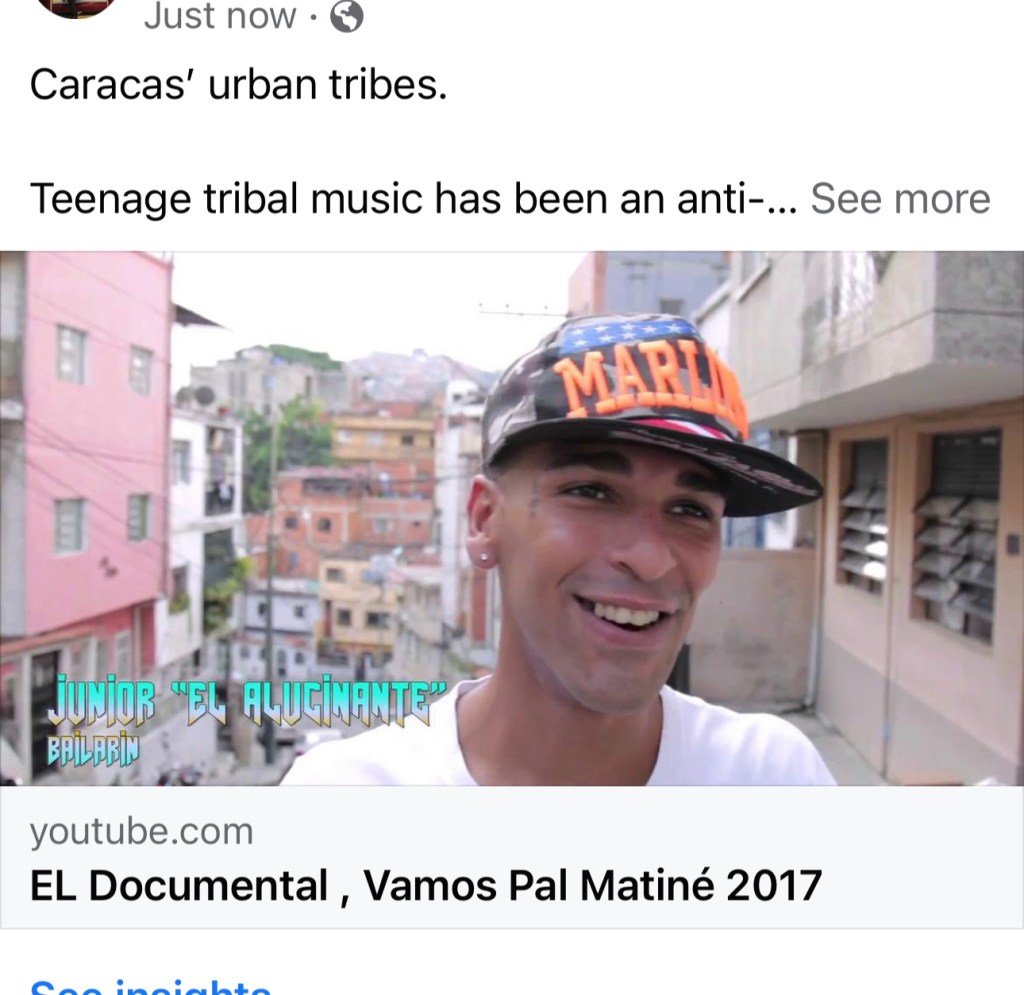
Caracas’ urban tribes.
Teenage tribal music has been an anti-epic urban register, picked up in the USA in musicals such as West Side Story. This musical tells a story of love and gang warfare, romanticizes violence, and registers the ethnic tensions of a part of New York City. Broadway has brought urban tensions to the stage on several occasions and, in this way, has captured and recorded its history. The last one I saw was the Midnight summer dream in Harlem.
In my youth, when I studied at Antonio José de Sucre in Los Magallanes de Catia, I would escape on Fridays at one o’clock in the afternoon to go to a matinee on Olivares Street, where we would make the walls of Nené Rivero’s house sweat, drink anisette and hopefully control one of the diablas of the José Antonio Caro. We always ended the matinee with a beating between schools, sections, grades, or neighborhoods. Salsa changai was the great discriminated then, it caused pouting among people from other sectors of Caracas, but Radio Aeropuerto picked up our spirit and transmitted the music to us. There is nothing apologetic about these adventures. They were sad events saturated with hormones in which knives, bottle spikes, and fights between women ended up giving a touch of failure to the afternoon. I imagine that every generation and the social group had its move bordering the limits of delinquency.
What then differentiated the techno Tuki generation freom previous generations? On the one hand, it was a generation of transition in many ways, a bridge from one decade to the other, from one model of the country to another (from a social democratic representative democracy to an authoritarian and messianic socialist government in free fall towards a postmodern dictatorship). Conversely, it was a way of consuming homemade music and producing homemade content.
At the end of the nineties and the first years of 2000, the country entered a phase of extreme confrontation accompanied by a violent discourse, which endorsed violence and mischief from power and used it to terrorize the middle class and, above all, to expose its reaction, It exalted the classist expressions of some sectors. Then it used them in the heated speeches in the presidential tribune of Hugo Chávez, a man very similar to the caudillos of the XIX century, who used the confrontation of castes and classes to advance their personal ambitions.
But Chavez only made it to the salsa; although already agonizing, in his last electoral campaign, the Chavez Beta appeared.
A little late.
Nicolás Maduro, a conservative man, would return to the Cuban danzón, the saoco, and the Guagancó. He dances like a madam del Callao while the police repress the people in the street
And the techno Tuki music?
I believe that none of the factors of power could or wanted to metabolize it.
It was born in the margins and remained in the margins. Their combustion was spontaneous. They used their knowledge learned in internet tutorials to mix music and take out the sounds of the city. They were true geniuses of hacking and preteria. They burned records and viralized them and marketed them in the street, in the boulevards, in the subway, and in improvised discotheques that were opened to call them multitudinous matinée, which was reattempted as crazed dancing fight clubs: armor and movement, step and break of the waist.
The had an impressive network.
It was the time of the quemaditos. Films, software, and music were burned. The music mingled on the house’s veranda, in the garage, or in the alley. In the actual staging, five, or six gangs and three or four neighborhoods confronted each other. The clothing characterized them; pipe pants, colorful sneakers, a baseball cap with any printed and colored markings worn on the side, to the use of the boards. The hat was a point of honor; therefore, to defend it, even at the cost of leaving the skin, a rib, a kidney, or the tendons of the arms, that did not frighten or astonish those who participated in the evening rumbas. They were like fiestas bravas, but everyone was in the arena, showing off their skills, generating moves, proving to be a better dancers than the others, machos más machos, and hembras más hembras. The women sometimes, according to the testimony of the participants, carried scalpel blades clenched in their teeth. The fights between them were bloody. Many ended up thrown to the pavement of one of the subway platforms, dead or midland. Energy ran through The veins and the deepest arteries of the city. Power in tune with the times, legitimized in violence, exalted in its most twisted expressions, and yet, as happens in urban tribal phenomena, it did not fail to express the fissures of the system that at that time was in the water, despite calling itself socialist and having appropriated the word “people,” incapable of stealing the Tuki, it left aside this expression of adolescent social tension and the cathartic need of youth very frustrated by the impossibility of seeing itself in any part of the country that was prefigured or of the one that the others wanted to sell.
These youngsters, cultists of technological and cybernetic piracy, created an underworld. From that time, we can also speak of another group of transhumans who ran along the banks of the Guiare doing their thing, The mediocre intelligence that abounds in the country and that is expressed in the social networks, demonized them by defining them at least as a barbaric expression of a society of which one should not make any apology. They used racist disqualifications and the condescension of one who tries to articulate a sentence look, ing at issue from above.
Years went by, and then we saw those same Tukies metamorphosed , coming out of the sewers and the ditches of the Guaire with wooden shields to confront the police of Maduro’s government; they used the same energy that their elders had used in the subway discotheques of the Caracas midday on the boulevard of Sabana Grande, a few years ago, now to confront the police and Maduro’s National Guard. Many were left dead in the street. It seemed to hurt no one. They were victims of human rights abuses in the basements of the Helicoide. They were exalted opportunistically in order to forget them quickly once the objectives were achieved…. They left their blood on the pavement and were forgotten. I do not doubt that those little squaddies belonged to the marginalized lineage that was clumsily used.
If you look for them, you can find them declaring on YouTube with their limited and yet paradoxical language, because they believe they have done something important, although, in reality, they did not know or would not know who they benefited or would benefit from their acts, that at the end of the day making rounds in front of some bonfire on the banks of a dry Guaire, they would count each other. They believe they have been part of the sad history of the country. They no longer fight against the Guaicaipuro neighborhood or against the cabillas of the Lomas de Urdaneta; El Valle or Las Minas, they do not confront the José Félix Ribas neighborhood or Filas; their faces would still be tired and sad, they would have been given hot bread donated by this or that guy who made a video and some bolivars to buy some cold beers and cigarettes. There will always be something to tell and spend the night. The moon is already beautiful in the East, as seen from the Guaiire.
 Israel Centeno Author
Leave a comment