
Israel Centeno
No rewards
If we transcend space and time, we probably will be nothing. It is no depth no surface no dimension, or other kind of reference, even there won’t be a vacuum chamber because nothing is exactly what we cannot express, paradise is a world dream from where we were expelled. Whether it is the case or worse if there is no case or eternal life, you are my Lord. You are irrupted in history. It doesn’t matter if it happened last week or two thousand years ago, you got me and will be there with me in the wilderness or the nothingness —¿it is possible to go through nothing? I do not have any answer but I am happy to be engaged with you, our pact is a pact of death and resurrection. My Rock, you will tie me up as Prometheus, the vacuum will wolf down my flesh and every expectancy but you’ll restore me in your flesh, probably we will be hydrogen or waves or particles, but if at the end I’ll just cease, I’ll do it in your eternity that is nothing because is outside any space temporal frame.
No reward.
Thank you, Lord, for my poverty which you have given me and which I gladly embrace. Nothing material binds me. Thank you for lasting affections, for discovering Agape, as the highest form of love. If you came to me now, and ask me to sell everything and follow you, I would leave my things and walk with you.
“For you were called to the freedom to serve one another out of love.”
So I will remain, with that commitment.
I went to the Porcuuncula Chapel at Franciscan University Ohio to give thanks. Gratitude is already a way of salvation. From grace to love, from Love to Grace. It is a chapel built just like a chapel in Assisi. It welcomes you in silence and in silence you can learn the great mystery: The Truth, which sets you free, has no sound, that is why it is impossible to articulate it, no image, which makes it untranslatable to the world of form, and yet it is revealed in the most intimate, in the deepest interweaving of the Soul.
The addiction to the frugal, to the second to the luminous sparkle, the brain saturated by the dopamines of the click, the second-hand runs on that small screen that steals our life. We do not settle for anything. We sacrifice everything to a public addicted to scrolling. We could not even name the most sensitive form of love, because it has also been sacrificed together with beauty on the altar of some rail. Artificial intelligence vampirizes us and almost makes any introspection impossible. There we are defeated, for it is there that we transcend, in the inner world, each time in the inmost part of our soul. Even the Trappist Brother Monks and the Carmelites update their statuses on social networks. There is almost no place left for solitary prayer, for intimate thought. The act of wisdom taught by Socrates, know thyself, has never been further away. The love of others is a like to one of the many causes that pop up on the screen, we have been overwhelmed by the most orgiastic form of idolatry to the superficial.
We have lost the head, not the gray matter, nor the bag of neurotransmitters, but that ineffable space where the being transcends, where the divine and human union is possible, as well the liberating introspections and dreams. We have been trapped on the outside, and we can’t go back and enter, we have closed the doors. We will live in the second forever, in the hustle and bustle and the overflowing craving for everything and nothing. We are the cream on the milk or the fog on the swamp.
Yes, I am old. I know I am. I know.
but
”But when you pray, go into your room, close the door and pray to your Father, who is unseen. Then your Father, who sees what is done in secret, will reward you. And when you pray, do not keep on babbling like pagans, for they think they will be heard because of their many words.”
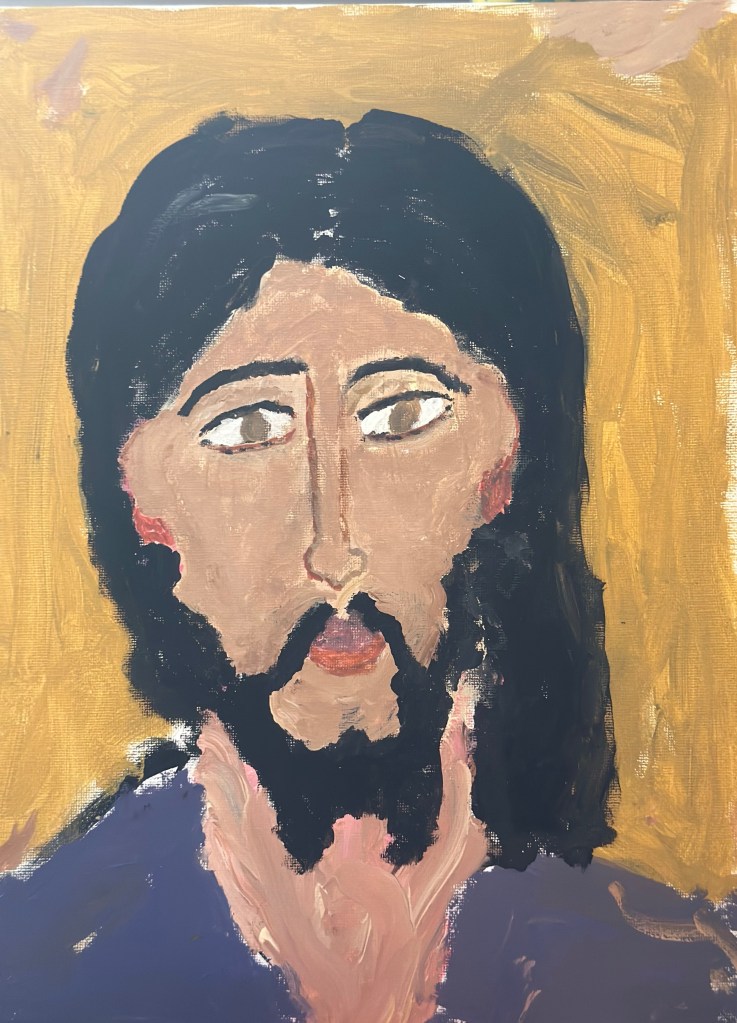
I come from a family like any other, with virtues and defects, but from which only that one could grow up being skeptical or atheist. Charles Darwin’s books and Plekhanov’s exclamations against Berkeley’s Idealism came early in my life. Reading Lenin and Marx made me a rarity among my friends at the time, who were more interested in Carnaby Street, the Hit Parade, and the Bangladesh concert. Being a dialectical materialist and, above all a person with a passion for science, futurism, and the world that would await us in 2000 was my purpose, the universal triumph of the dictatorship of the proletariat, on the other hand, I was a witness – participant of some manipulations that reinforced my disbelief and my disenchantment with any kind of spirituality. The most natural thing was that I had views contrary to those I have now, that I was a Marxist, Neo-Marxist, and reductionist, attached to empirical findings. Or Nihilistic, because there were moments in my life when Camus’ The Myth of Sisyphus exerted a great influence on my thinking. But in the eighties, I had my first jolt in a squatter in London. A Catalan friend initiated me in the reading of Master Eckart and in the reading of a little book that I did not understand much at that time, The Revelations of Divine Love by Julian Of Norwich. I also had my first mystical experience without having smoked marijuana or taken acid. We Marxists then were puritanical in matters of drugs. I read it more interested in the fact that Julian Of Norwich was the first English woman to write, and in the midst of the black plague that plagued England in the Middle Ages, and above all, I was captivated by the vicissitudes of the book in its struggle for survival. Then came my approach to Pythagoras, Plato, and my passionate readings of Dostoyevsky. Thank you, Camus, for having opened the doors of Dostoyevsky to me, you freed me from your irritating despair. In such a way, another world was rearranged, and my vital experiences confronted my childhood and my youth. After having visited hell, late in leaving it, I began to climb its steps back to the intermediate purgatory called Earth by the hand of Petrarch, Bocaccio, Dante, and Blake. And my vision has changed, despite all odds. My friends look at it with some grimness, it’s old man stuff, they say. No, Monserrat didn’t happen just then. Others smile condescendingly, and yet I feel, although far from Grace, much closer to something that is not exactly me, but still pleases me and gives me much more joy than the emptiness and absurdity of the intelligent. Simon Weil has taught me to pay attention when reading when seeing the other, and I know, like her that to look attentively at the other is an almost perfect act of neighborly love and that the world is in great need of the sign of Jonas.
In St. John, love is the way of the Cross. That is why his poetry is amorous. He draws in his poetry the keys to the emptying, the disassembling; he does not want to be anything but the beloved in the lover and the lover in the beloved. The wedding and the bridal chamber, the annulment of the self in the love of the beloved. You do not bear the silence of the beloved and you suffer the hells of your nakedness, stripped of everything, you are in the void waiting for him, and once the beloved gives you Grace, you wish to die to eternalize yourself in it. In the beloved, you are martyrized by love, and as Cristina Kaufmann, a Carmelite nun, says, you throw everything overboard except love. Because you want to live in a love that does not change and that is of a nature that is not human. In the depths of the human soul, there is a minimal space where it is possible to find the love of the One, of the Divinity, of that which transcends all science.
That is what we read in The Living Flame, in The Spiritual Canticle, and in The Dark Night, and the arcane is the same as always, to annihilate yourself in the process so that the beloved fills you and to lose everything in order to gain the Grace of the beloved. But the beloved changes, changes, and can abandon you in the void, except the one who does not change. The one who invites you to cross the silence in silence, to strip even your skin and your bones. In him, we find what is enough, the ultimate meaning, the full love life converted.
The loving key of the Poems of St. John and St. Teresa reveals to whoever knows how to read them the path revealed two thousand years ago. The path consummated after your painful complaint of spite, God, why have you abandoned me, the place where you say, in your hands, I entrust my spirit. And thereafter, if all is consummated, nothing will be left from you but love, the love you did not throw overboard.
 Israel Centeno Author
Leave a comment