
Sergei Bulgakov
IC
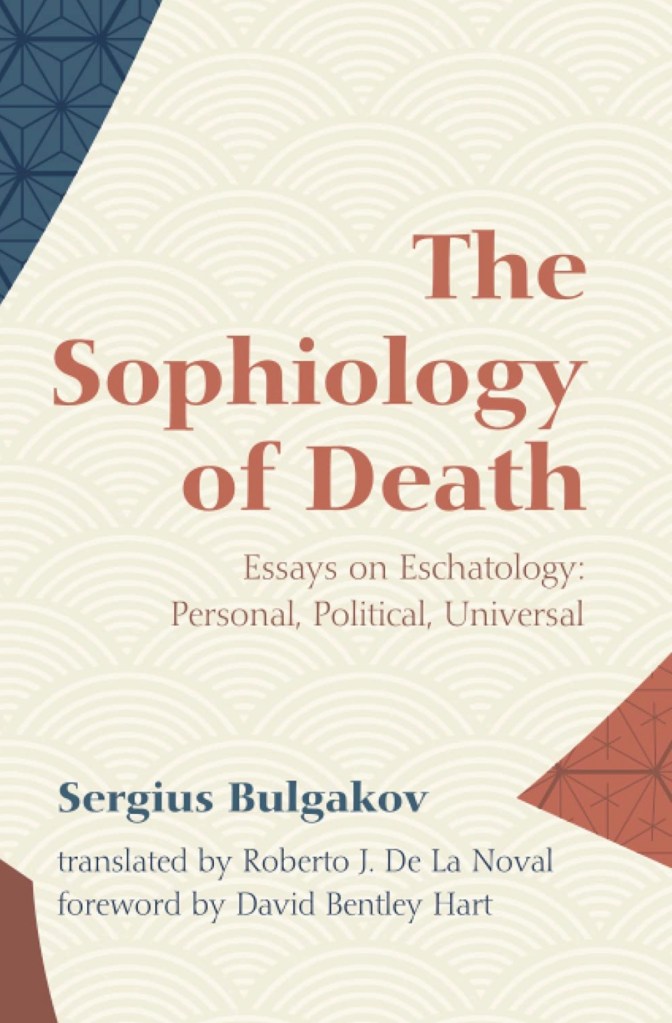
Sergei Bulgakov’s “Sophiology of Death” is a complex and multifaceted work that draws on a wide range of philosophical, theological, and mystical perspectives. The book is deeply rooted in Bulgakov’s Christian faith and his concept of Sophia, which he sees as the embodiment of divine wisdom and the creative force behind the universe.
Bulgakov sees death as a moment of transformation and rebirth, in which the soul is liberated from the constraints of the physical body and enters into a new realm of existence. He argues that death is not simply the end of life, but a gateway to a new and more profound experience of reality.
One of the key themes of the book is the idea that death is not simply a negative or destructive force, but a positive and transformative one. Bulgakov sees death as an essential part of the creative process, in which the soul is called to participate in the divine life of Sophia and to contribute to the ongoing evolution of the universe.
Bulgakov also explores the nature of the afterlife, arguing that it is a dynamic and evolving realm in which the soul continues to grow and develop. He sees the afterlife as a place of purgation and transformation, in which the soul is purified of its earthly attachments and prepared for union with Sophia.
Throughout the book, Bulgakov draws on a wide range of philosophical, theological, and mystical sources, including ancient Greek philosophy, Christian theology, and the writings of mystics such as Jacob Boehme and Meister Eckhart. He weaves together these perspectives to create a complex and nuanced vision of death and the afterlife that is both deeply spiritual and intellectually challenging.
Overall, “Sophiology of Death” is a profound and thought-provoking work that offers a unique perspective on one of the most fundamental and mysterious aspects of human existence. It challenges readers to reconsider their assumptions about death and the afterlife, and to explore the spiritual dimensions of these essential aspects of human experience.
Sergei Bulgakov (1871-1944) was a Russian theologian, philosopher, and economist, who played a major role in the development of Russian religious thought in the early 20th century. Born in the town of Livny, in the Oryol Governorate of the Russian Empire, Bulgakov was raised in a family of intellectuals and received a classical education in Moscow and Kiev.
After completing his studies, Bulgakov began a career in journalism and became involved in the social and political issues of his time. He worked as a correspondent for various newspapers and journals, and was involved in the Russian revolutionary movement, although he later became disillusioned with its violent tactics and turned to more moderate forms of social and political activism.
In the early 20th century, Bulgakov became increasingly interested in theology and philosophy, and began to develop a unique synthesis of Christian thought, mystical insight, and Marxist theory. He saw Christianity as a way to reconcile the contradictions and conflicts of modernity, and he believed that the message of Christ had the power to transform society and bring about a more just and equitable world.
Bulgakov became a prolific writer and thinker, and his works included philosophical treatises, theological works, and literary and artistic critiques. His most famous works include “The Philosophy of Economy”, “The Bride of the Lamb”, and “The Unfading Light”. He also wrote extensively on the concept of Sophia, or divine wisdom, which he saw as a central aspect of Christian thought and a key to understanding the mysteries of the universe.
During the Soviet era, Bulgakov faced persecution and censorship for his religious views, and he was forced to flee Russia in 1922. He spent the remainder of his life in France, where he continued to write and lecture on theology and philosophy. He became a major influence on the development of Orthodox theology in the West, and his works continue to be read and studied by scholars and students of theology and philosophy around the world.
 Israel Centeno Author
Leave a comment