
From Persecutor to Preacher: The Conversion that Reshaped the World
Conversion on Damascus Road
by Israel Centeno
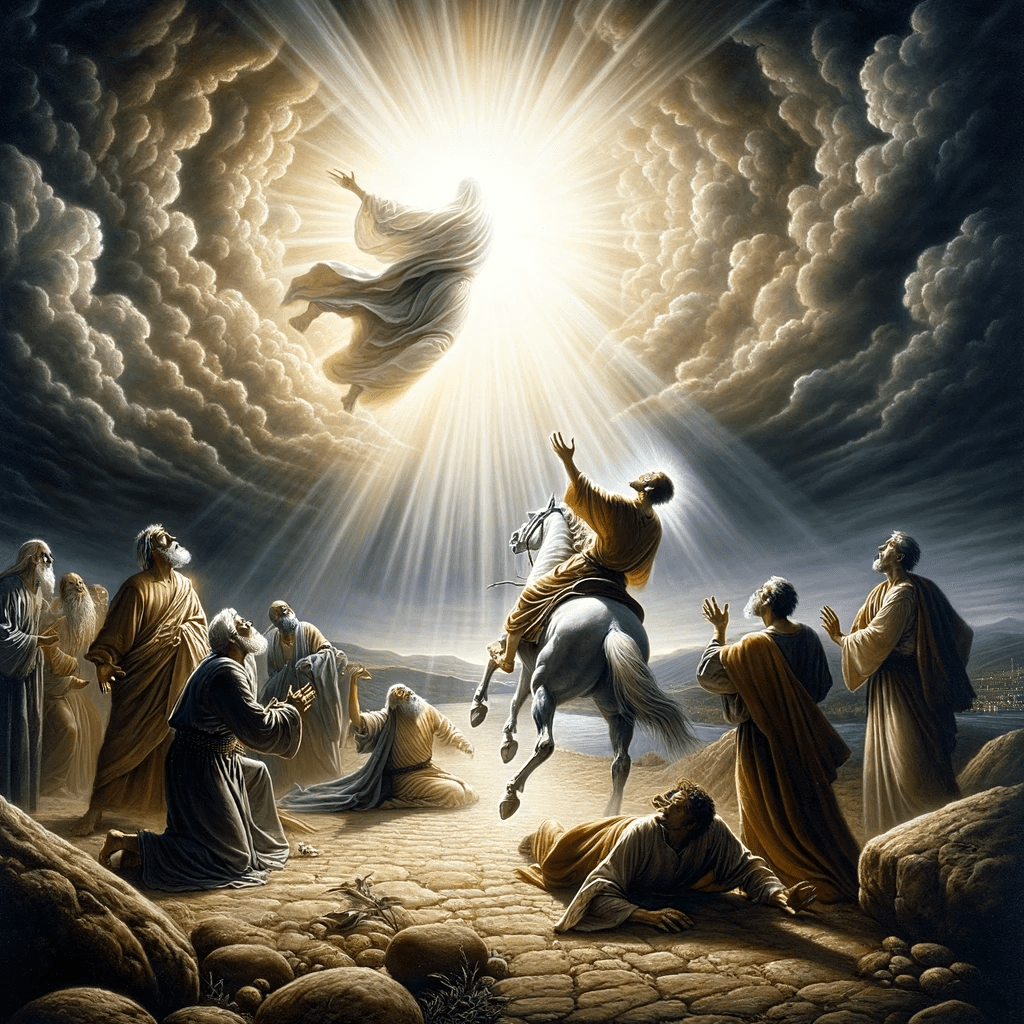
I clenched my fists as I walked through the dusty streets of Damascus. I was on a mission, to find and arrest any followers of this Jesus that people were talking about. But as I entered the city gates, a blinding light surrounded me, and I fell to the ground.
When I opened my eyes, I saw Jesus standing before me, speaking to me in a voice that shook me to my core. I realized then that everything I had believed and fought for was wrong. Jesus was the true Messiah. From that moment on, my life changed drastically. I became a witness to the power and love of Christ, even though I once persecuted His followers. And now, instead of hunting them down, I couldn’t help but share the Good News with everyone I met.
Despite my past sins, I felt chosen by God to spread His message of hope and redemption. I was humbled by this responsibility and dedicated my life to sharing the transformative power of Christ’s love and mercy. Every day, I feel grateful for the grace that has been bestowed upon me. I know that I am just a humble servant and that it is only through God’s love that I have been able to overcome my former life as a sinner. Now, all I want is for others to experience the same forgiveness and hope that has changed my life forever.
My mind was consumed by the tragic loss of Jesus while I trudged along the barren paths. His selfless love had a profound impact, giving me a newfound sense of purpose and redemption. My past had faded into oblivion, replaced by this renewed sense of meaning. It is not I who live, but Christ who lives in me. But as I continued to reflect on His crucifixion, I could imagine how hopeless it must have seemed for those who witnessed it. To them, it was not a heroic martyrdom or a vindication of His mission. It was a humiliating defeat and a discredit to all that He had claimed to be.
The religious authorities had condemned Him as a blasphemer, and even the secular authorities saw Him as a threat to their power. The very people He came to save had turned against Him, and He suffered a godless death—an unthinkable end for someone who preached in the name of God. As I pondered this, my heart was filled with both sorrow and gratitude for what He had endured for us.
My thoughts were consumed by the tragic death of Jesus as I walked along the dusty roads. It was His love that transformed me and gave me a new purpose in life, leaving behind my old ways. Now, my life is dedicated to Him. The events of His crucifixion weighed heavily on my mind, and I couldn’t help but imagine how hopeless it must have seemed to those who were there. It was not seen as a noble sacrifice or a validation of His teachings, but rather a crushing defeat that shattered all belief in Him.
The religious authorities had condemned Him as a blasphemer, and even the secular authorities saw Him as a threat to their power. The very people He came to save had turned against Him, and He suffered a godless death – an unthinkable end for someone who preached in the name of God.
Contemplating this, a mixture of sorrow and gratitude filled my heart for His ultimate sacrifice.
The end of this reflection signals the start of a new and remarkable chapter in my role as an apostle of Jesus Christ. As the sun dips below the horizon, I am determined to push forward on my journey, wrestling with these ideas and striving for a greater comprehension of the cross and the limitless love of God it embodies.
For what may seem like a godforsaken death holds within it the most divine act of love and redemption known to humankind.
I have walked countless roads across the ancient world, bearing witness to the transformative power of Jesus Christ. Yet, never far from my thoughts is the weight he bore on that cross – suffering shame and degradation at the hands of humans despite his innocence. This remains a sobering truth both in my time and now.
Yet, this assumption of lowliness, this ungodliness taken on by the incarnate Son, embodies the true power of God. Without it, there is no gospel – just empty religiosity.
The cross is a symbol of revolutionary hope, as taught by Paul, John, and Luke. It represents the eternal Spirit of the crucified and risen Christ, a transformative force that will forever live on.
The brutal nature of crucifixion was intended to be a spectacle for all to see. The victim’s prolonged agony and public humiliation were designed to shame and dehumanize them before the world. It was a proclamation that the person condemned to such a fate was seen as less significant than even an insect.
Crosses were strategically placed not for any semblance of convenience or sanitation but for maximum exposure and ignominy. Crucifixion’s goal was to erase its victims from the collective memory, to completely obliterate their existence. It was a chilling warning to those who might dare to challenge the status quo, indicating that they, too, could be eradicated in a similar, ritualized manner.
This sinister and macabre act was a display of humanity’s darkest impulses. Into this very abyss of despair and horror, the Son of God willingly entered, accepting upon Himself the world’s collective darkness and pain through His self-sacrificial journey to the cross.
He did this not only to bear our sins but also to show us the way forward. He taught that we, too, must bear our own crosses, willing to die to the world and its corrupting influences in order to attain eternal life. It was through His example that we learned the path to redemption—embracing our sufferings and renouncing worldly temptations as we follow in His transformative footsteps.
The enormity of his sacrifice consumed my thoughts as I journeyed on, spreading the good news of the risen Christ. Jesus, the innocent lamb, bore the weight of our sin and shame, enduring a brutal crucifixion so that we could be redeemed and reconciled to God. The cross, once a symbol of inhumanity and death, now stood as the ultimate testament to God’s love for us.
The harrowing scene of Jesus’ crucifixion is etched into my memory like it was just yesterday. The scourging, dirt filling his wounds and intensifying the pain. His hands nailed to the crossbar, not tied as commonly depicted but cruelly driven through his wrists. In an ancient world where any mutilation of the body was seen as dishonorable, Jesus endured mockery, spitting, scorn, and the stripping of his kingship. The crown of thorns and purple robe were all part of a deliberate and calculated dethronement leading up to the ultimate humiliation – crucifixion.
The horror of crucifixion lies in one’s own body becoming the instrument of excruciating suffering and eventual asphyxiation. I cannot fathom the depths of pain that Jesus must have endured on that cross, and yet he bore it willingly for our sake. As I continue my mission, proclaiming the good news of Christ, I am haunted by his passion. Reflecting on his humiliation and suffering only deepens my awe for his immense love for us. In the face of unspeakable cruelty, he remained steadfast in his purpose. The cross is more than just a symbol of death; it is a powerful reminder of Christ’s unyielding love and his willingness to go to great lengths to save us from our sins.
The foundation of our identity was once the law, but it held us captive under a curse. As it is written, “Cursed is everyone who does not keep all of the things written in the book of the Law.” It is clear that no one can be made righteous before God through the Law alone, for “The one who is justified by faith will live.” The Law does not originate from faith, and thus it says, “The one who keeps the commandments will live by them.”
But Christ, in his boundless grace and mercy, redeemed us from the curse of the Law and ourselves by becoming a curse for us. As it is written, “Cursed is everyone who is hung on a tree.” He did this so that the blessing given to Abraham might come to the Gentiles through Jesus Christ, and we might receive the promise of the Spirit through faith.
The significance of Christ’s sacrifice is often overlooked, but it can be found in this crucial passage. By his death on the cross, Jesus broke the curse that bound us and opened the way to salvation for all who would believe.
As I continued my mission to spread the gospel of Jesus Christ, my heart overflowed with gratitude and awe for the love he demonstrated on the cross. The cry of dereliction resounded in my ears, a powerful reminder of how far he descended to lift us up.
Reflecting on the Law and its effect on devoted followers, I came to the realization that those who defined themselves solely by its adherence were plagued by a curse. The words inscribed in Deuteronomy 27:26 made this fact evident: “Cursed is everyone who does not uphold all the words of this law by observing them.” Yet, it is also apparent that one cannot be deemed righteous in the eyes of God simply by following the Law. As Habakkuk 2:4 declares, “But the righteous person shall live by faith.”
The Law’s origin is not found in faith; if it were, it would not proclaim, “The one who follows the commandments will live by them” [Lev. 18:5
The strength of humanity is found in our weaknesses, as shown by Jesus, the savior who willingly took on the curse of sin and death for us. It is a profound mystery that surpasses human understanding, meant to inspire awe and gratitude rather than fear or doubt. Through this selfless act of immeasurable love, God reveals his boundless grace and mercy, offering us a path to redemption and restoration.
As I trembled with each word, I was struck by the weight of this truth and the magnitude of Christ’s sacrifice. Every sentence I spoke sought to illuminate this paradox, for it lies at the heart of our faith and serves as our source of hope even in the darkest times. The air around me seemed to pulsate with the power of this revelation, filling me with a sense of reverence and wonder. For truly, there is no greater love than this: that a man would lay down his life for his friends.
As I stood before the audience, my voice shook with both reverence and conviction. The atmosphere was thick with anticipation as I prepared to reveal the message that had consumed my every thought and action.
“Brothers and sisters,” I began, sweeping my gaze across the faces before me, “let us not shy away from this truth. For it is in our weaknesses that we find strength, and through Christ’s sacrifice we are redeemed.”
A silence fell over the crowd, the weight of my words settling deep into their souls. It was as if time itself halted to allow the gravity of what I had spoken to sink in. In that sacred moment, I could sense a collective understanding dawn upon each person.
With growing intensity, I continued, “Just like Jesus willingly bore our sinful selves and brokenness on his shoulders, we too must embrace our vulnerabilities and surrender them to God. For it is through our weaknesses that His power shines brightest.”
 Israel Centeno Author
Leave a comment