
Israel Centeno
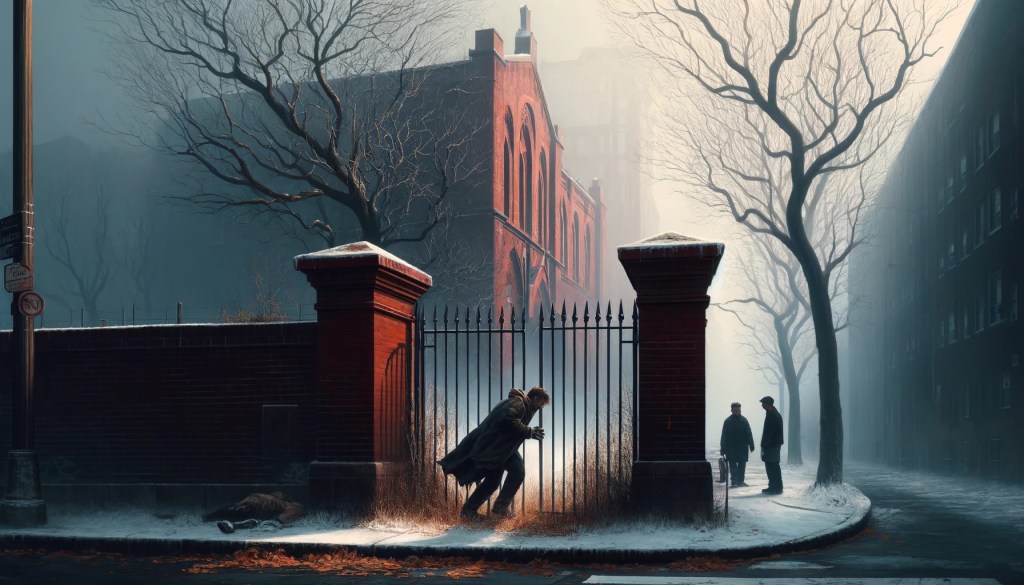
On the other side of the street, a vacant lot lay where winter had left the trees skeletal and ghostly. Despite the clear day, a halo of fog hung over everything, and a cold light illuminated the bare branches. At the top of the street, an old, solid, and imposing red brick wall loomed.
Rubén Tenorio shoved his hands into his coat pockets, clutching it tightly against his chest, and quickened his pace, desperate to find a place with some heat. He breathed deeply, his footsteps crunching over the fallen leaves, the frigid morning air cutting through him. He felt lightheaded, as if the oxygen itself had turned against him. Desperately, he saw the yard he still had to cross to reach the entrance of the Catholic school. Five minutes felt like an eternity, time stretching like a taut, weightless fabric.
When he reached the institute’s gate, he gripped the iron bars, their coldness biting into his skin. He shook the gate once, twice, and a small figure appeared at the far end of the yard, where a couple of boys were playing basketball. It was a man in a black habit. He beckoned to him.
“Wait, wait!” he shouted. Rubén didn’t hear him; in his mind, bells tolled — a memory from his childhood, an echo that haunted him. The religious man opened the door and directed him towards one of the side corridors that led to a chapel. “Father Ferguson is expecting you.”
How the hell did he know who he was? Rubén didn’t even have time to ponder the question when the small friar added, “First, you need to confess.”
“Confess?” Rubén asked, incredulous.
“Yes, yes, over there. Go on, follow the left corridor, and you’ll see the confessional.” Tenorio didn’t want to argue, but he hoped to skip the confession and get straight to the point with Ferguson.
The chapel was small and orthodox, with the Stations of the Cross etched into the walls and a replica of the Christ that Saint Francis of Assisi prayed to at the far end. Rubén didn’t enter the confessional. A voice urged him to do so, and he responded:
“I have nothing to confess.”
“Are you sure?” asked the voice behind the wood. “Are you a man without sin? Step inside.”
“I’m not going to tell whoever’s behind that screen my sins, forgive me, Father.”
“Nobody speaks with Father Ferguson without first confessing.”
“You’re not Father Ferguson?”
Silence.
Rubén shrugged and entered the cramped space, choosing to sit on the uncomfortable bench rather than kneel, feeling both uneasy and oddly comforted by the cloistered space. On the other side of the screen, the confessor’s heavy breathing was audible, not seeking interaction, remaining silent, occasionally whispering the Rosary.
“It’s been a long time since my last confession, and it didn’t end well. I confessed to the chaplain of the police department in Caracas. Somehow, my commissioner got wind of the details of my confession. Days later, two men from the late Sierra tried to kidnap me.” The confessor remained silent. Tenorio knelt, feeling the weight of his actions.
“I’ve broken the ten commandments.”
“That’s enough, no need for details. I absolve you, my son. Pray for the souls in purgatory and try not to sin again. Go to the first floor, to the right you’ll find a hallway. At the end, there’s an office. Father Ferguson is waiting for you.”
Father Ferguson wasn’t a man, but a place: the boxing gym for detectives in Pittsburgh. There, detectives practiced the art of investigation without resorting to violence, at least not as much as before. The era of hard-nosed cops was over; now, detectives were expected to engage more in human relations and broaden the spectrum of people with new visibility. That’s what the departments were called.
Rubén Tenorio scratched his head and entered the gym. There, he received an envelope with instructions about a case to solve in an abbey in the Midwest, where two monks from Maracaibo had disappeared. Rubén Tenorio put his hands to his head and shouted, “What did I do to deserve this case?”
“You’ve broken the ten commandments, my son, no more, no less,” responded a voice identifying itself as Father Ferguson.
 Israel Centeno Author
Leave a comment