
Israel Centeno
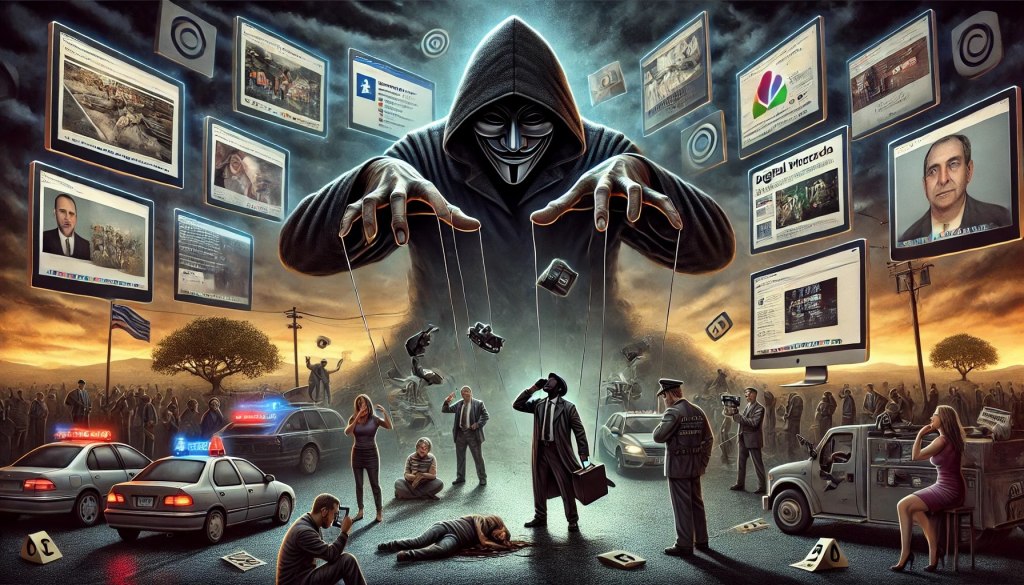
Manipulation of crime scenes is a calculated assault on reality and truth, perpetuated by those who crave power and control. With each falsified detail, they are twisting the very fabric of justice and betraying the public’s trust. Their actions are akin to murder – killing off the truth and allowing injustice to thrive.
By distorting crime scenes to fit their own agendas, whether fueled by personal biases or political greed, these individuals are complicit in heinous crimes against humanity. They sow seeds of doubt that lead to wrongful accusations and convictions, while true perpetrators walk free. The consequences reverberate far beyond the single case, corroding society’s faith in its legal system and those responsible for upholding it.
In today’s world, determining the truth amidst a sea of misinformation and propaganda is an uphill battle. And this ambiguity is a dire threat to our fundamental rights and freedoms. When truth becomes a casualty, it opens the door for oppression and tyranny – as people become pawns in the hands of manipulators. Our only defense against such atrocities is to stand firm in our pursuit of the truth, no matter how elusive it may seem. For without truth, there can be no justice, and without justice, there can be no freedom.
In today’s society, technology and media hold a dual role in shaping our reality. On one hand, they provide powerful tools for uncovering and spreading the truth. However, on the other hand, they can also be used to create and spread false information with unprecedented speed and reach. With apps and trolling techniques readily available, anyone can manipulate a scene from afar. Social media platforms have become battlegrounds for conflicting narratives, often prioritizing sensationalism over accuracy. The ease of editing and sharing images, videos, and testimonies only adds to the difficulty of distinguishing between genuine evidence and fabricated content.
Amidst this modern landscape of information manipulation, the question of who truly controls the currents becomes crucial. Identifying the masterminds behind these manipulations is vital in understanding their broader implications and developing strategies to combat misinformation. However, with the anonymity and distance afforded by technology, this task has become increasingly challenging but no less essential.
Despite some attempting to discredit its existence, objective truth does indeed exist. Denying this fact opens the door to relativizing reality and justifying any narrative, regardless of its lack of foundation or potential harm. The recognition of objective truth is critical for upholding justice, protecting human rights, and fostering social cohesion. Without an agreement on what is objectively true, we risk descending into chaos where any version of facts can be forcibly imposed or manipulated.
They operated in the shadows, their influence subtly weaving through the digital landscape like a malicious virus. The capitalizers of the currents had no face, no name that the public could place blame upon. They orchestrated online movements, stirring up outrage and division with calculated precision. Each post, each tweet, each video was a carefully crafted piece in their grand puzzle of control.
As the chaos escalated, so did their power. They fed on the fear and uncertainty of the masses, amplifying it to suit their own agendas. Behind the anonymity of their screens, they pulled strings and manipulated narratives, shaping the very reality that people believed in.
But amidst the sea of misinformation and discord they sowed, there were whispers of resistance. A group of digital vigilantes had formed, dedicated to unmasking the true puppeteers behind the chaos. They worked tirelessly in the shadows, tracing digital footprints and connecting dots that led them closer to exposing the capitalizers of the currents for who they truly were.
 Israel Centeno Author
Leave a comment