
Israel Centeno
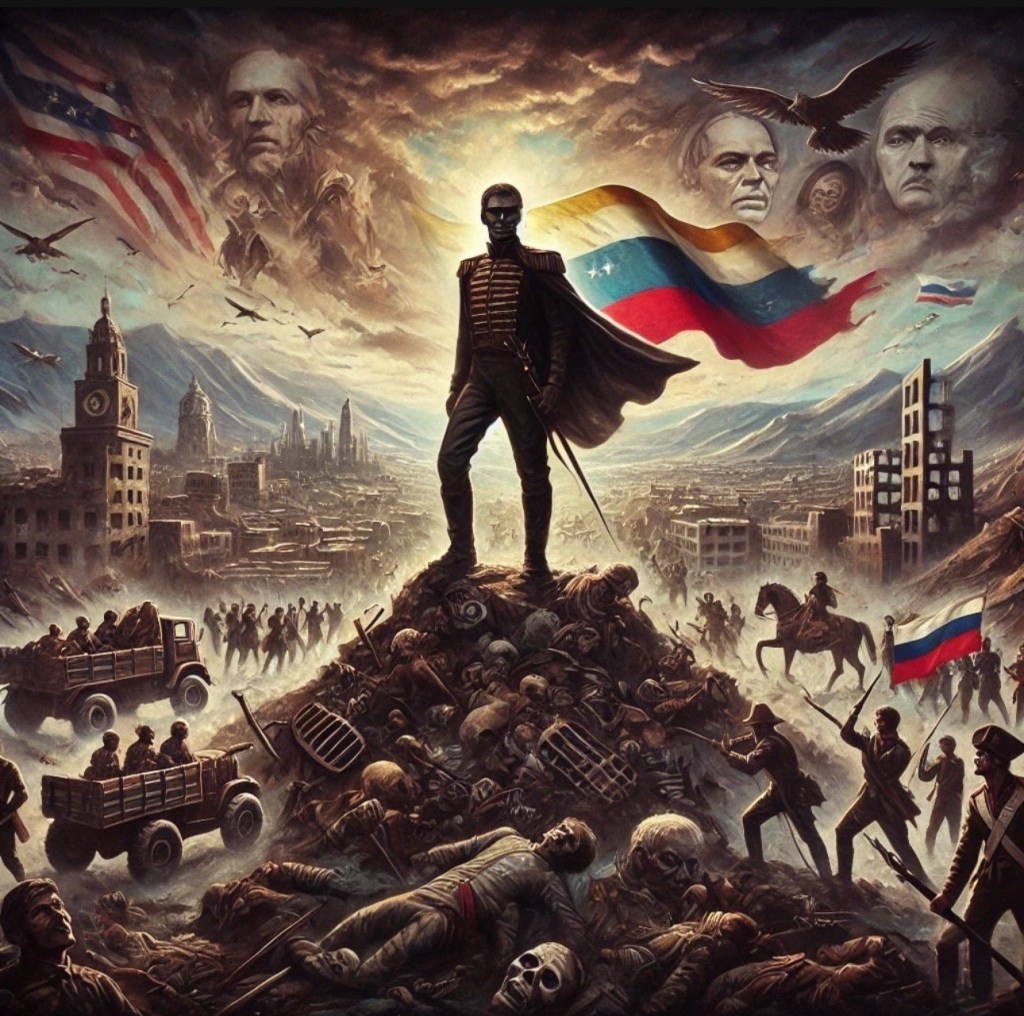
The history of Latin American independence is tinged with noble ideals and inevitable tragedies, a drama of epic proportions that still resonates within the nations that emerged from the collapse of the Spanish Empire. Among the most moving and complex episodes is the birth and fall of the first and second Republics in Venezuela, amidst the whirlwind of the independence war, where dreams of freedom and justice intertwined with the horrors of civil war, leaving an indelible mark on Latin American history.
In the early 19th century, while Spain was reeling under Napoleon’s yoke, a group of visionary leaders in the American colonies saw an opportunity to follow the example of their northern neighbors, who had successfully established an independent republic. The idea of founding a republic was not only an act of political emancipation but also a reflection of the spirit of the times, a manifestation of the desire for self-determination and a future built by free citizens.
However, the reality of Hispanic America was considerably more complex. Deep social divisions, inequalities, and latent tensions among the different sectors of the colonial population quickly became fertile ground for the eruption of internal conflicts. Local bandits and warlords, who had been relegated to the margins of colonial power and who saw the republic as a threat to their interests, began a series of uprisings that rapidly degenerated into a devastating civil war. This fratricidal struggle, far from consolidating a republican project, ended up bleeding the region dry, leaving behind a desolate landscape where two-thirds of the population perished just in Venezuela.
Simón Bolívar, the man destined to become the Liberator, faced a monumental crossroads. He painfully realized that to triumph in this war, he had to adapt to the realities of his time, adopting the role of a warlord, a populist capable of mobilizing the masses and dealing with the prevailing anarchy. Throughout his campaign, which took him across vast territories to the heights of Upper Peru, Bolívar had to fight not only against royalist forces but also against the ghosts of treason and disloyalty that haunted his republican project.
The common man, amid the whirlwind of Latin American independence, often found himself in an ambiguous and contradictory position. For many, loyalty to Spain was not merely a matter of cultural attachment or devotion to the Crown but an expression of distrust towards the republican leaders emerging on the political scene. These republicans, mostly creoles, were seen by the lower classes as the landowners and tenientes, the same people who, under the colonial regime, had perpetuated a system of inequalities and exploitation.
While the ideals of freedom, equality, and self-determination resonated in the speeches of the independence leaders, the common man, often illiterate and far removed from the centers of power, saw in these speeches little more than a continuation of existing hierarchies. To him, the republicans did not represent a true break with the past but rather the continuation of a system where power and wealth remained concentrated in the same hands.
In this context, loyalty to Spain offered a sense of familiarity and stability in a world in turmoil. The Crown, despite its flaws and abuses, was seen as a distant but legitimate power, while the republican leaders, many of them large landowners, were perceived as the new feudal lords simply seeking to consolidate their dominion under a new flag.
This perception was exploited by the royalist forces, who appealed to the common man’s sense of identity and belonging, presenting themselves as defenders of traditional order against the chaos and uncertainty that the republic promised. In many regions, this narrative resonated strongly, and not a few peasants and rural inhabitants took up arms in defense of the monarchy, not so much out of fervor for the king but out of fear of a change that seemed destined to worsen their situation.
Thus, the war of independence became not only a struggle for political emancipation but also a battle for the soul of the people, where loyalties were divided, and alliances were forged under the weight of centuries of inequality and oppression. The common man, caught between the ideal of the republic and the reality of his daily life, found himself in an existential dilemma, where his identity and future were at stake.
The birth of Bolivia, one of Bolívar’s most ambitious creations, marked the pinnacle of his efforts. However, Bolívar soon realized that the republic he had dreamed of was sliding irretrievably into chaos. The excessive ambitions of the warlords, the absence of a deeply rooted civic culture, and the fragility of the institutions forced Bolívar to take authoritarian measures, dangerously approaching dictatorship. He governed amidst conspiracies and assassination attempts, trying to rescue the citizen from the clutches of warlordism, but the dream of a republic of equals was crumbling before his eyes.
At the end of his life, Bolívar found himself bitter and disillusioned. The republic he had fought to establish was plagued by corruption and populism, devoured by the very vices he had tried to eradicate. His creation had consumed him, and the America he had liberated was heading towards a 19th century filled with endless revolutions and civil wars, led by warlords and bandits who would continue to shape the region’s destiny.
The 20th century, far from being the redemption Bolívar might have dreamed of, inherited these same dynamics. Emerging democracies found themselves constantly threatened by warlordism and uprisings, which, like a historical curse, continued to erode the structures of the State. In a region where the rule of law remains fragile, the figure of the bandit, the warlord who challenges institutions, persists in popular culture, reflected in songs and ballads that glorify subversion as an act of justice.
Today, Latin America continues to grapple with the legacy of that traumatic separation from Spain, a legacy where rebellion and distrust towards institutional power remain powerful forces. The shadow of Bolívar, that man who tried to forge a republic amidst chaos, still looms over a region where institutions struggle to sustain themselves, where the dream of the republic remains, in many ways, an unfinished project.
 Israel Centeno Author
Leave a comment