
Israel Centeno
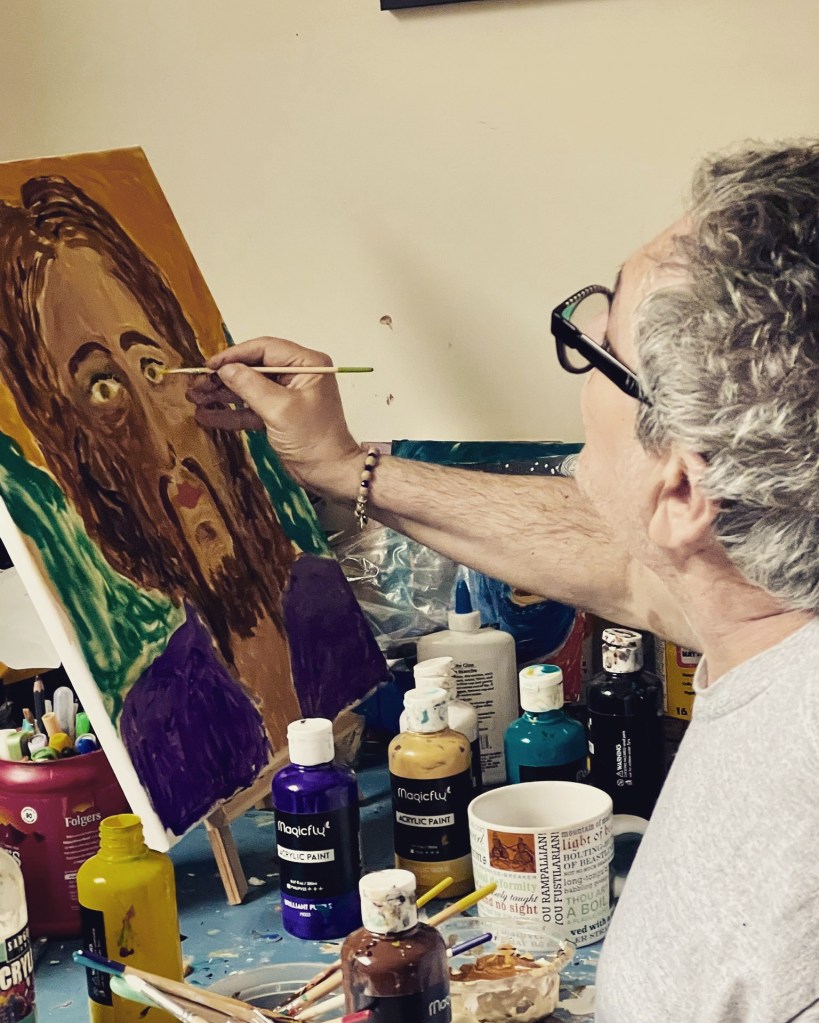
Those who know me might wonder about the state of my reading habits at this stage of my life. When I speak of this moment, I do so from the perspective of the consolidation of my maturity, the deep knowledge of myself, my limitations, and my own mortality. From this viewpoint, many things in my life have been reordered, establishing new priorities, including in the realm of reading.
I find myself in a time where I no longer feel the need to seek approval or to pretend to discover something just to please others. It’s a time where I demand from myself an extreme fidelity in the exercise of my freedom. However, I now understand that true freedom is only attained in a state of union with the divine—a notion incomprehensible to those who have removed the divine from their lives. Within this framework, I feel liberated from my futile efforts to transcend, focusing instead on lightening the load, on letting go of everything that weighs me down, everything that hinders my inevitable journey toward the end.
That said, let me return to the topic of books. With a calm spirit, I can say that many of my classics remain untouched. My canon is simple and unorthodox; I’ve incorporated into my reading the texts of the early Church Fathers, whose poetry holds an invaluable depth. The Spanish Renaissance has also become a part of my daily reading, with figures like Saint Teresa of Ávila and Saint John of the Cross. With them, I have—or would have—enough to last me a lifetime.
Among my Latin American authors, only a few have endured in my canon. Among them, two Argentinians: Jorge Luis Borges and Adolfo Bioy Casares, and the Uruguayan Juan Carlos Onetti. From Mexico, Juan Rulfo and Carlos Fuentes. I’ve read and enjoyed all the others, much like one enjoys fashion—with delight—but over time, these authors have lost their luster and, in some way, have disenchanted me. Not because they are bad or inadequate, but because they have aged in my eyes. At times, I feel a certain tenderness for that youthful enthusiasm, but I am certain that they no longer speak to me.
I could add much more, even discuss my Venezuelan authors, but this would probably be an exercise in futility, contributing nothing to a non-existent critique or to the weak dynamic of our literature in these times. I will simply say that I no longer read new releases; I do not feel compelled to acknowledge anyone just to be acknowledged. Those who know me are already aware of my tastes and readings when it comes to the authors from my country.
Moreover, as I mentioned, I am also reading philosophy, and within this realm, Edith Stein has been a remarkable discovery. However, before concluding, I want to highlight a recent reading from a prolific and underappreciated author despite her quality and consistency: Iris Murdoch. Her novels have captivated me so much that I’ve had to pace myself so as not to exhaust them too quickly.
So, in this note, you won’t find an exhaustive list, but you will understand that, nowadays, I lean more towards the Russians than the French, more towards the British than the Americans. And it comforts me to feel that, although I am in a moment of closure, I have made significant progress in shedding burdens, gradually releasing the ballast from my balloon. In the end, as Eliot said in East Coker: “In my end is my beginning.”
 Israel Centeno Author
Leave a comment