
The Thomistic Point of View: Summary of Idealism, Catholic Realism, and the Five Ways
Israel Centeno
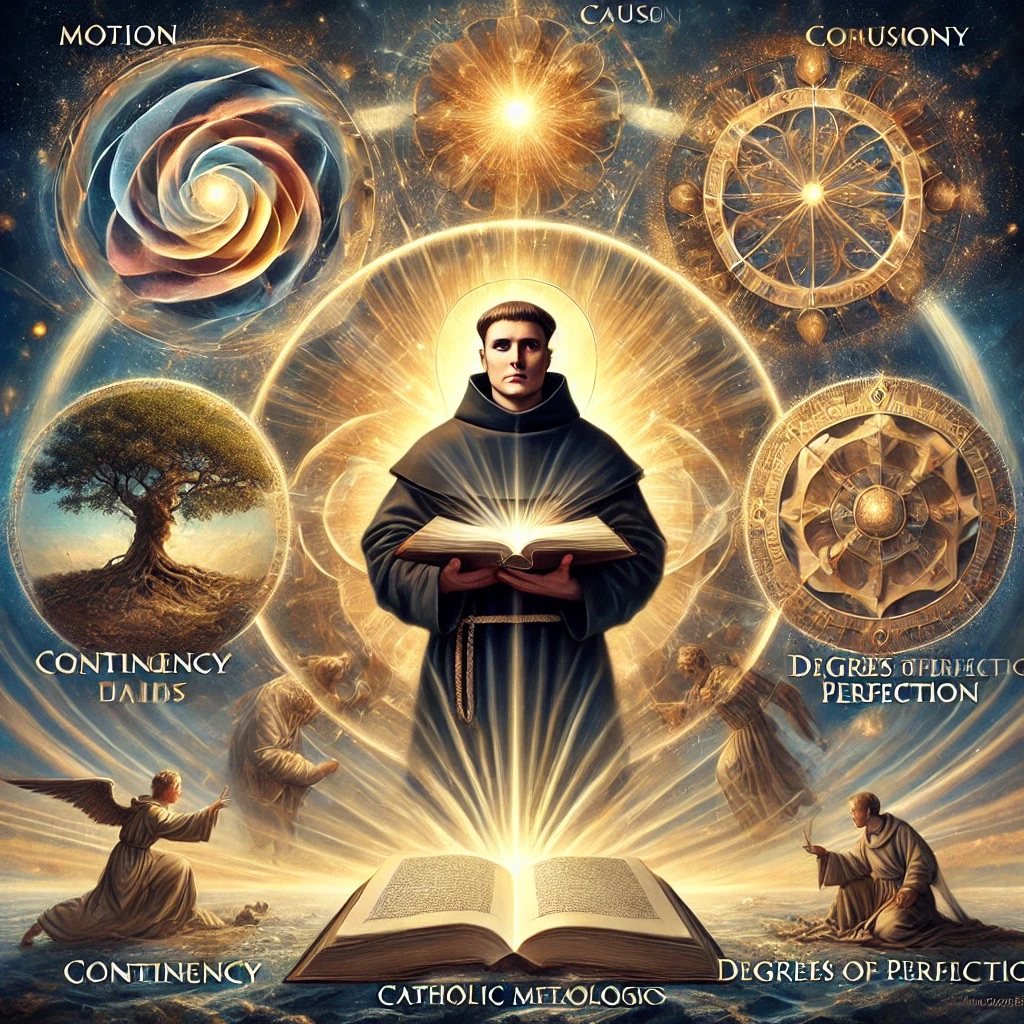
From the Thomistic perspective, developed by Saint Thomas Aquinas, reality is composed of both material and immaterial elements. Influenced by Aristotle, Aquinas held that objective reality exists independently of human perception and that our knowledge of this reality begins through the senses. This contrasts sharply with idealism, which suggests that reality depends on mental perception or consciousness.
Below, we explore how Aquinas’ philosophy contrasts with Berkeleyan idealism and Bernardo Kastrup’s Analytic Idealism, addressing the Catholic view on the nature of reality and God’s relationship with creation. Finally, we will highlight Aquinas’ Five Ways, the arguments he presents to demonstrate the existence of God.
1. Being and Essence: Reality Independent of Perception
For Saint Thomas Aquinas, reality is defined by the distinction between being and essence. The essence of a thing is what it is, while its being is that it exists. Aquinas asserts that essences exist independently of whether or not they are perceived, which contrasts with Berkeley’s idealism, which holds that existence depends on perception.
In Aquinas’ metaphysical realism, the material world exists because God, as the First Cause, created it, not because it is continually perceived. While idealism suggests that the world only exists insofar as it is perceived, Catholic theology teaches that the material world has objective reality and continues to exist independently of human or divine perception.
2. God’s Act of Creation: Beyond Idealism
For Aquinas, God is pure act and pure potentiality, existing outside of space and time. Creation is an act of God’s will: God creates the universe ex nihilo (from nothing), and while the material world is sustained by God, it has an independent existence.
This concept contrasts with Bernardo Kastrup’s Analytic Idealism, which proposes that reality is mental and that the material world is a manifestation of a universal consciousness. Catholic theology holds that God is transcendent and distinct from His creation.
3. The Nature of God: The Trinity and the Personal God
In Thomistic theology, God is one and triune, existing as Father, Son, and Holy Spirit. This doctrine of the Trinity emphasizes that God is not a simple, undifferentiated consciousness but a personal and relational being. Each Person of the Trinity is fully God, yet distinct in relation to the others.
Idealism, which often emphasizes a universal consciousness, does not align with the Trinitarian view of God, which is central to the Catholic faith.
4. The Incarnation and the Goodness of the Material World
Aquinas defends the goodness and reality of the material world. In Genesis 1:31, God sees that His creation is “very good.” The Incarnation, where God became man in the person of Jesus Christ, reveals that the material world is not only real but also the place where redemption occurs.
In contrast, Kastrup’s Idealism sees the material world as an illusion or mental construct. Catholic theology, however, affirms that the material world is objectively real and good.
5. Human Nature: Unity of Body and Soul
For Aquinas, human beings are a unity of body and soul. The soul is created directly by God and is immortal, while the body is material and essential to human nature. Catholic theology teaches that the resurrection of the body at the end of time highlights the importance of the physical world.
Idealism, by focusing on consciousness, tends to minimize the role of the body and the material world, which is incompatible with the Catholic belief in the dignity of both body and soul.
The Five Ways of Saint Thomas: Demonstrations of the Existence of God
Saint Thomas Aquinas presents five logical arguments to demonstrate the existence of God, known as the Five Ways. These are:
- The Argument from Motion: Everything in motion must have been set in motion by something else, and there must be a First Mover who is unmoved—this is God.
- The Argument from Efficient Cause: Everything has a cause, and there cannot be an infinite regression of causes. There must be a First Cause that is uncaused—this is God.
- The Argument from Contingency: Contingent beings depend on other things for their existence. If everything were contingent, there would have been a time when nothing existed. Therefore, there must be a necessary being, which is God.
- The Argument from Degrees of Perfection: We observe varying degrees of qualities such as goodness, truth, and beauty in the world. There must be an ultimate source of all perfection—this is God.
- The Argument from Design (Teleological Argument): The universe operates with purpose and order. Non-intelligent objects, such as planets and natural forces, work toward specific ends, implying the existence of a Designer—this is God.
A Catholic Approach to Realism
In summary, both Berkeleyan Idealism and Bernardo Kastrup’s Analytic Idealism offer interesting perspectives on consciousness and reality, but they are not fully compatible with Catholic theology. Thomistic metaphysics, on the other hand, provides a more robust and coherent approach, affirming both the objective reality of the material world and the transcendence and immanence of God.
The Five Ways of Aquinas offer a logical basis for understanding the existence of God as the First Cause of all that exists. The Thomistic view emphasizes that the material world, while dependent on God for its existence, is real and good, and that the unity of body and soul is essential to human nature.
For those seeking a philosophical approach aligned with Catholic doctrine, Thomistic metaphysics is a deep and reasoned path for understanding the mysteries of God, creation, and human nature
 Israel Centeno Author
Leave a comment