
Israel Centeno
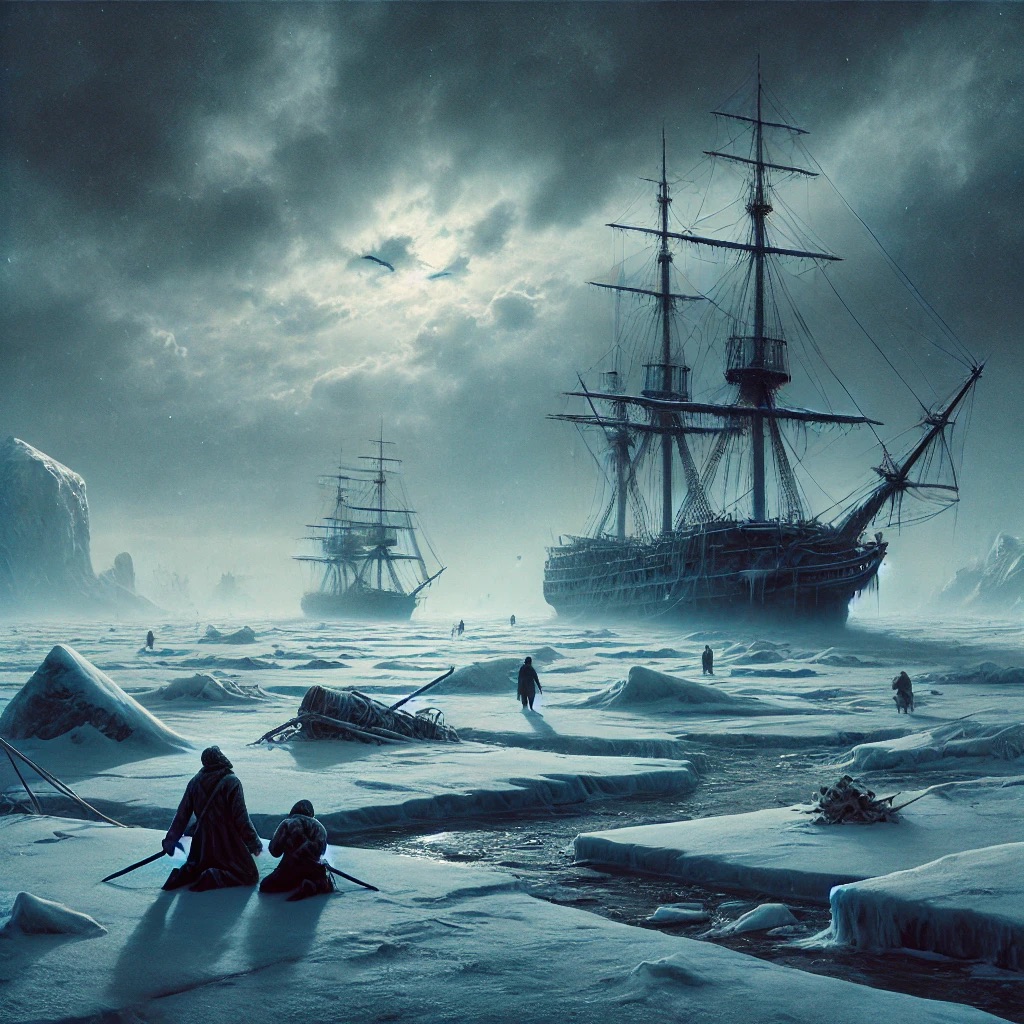
I’ve just finished watching The Terror, an AMC series that recounts John Franklin’s ill-fated expedition in search of the Northwest Passage through the Arctic. When I started the series, I wasn’t sure if it was based on a real event or just a piece of horror fiction. After watching the first episode, I did some research and realized that the series covers both: real events and a horror narrative. However, what truly surprised me was that, as the series progressed, I found myself witnessing an infernal reality, both literally in the suffering of the characters and metaphorically in the absence of hope.
I’m not sure if others will have this same interpretation of the series, but as the plot unfolds, I realize that all the men in this story are individuals burdened with deep past failures, carrying guilt, and who, in a way, were never the first choice to embark on this expedition. When the Erebus and Terror become trapped in the ice, we see the lack of empathy and compassion in most of the crew. What’s most disturbing is that, with the exception of Captain Franklin, who has a Pharisaic view of God, all of them seem to be men without God, or men from whom God has withdrawn.
As the frozen landscape becomes more barren, the sun sets to give way to a long, dark winter, and after Franklin’s death, everything seems to evolve into a curse. While we can’t say for certain that everything described in the series is historically accurate, what is true is that the series conveys a very clear, and in my opinion, fairly accurate vision of hell.
The Franklin expedition embarks on a journey of self-annihilation, where none of the crew—neither sailors nor captains—turns to God, either for help or repentance. There is no hint of hope, even when everything else has failed. What we witness is the embodiment of evil: Hickey on one hand, and the Tuunbaq monster on the other, possessing absolute power over this desolate realm. There is nothing to counteract it, not even hope.
Rejecting the Body of Christ and Embracing Cannibalism
A fundamental aspect of this infernal narrative is the clear choice to reject good and embrace evil. A key moment in the series is when a secondary character, who has already resorted to cannibalism, approaches anatomist Harry Goodsir and tells him how, as a child, he was forced by his Papist aunts to attend mass and partake in the Eucharist. That experience of receiving the Body of Christ liberated him and gave him a sense of spiritual cleansing, but as an adult, he chose never to return to Catholic mass. The series draws a crucial distinction between consuming the Body and Blood of Christ in the Eucharist, an act that brings redemption, and the moral degradation of cannibalism.
In The Terror, cannibalism is not just a response to physical desperation, but a symbol of moral downfall. Embracing cannibalism means surrendering human dignity and divine ethics, an act of desperation that the characters justify as a way to satisfy their hunger. But this hunger is not merely physical; it is spiritual and moral. The character who recounts his Eucharistic experience is consumed by hunger, and he cannot stop thinking that cannibalism will be a temporary solution, even if it brings a deep moral burden. This contrast between the Eucharist, which purifies and gives life, and cannibalism, which degrades and condemns, offers us a symbolic representation of the choice between good and evil.
The Hubris of Captain Franklin
Captain Franklin, in his role as the expedition leader, embodies another aspect of evil in the series: pride, or hubris. Franklin presents himself as a man of faith, but his faith is deeply tainted by arrogance. Instead of seeing his position as captain as one of service and responsibility, his hubris leads him to believe that his will and authority are enough to control the expedition’s fate, even when reality proves otherwise.
His Christianity is more protocol than authentic faith. Franklin clings to a Pharisaic vision of religion, where rituals and rules are more important than humility and a genuine connection with God. This approach alienates him from the true essence of Christianity and pushes him to make fatal decisions, like continuing deeper into the Arctic despite warnings and deteriorating conditions. His pride blinds him to the reality of the situation, and ultimately, it leads to his death, a reflection of how hubris can destroy even those who see themselves as men of faith.
Hell is the Place Where God is Absent
If anything defines hell in The Terror, it is the absence of God. In this sense, the series is a clear prefiguration of theological hell: a place where there is no redemption, no hope, and where evil reigns unchecked. The characters, facing extreme suffering, do not turn to God for help or seek hope in adversity. Instead, they accept their damnation, whether through cannibalism or through selfish and destructive decisions.
The series presents us with a hell without flames, without traditional torments, but with an omnipresent evil, both in the form of the Tuunbaq monster and in the internal corruption of the men. This Arctic desolation is a representation of eternal damnation, where humans self-destruct by rejecting God and embracing their worst instincts. The natives, like the Inuit woman and the shaman, seem to be the only innocent figures, protected by their connection to nature and the spirit. Meanwhile, the members of the Franklin expedition are portrayed as cursed men, without God, progressively exterminating themselves in a landscape where God is absent.
Conclusion
My reading of The Terror is unmistakably theological. Through its narrative, the director and writers show us a vision of hell: the absolute absence of God and His mercy. The rejection of the Body of Christ and the acceptance of cannibalism, along with Franklin’s hubris, are symbols of humanity’s self-destruction when it turns away from God. Instead of redemption, we find damnation; instead of hope, we see despair. Evil reigns in a desolate landscape, where the human soul disintegrates in the absence of the Creator.
The series not only left me with a profound sense of physical and moral horror, but also with a disturbing theological reflection. If hell, according to Christian tradition, is the place where God is not present, The Terror offers us a clear image of what it means to live without God’s presence. And in doing so, it confronts us with a terrifying question: what happens when there is no hope, no redemption, no divine light to guide mankind?
Logbook of Horror.
 Israel Centeno Author
Leave a comment