
Israel Centeno
I crossed the Roberto Clemente Bridge on a rusty bike that squeaked with every damn pedal. Pittsburgh was covered in a dirty haze, like someone lit a giant cigarette and forgot to put it out. The skyscrapers loomed like mausoleums of steel and glass, throwing long, sad shadows over the empty streets. For a second, everything seemed neat, bright, almost clean—but you don’t have to scratch too hard to find the filth.
The city was a bad joke. On one side, you had restaurants full of people laughing too loud and drinking too much expensive wine. On the other, the living ghosts: the homeless, lost souls wandering like shadows nobody wants to see. You see them for a second, but blink and they’re gone. Pittsburgh was all contrasts, and I was stuck right in the middle of that mess.
Some of the buildings looked like something out of the Soviet Union, others like they were plucked from a Nazi’s wet dream. Big, imposing, and cold as a dead dog on the sidewalk. They made me want to spit.
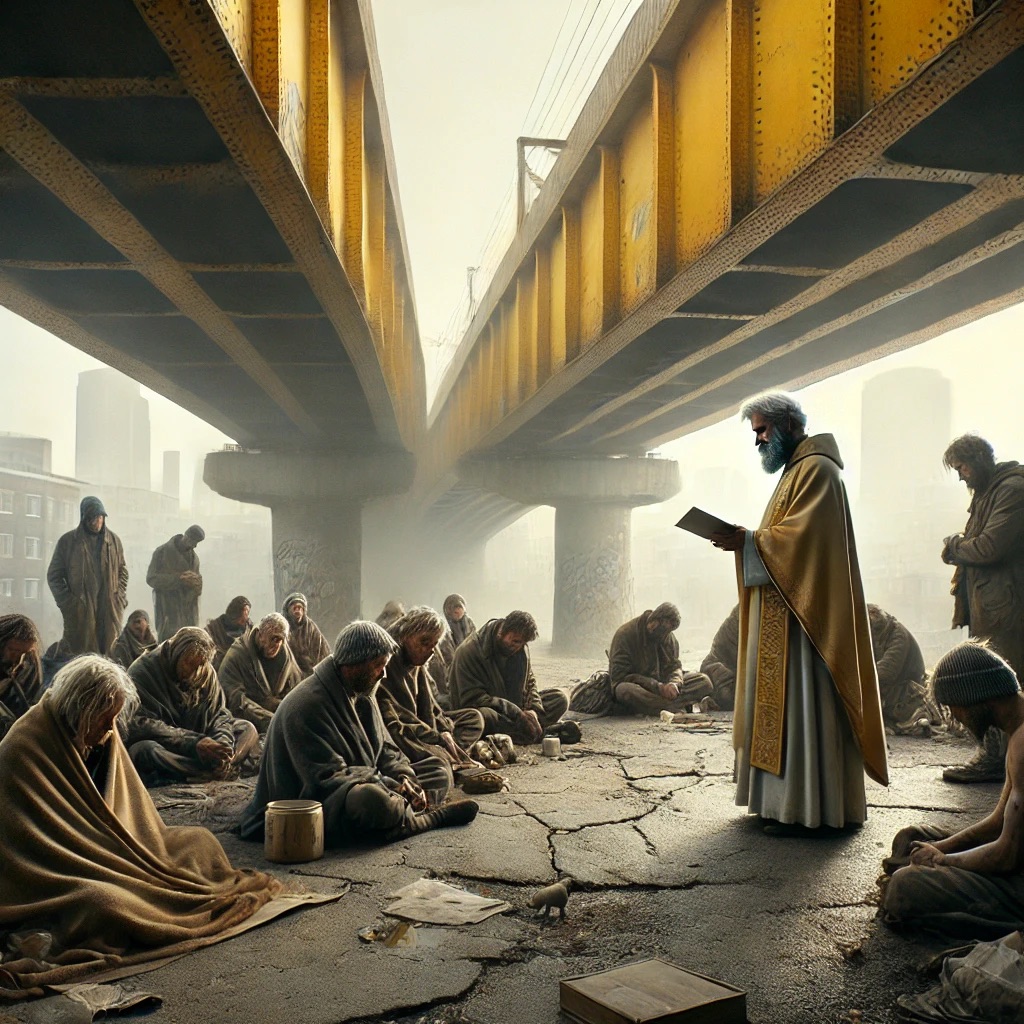
That’s when I met Father Manuel. A monk, but not the kind who hides away in candles and prayers. The guy left the monastery to live among the forgotten. You could say he lost his faith, or maybe he found it in the worst way possible. Didn’t matter. What mattered was that he was there, serving those no one else wanted to touch. He did mass in places where even stray dogs wouldn’t take a dump. Alleys, under bridges. And he didn’t do it with some saintly voice—he did it with the tired tone of someone who knows the world’s screwed, but keeps going anyway.
For some reason, I followed his lead. Started wandering the streets, sleeping in shelters that stank of desperation and grime. Watching the world from the sidewalk, from the corners nobody notices. People passed by, wrapped up in their bubbles, like we were stains in a photo they’d rather erase.
In this country, you can go your whole life without seeing the other half. All you gotta do is change cafés, switch supermarkets. Avoid certain streets. Easy. But the problem with crossing that line is, once you do, you become invisible. The world stops seeing you, and you start to disappear.
That’s what Father Manuel understood when he left the monastery. He didn’t just come to help, he came to be one of them. He was like another ghost, only with a Bible and a half-empty bottle.
And there I was, in the middle of it, looking for a missing Carmelite nun. A case that, at first, I didn’t think would take me down this hole. But the city has a special way of chewing you up and spitting you out, and I was already neck-deep in crap. Every corner, every encounter with the forgotten showed me a truth no one wanted to admit: Pittsburgh wasn’t just lights and skyscrapers. It was a monster that bit your soul, and I was starting to lose mine.
The cops had stopped following me a while ago. They dumped me with a dead case, something about Pollo Carvajal. Something about a desert, I don’t really remember. Since then, my life as a private detective had become a fight to avoid ending up like the poor bastards I was keeping tabs on. But I had some leads, loose ends that were starting to tie into a knot.
Father Ferguson was the one who helped me disappear. Showed me how to live in the shelters, change clothes, change life. Now I was working undercover, getting ready to slip into one of those filthy holes, like Victor Hugo’s Court of Miracles. But this wasn’t a novel, this was the goddamn reality. And I was about to cross a line I wouldn’t come back from.
 Israel Centeno Author
Leave a comment