
Israel Centeno Review
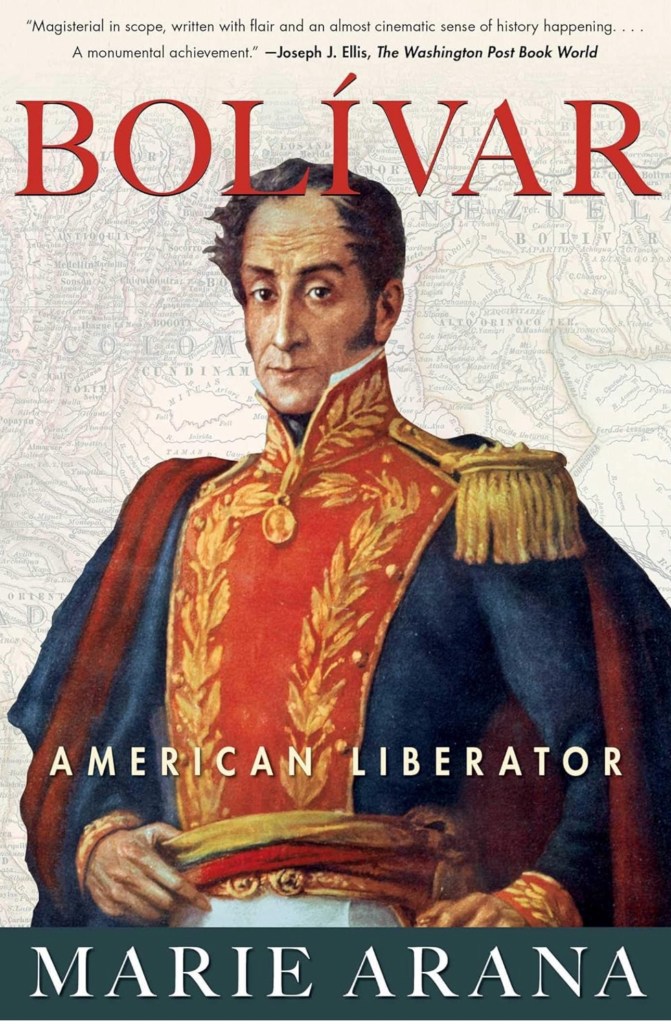
Marie Arana’s Bolivar
I recently encountered a powerful sentence in Biografía del Libertador, a work that encapsulates the tragedy of Simón Bolívar’s life: “Never a man did so much and suffered in life and in death so much ungratefulness as the Liberator Simón Bolívar.” This sentiment captures the essence of Bolívar’s journey, one marked by unparalleled contributions to the freedom of an entire continent, yet shadowed by ingratitude, betrayal, and posthumous distortion.
Over the years, Bolívar’s image has been co-opted by nefarious figures from the political, demagogic, and military spheres—many of whom were the very types of individuals who tormented him during his lifetime. Worse still, his legacy has been twisted, not only by unscrupulous leaders but also by a culture steeped in gossip and superficiality.
The Humanization of Bolívar: A Double-Edged Sword
In my lifetime, I have observed what could be termed the “humanization” of Bolívar—a project ostensibly aimed at demystifying the Liberator and presenting him as a man of flesh and blood. While this endeavor sought to counter the idolization promoted by late 19th- and early 20th-century populists and dictators, it often devolved into a demagogic exercise in itself. Instead of revealing the complex humanity of Bolívar, it became a theater of bad faith, rife with gossip, historical inaccuracies, and speculative plots.
The works of commentators like Francisco Herrera Luque epitomize this approach, offering entertaining but poorly substantiated narratives. Unfortunately, such interpretations laid the groundwork for lazy historians to perpetuate myths and trivialize Bolívar’s achievements. The failure to adhere to rigorous historical methods turned Bolívar’s image into a caricature, informed more by anecdote than by fact.
This is not merely a scholarly failing but a cultural one. Venezuelans, in their eagerness to innovate and redefine themselves, have often fallen into vicious cycles of gossip and sensationalism. The result is a peculiar blend of novelties and vituperation, a tendency to confuse frivolity with progress.
Bolívar’s Legacy Hijacked
The ultimate desecration of Bolívar’s legacy came with the rise of Hugo Chávez and his so-called “Bolivarian Revolution.” Chávez and his lieutenants invoked Bolívar’s name to lend legitimacy to a demagogic and authoritarian project, one that culminated in the desecration of Bolívar’s tomb and the transformation of Venezuela into a tragic narco-state under Nicolás Maduro.
The irony is stark: the ideals of Bolívar—unity, liberty, and republicanism—were weaponized to justify a regime that embodies the antithesis of those principles. Bolívar, who sought to liberate, has been turned into a symbol for oppression and division.
Redemption Through Scholarship
In the midst of this bleak landscape, I found a glimmer of redemption in the biography of Bolívar by Marie Arana. Her work represents a triumph of historical scholarship, rescuing the Liberator from the distortions of gossip and political exploitation. Arana’s meticulous research and contextualization of Bolívar’s life offer a much-needed corrective. She not only illuminates Bolívar’s genius but also provides a detailed radiography of the society that produced him.
Arana’s Bolívar is not a demigod, nor is he a fallen idol. He is a man of extraordinary vision and complexity, shaped by and shaping the tumultuous world around him. Her work serves as a reminder of Bolívar’s unparalleled contributions to history and offers a pathway to reclaim his legacy from those who have misused it.
Simón Bolívar’s life and legacy stand as a testament to the heights of human achievement and the depths of human ingratitude. As Venezuelans, and as citizens of the world, we owe it to Bolívar—and to ourselves—to approach his story with the seriousness and rigor it deserves. In doing so, we honor not only the man but also the ideals for which he lived and died.
Marie Arana’s biography is a step in the right direction, a beacon of hope amid the shadows of historical distortion. Through her work, Bolívar emerges not only as a figure of the past but also as an enduring symbol of resilience and vision in the face of adversity. It is a story we must tell—and tell well.
 Israel Centeno Author
Leave a comment