
Israel Centeno
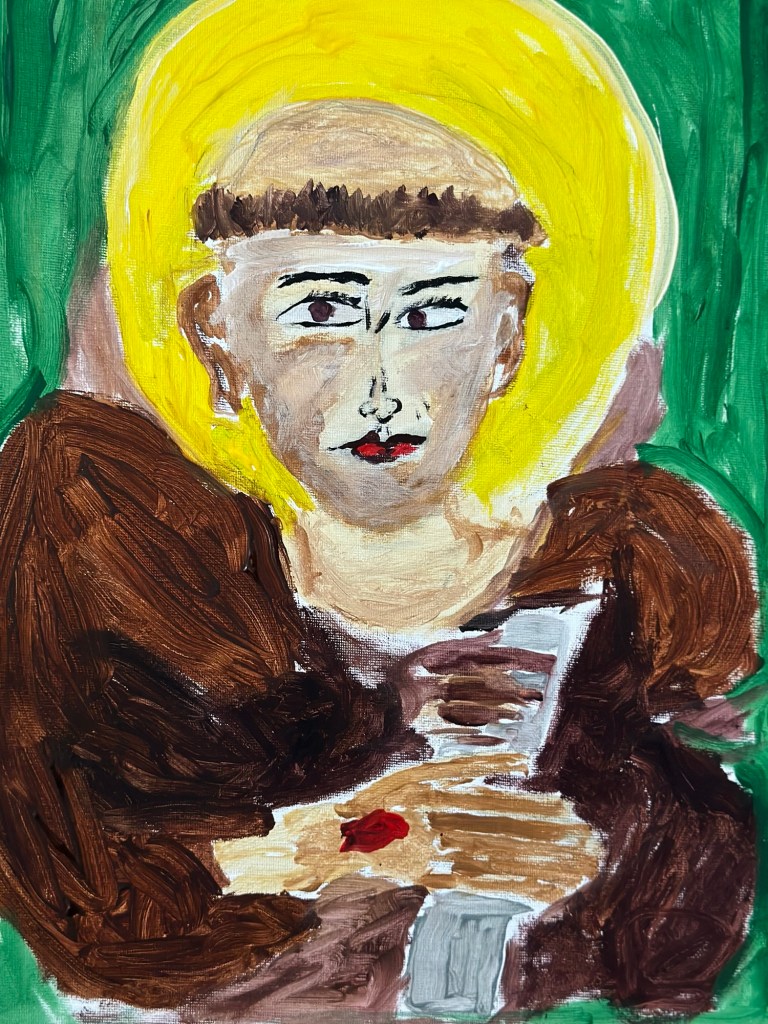
He was once a young man filled with worldly dreams. Francis, the son of the merchant Pietro Bernardone, longed for the allure of earthly conquests: luxury, fame, and the excitement of war. However, the reality of war, which he had envisioned as glorious, ultimately broke him. His body became ill, his spirit faltered, and during the year he spent in captivity, a silent dialogue with his soul began. In the shadows of his uncertainty, the first cracks in his ambition allowed a light not of this world to seep in.
Upon his return to Assisi, Francis underwent a profound transformation, as if a veil had been lifted from his heart. He felt a deep unease settle within him—a painful awareness that the glimmering riches that once enchanted his spirit now felt like heavy chains, binding him to a life that seemed increasingly hollow. The silks that had once delighted his senses and the lavish feasts that had filled him with pleasure no longer brought him happiness. Instead, he began to feel a gentle yet persistent calling, urging him toward something deeper and more meaningful, just out of reach.
This inner turmoil reached a pivotal point during his journey when he encountered a leper on the outskirts of town. The sight of this man, with his disfigured skin and the air thick with the scent of decay, filled Francis with an instinctive revulsion that coursed through him like ice water. The wave of emotions that washed over him was so intense it felt almost overwhelming. Yet, in that agonizing moment, a quiet voice broke through the chaos in his mind—a whisper filled with divine urgency, encouraging him to rise above his fear and loathing.
Summoning all his courage, Francis dismounted his horse, each step toward the leper feeling like a monumental act of compassion. With trembling hands, he embraced the man, allowing tears to stream down his cheeks as he leaned in to press his lips gently against the leper’s ravaged face. In that deeply transformative moment, the boundaries of his soul expanded, and he discovered a profound love that shattered the chains of his former existence, allowing him to connect with the essence of humanity in a truly heartfelt way.
That kiss was not just a gesture; it was a transformation. Francis left behind the proud young man he had been and became a new man. He would later recall that moment as the beginning of a more beautiful life, one where love drove out fear and humility triumphed over pride. In the leper, he had kissed the face of Christ, and from that day on, his mission would be to rebuild not only the church of stone but also the living Church of hearts.
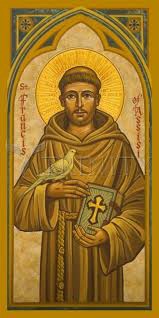
A Call to Poverty and Universal Brotherhood
In his desire to follow the path of Christ, Francis renounced everything. He left his father’s wealth and dressed in rags, giving himself entirely to poverty. “My God, my God,” he would cry in his prayers, “I want to be a servant among the smallest, a brother among brothers, just another creature in your creation.”
For Francis, nature was not a passive backdrop. It was a family. The sun was his brother, the moon his sister, fire a cheerful companion, and water a humble sister always ready to serve. Even death, feared by so many, he called “Sister Death” and greeted with love, as a bridge to eternal life.
In his final years, as his body bore the marks of suffering, Francis remained a beacon of praise and gratitude. Despite his weakened voice, he created moving hymns like the Canticle of the Creatures, each verse a heartfelt celebration of God’s goodness manifested in the beauty around him. Even in his moments of pain, he discovered beauty, and in the face of death, he held onto a profound sense of joy. His spirit shone brightly, reminding us all of the grace that can be found in even the hardest times.
In a time when the Church seemed to falter under the weight of internal struggles and worldly ambitions, Francis heard a clear call: “Rebuild my Church.” He began literally repairing ruined chapels, carrying stones with his own hands. But beyond the physical labor, Francis understood that the true task was to restore the spirit of the Church: to return it to simplicity, evangelical poverty, and love for the smallest and most forgotten.
In an era marked by shadows and uncertainty, Francis emerged as a radiant beacon of hope. He embodied the essence of the Gospel through every word he spoke, every gesture he made, and the very essence of his being. His life served as a powerful invitation for others to embrace the transformative love of Christ, exuding a radical joy that was contagious and uplifting. Francis’s presence inspired those around him to seek a deeper understanding of faith, encouraging them to live boldly and joyfully in accordance with the teachings of love and compassion.
The Little Flowers of Saint Francis.

In his time, Saint Francis was an outsider. A man who stood apart in a world of ambition and power. While many sought wealth, he embraced poverty; while others pursued greatness, he bent low toward the smallest. His life, narrated in the humble and luminous Little Flowers, bears witness to someone who chose to live at the margins of the world’s expectations but at the heart of God’s love.
In today’s world, many of us may feel like outsiders—whether we’ve left our homeland or perhaps our homeland feels transformed in ways we didn’t expect. In such times, the teachings of the Little Flowers of Saint Francis resonate deeply. Their message, though simple, is profoundly refreshing: everyone has a place in the tapestry of creation, even those who may seem out of place. Saint Francis’s life story illustrates this beautifully; he chose to build bridges instead of walls. He welcomed the stranger with open arms, and instead of fearing differences, he embraced them as his brothers and sisters. This spirit of inclusion offers a comforting reminder that we all belong, no matter our circumstances.
In this age of dizzying changes, where generations seem to clash as if speaking different languages, the example of Francis reminds us that true revolution doesn’t divide but reconciles. He lived in a time of similar tensions: declining ecclesial power, political struggles between classes, and emerging movements challenging the established order. But Francis didn’t choose confrontation as a response; he chose love.
The Little Flowers invite us to reflect on a love that doesn’t judge others for their pace but walks beside them. In these stories, we see how Francis spoke humbly to both the rich and the poor, to the wise and the ignorant, reminding them that all are invited to the same table. This is a lesson we still need, now more than ever.
Saint Francis and the Rhythm of the World
In a world that often moves faster than we can keep up, the life of Francis is an invitation to pause. To listen. To contemplate. When Francis spoke with the wolf of Gubbio, with the birds, or with his brothers the poor, he did so with the time of love, which is the only time without urgency.
Perhaps, like Francis, we need to learn to see creation with new eyes. To recognize Christ’s face in those who suffer, in those who feel lost, in those who don’t fit. In a time of so many crises—ecological, social, spiritual—the Little Flowers remind us that we are not alone and that even in the smallest things, we can find hope.
The Church: A Light That Never Fails
The Church, despite its human frailties, has been the place where the gaze of Christ endures. Through men and women like Francis, who heard the Lord’s call and responded with their whole being, the Church has been sustained, renewed, and strengthened. Its history is a testament to the power of grace and Christ’s faithfulness to his promise. Francis, with his vow of poverty and his simple life, not only strengthened the Church of his time but left a legacy that remains a light for ours.
Today, as many search for meaning, as loneliness and emptiness seem to dominate, the example of Francis invites us to look with Christ’s eyes. To see in others not only their material needs but their deepest longings: for love, peace, truth, and light. It invites us to be Christ’s presence for those who need him most, to be his hands, his feet, and his heart in a world that often seems to have lost its way.
The Message of the Little Flowers Today
In the humble and marvelous Little Flowers of Saint Francis, we find stories of a living faith, of radical love, and of disarming humility. These are not mere tales of the past; they illuminate the present. They remind us that, amid the challenges of our time, Jesus remains with us, guiding, sustaining, and calling us to rebuild, reconcile, and love.
Francis showed us that with love and faith, even the smallest act can become a flower that perfumes the world. And that message remains true today: even if we feel like strangers in our own time, even if the pace of the world seems overwhelming, we can still be instruments of peace, light, and love. Because, as Francis taught, everything begins by looking at others with the eyes of Christ.
 Israel Centeno Author
Leave a comment