
Israel Centeno
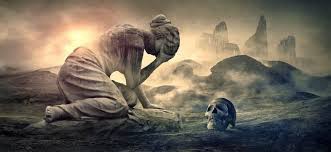
The question of evil, that old unease accompanying humanity, seems to have an obvious answer: evil is a human problem. However, a deeper analysis reveals that this obviousness is deceptive. When we argue that God is neither good nor omnipotent because He does not prevent evil, we not only challenge the notion of divinity but also place our consciousness at the center of a dilemma that transcends the experience of other creatures.
Is Evil Exclusive to Humans?
A turtle, whose nest is raided by gulls, does not seem to question the injustice of the act. Nor does a fawn that loses its mother to a wolf, or cows subjected to cruel conditions in industrial farms. Animals, it appears, do not conceptualize evil. A pig in a slaughterhouse does not perceive its killers as agents of malice; only humans assign such categories, and they do so because their consciousness drives them to make sense of occurrences not just from functionality but from a moral perspective.
Why Is Genocide an Exclusively Human Concept?
The term genocide, a word that encapsulates the horrors of systematic annihilation, applies only to humans. There is no “dogicide,” “caticide,” or “cowicide”—only homicide. This distinction reveals an objective morality tied to humanity’s unique ability to recognize and value individual and collective existence. Why? Because, unlike bees or trees in a felled forest, humans find it unjust and malevolent to systematically destroy an entire group. This perception arises from our capacity to see ourselves as unique, irreplaceable beings, and—most importantly—conscious of our individuality. Evil, then, seems deeply tied to this consciousness of separation: to the perception that each human being possesses an intrinsic value that must be protected.
Is Evil an Illusion?
If evil arises from our consciousness, is it real or an illusion? What makes us think of good, and how do we measure it? Unlike other creatures, which seemingly lack absolute values, humans have developed a moral compass allowing them to distinguish between good and evil, between justice and injustice. Yet this compass is neither universal nor objective; it is conditioned by cultures, contexts, and individual decisions.
Good and evil are not static categories. A murderer who takes another human life is judged not only by their victim but also by themselves, their surroundings, and their conscience. Even in the absence of witnesses, guilt—that profoundly human experience—can become their harshest judge. Yet, if someone destroys an anthill with a stomp, there is no scandal; if they kick an innocent person, reactions are immediate, both external and internal. This difference underscores that evil is not just about actions but also about perceptions and consequences.
The human conscience even extends its moral framework to nature itself. Humans began to feel guilt for the extermination of whales, a sentiment captured in Moby-Dick. The novel’s excessive tragedy reflects humanity’s recognition of the moral weight of its own actions, projecting guilt and regret onto the natural world. And we started to talk about genocide, and we began to feel uncomfortable when we see how chickens are treated in industrial farms. More consciousness and more reflection lead inevitably to more guilt. If we can discriminate our biases, we can also discriminate our guilts. And as our guilt becomes more sophisticated, we must ask: can this guilt be transmitted to artificial intelligence? Will AI, programmed with our moral frameworks, inherit our burdens of conscience and responsibility?
Does Morality Benefit Us as a Species?
Some might argue that morality makes us less effective as creatures. A humanity governed solely by instinct, like bees or ants, could hunt in groups without the ethical dilemmas that often divide our decisions. However, it would also be a humanity without dissent, without questioning, without the capacity to risk or challenge norms. Our ability to choose between nuances—between what is good, bad, or ambiguous—grants us a complexity that transcends mere survival.
Moral consciousness, though it seems to hinder functionality, is what allows us to construct meanings beyond instinct. It drives us to seek a model of absolute goodness, an ideal that can be metaphysical, spiritual, or philosophical. Light and darkness hold metaphysical significance for humans precisely because our consciousness seeks to transcend the purely biological.
Why Think About Good and Evil?
At this point, a deeply pragmatic question arises: what does reflecting on good and evil contribute to my workday as a service advisor? It might seem pointless, but it is precisely this capacity for abstract thought, for questioning and reflecting, that defines us as human. It is not merely about functionality; it is an affirmation of our humanity.
What alarms me, however, is that these questions could just as easily be formulated by one of those imbecilic opinionators, searching for answers that fit their narrow worldview. Using artificial intelligence as a secretary, an assistant, or even a developer of ideas, they might publish their thoughts online and unintentionally attract the attention of someone unhinged. This possibility highlights the dangerous duality of our tools: capable of deep reflection but equally capable of amplifying distorted or dangerous ideas.
Yet, why do these reflections lead me to think that there is something beyond myself, something I cannot explain, that has not been revealed to me but whose existence I am certain of? I find myself believing that such a thing can only be known as a revealed truth. All truth is revealed. Einstein and Newton were prophets of two physical truths. As Edith Stein says, “If you seek the truth, you will find God.” In the case of mathematicians and physicists, they find the decoding of the universe.
Is Evil the Price of Consciousness?
The problem of evil, then, is not one that affects only theologians or philosophers. It is a question arising from consciousness itself, from the struggle to find meaning in a world where justice and goodness are always imperfect. Responding to these questions is not just an intellectual exercise; it is a profoundly human act that connects us to the best and worst of our nature. It also reminds us that our very ability to contemplate these dilemmas hints at something transcendent—a truth that calls us, reveals itself, and invites us to decode not only the universe but also the moral fabric of existence itself. Always, at the very end, we have to choose—even to choose no choice—and we are conscious of our choice and its consequences.
What Does Evil Believe About Goodness?
What does evil believe about goodness, and what does goodness believe about evil? Is evil simply the absence of goodness, or does it possess its own identity, its own motives and perceptions? These questions challenge us to reflect on whether morality is a spectrum of light and shadow or a battlefield where distinct forces clash. The answers, elusive as they may be, shape the way we understand not only our moral frameworks but also our place in the greater narrative of existence.
 Israel Centeno Author
Leave a comment