
To my dearest Graciela, Mariana, and Camila, as well as my cherished brother and sisters – your love and support light up my world.
To Norma
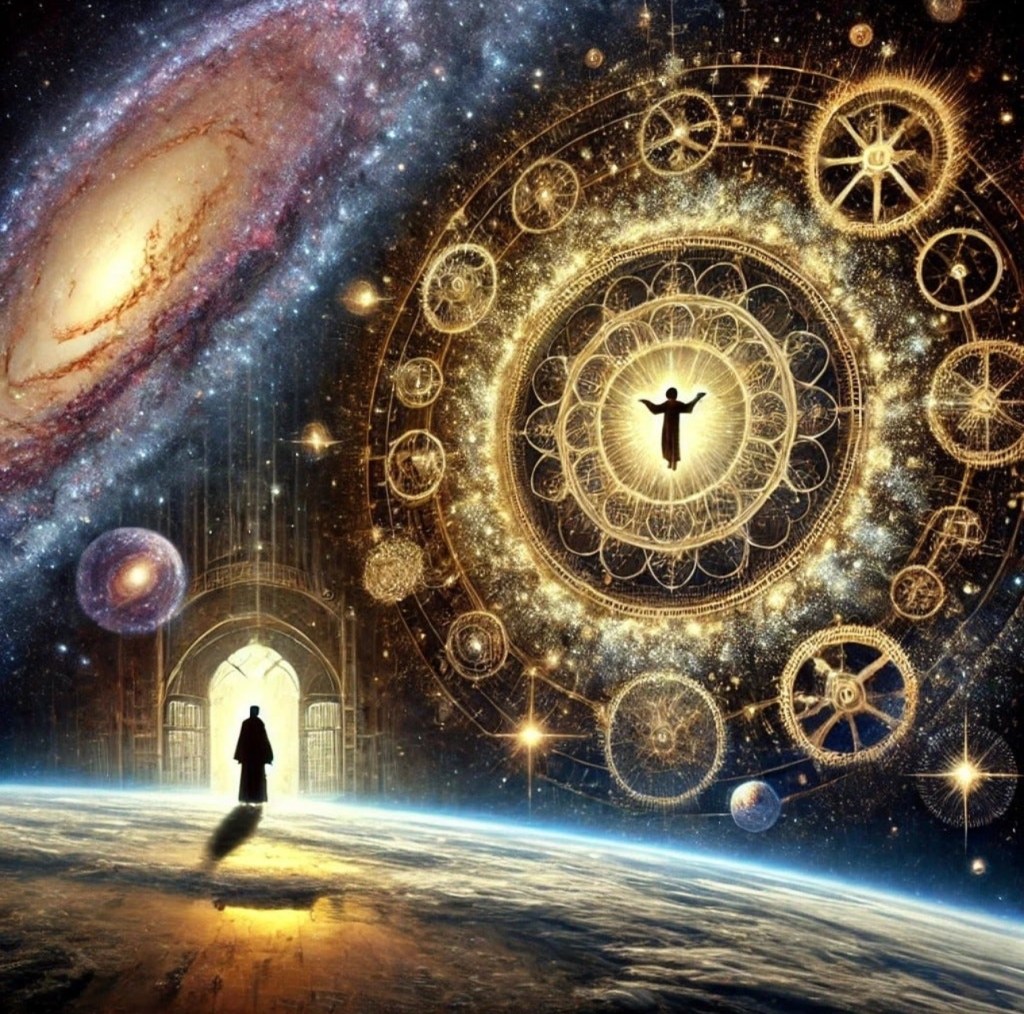
I couldn’t tell you for certain when it all began. The delirium? The revelation? Psychiatrists called it ambiguation; before that, others had diagnosed it as continuous depersonalization. I call it Grace. No one in science uses that word. It cannot be measured, cannot be enclosed in a flask or plotted on a Cartesian axis. And yet, what I saw, what I understood, was more real than any number or formula.
My mind is a stranger inhabiting me, claiming to be my person, but it is not. “Your consciousness is an unwelcome guest,” my psychiatrist told me after I failed the empathy tests. But I am not here to talk about my struggles with my own mind, but about what it, in its delirium or revelation, showed me.
I saw that we are less than a grain of part salt, part sugar, part ginger in the entire visible universe. And yet, that infinitesimal particle has life and movement within itself. Everything is complex, harmonious, a symphony of incalculable precision. Every angle, every mechanism, every gear of the cosmos fits with the perfection of a divine clock. But then came panic. Because if there is no conscious observer in the universe, if no one sees this wonder, what is it? An exquisite corpse of coincidences, an abyssal fugacity.
Fear left me vulnerable. But in the midst of despair, Grace spoke.
God, the creator of this supreme geometry, did not remain distant. He was not the indifferent clockmaker scientists described. No. He entered the grain of ginger, salt, and sugar. First as a burning bush, then in the voices of His creatures. In this living particle, so minuscule in the immensity, there were beings who built realities with their languages: mathematics, painting, music, narratives. One of them said one day that the Creator spoke through his mouth and through the mouths of others like him. And in an impossible act of empathy, the Creator Himself descended, took flesh, and became man.
A scandal. A delusion. But it was the truth.
The infinite became finite, the eternal assumed mortality. And He did it for those who, in their pettiness and limitation, spat on Him, scorned Him, rejected Him. Trusting that even so, He would grant them salvation. In a kingdom where insignificance would gain the significance given by love, and where ephemeral beings would be invited to share eternity with their Creator.
Wittgenstein said that what cannot be articulated does not exist. But what is language if not a small lantern in the cavern of mystery? How could the minuscule pretend to encompass the absolute? Ignorance is the shadow that surrounds knowledge, but within it lies a path, an illuminated path. A path of truth, of light, of transcendence. And we have been given the choice to take it.
It is madness, yes. But it fits. It fits in the perfect order of things. Because Christ’s revelation is not just an act of piety but an act of absolute love. In His death, He subdued the prince of this world, selfishness, vanity, and rescued the glory of God for those condemned to oblivion. It was not just suffering but the promise of a new reality, one where pain and death will cease to exist.
And this sounds absurd, too good to be true. But He does not promise to make suffering, the valley of shadow, death, pain, and injustice disappear. He promises something deeper: to be there, to accompany us in every choice, to sustain us in every fall, and, in the end, to give us life, and in abundance.
Because this life is full of errors, of crossroads, of, as Borges said, paths that fork, variations to choose from. This is the life of a beautiful but imperfect world, and beyond the threshold lies life in communion with the Triune God, with glory and fullness. “No eye has seen, no ear has heard,” says Paul, and yet, though we cannot decipher the mystery with absolute certainty in this life, we know what awaits us if we bear fruit.
We are called to the banquet, to the wedding feast, to the definitive union with the Beloved. Not in the fragility of this fleeting existence, but in the eternity that awaits us. In love that does not decay, in light that does not extinguish. And that, though it may seem madness, is the most solid truth of all.
 Israel Centeno Author
Leave a comment