
Israel Centeno
adapting Simone to a Greek chant
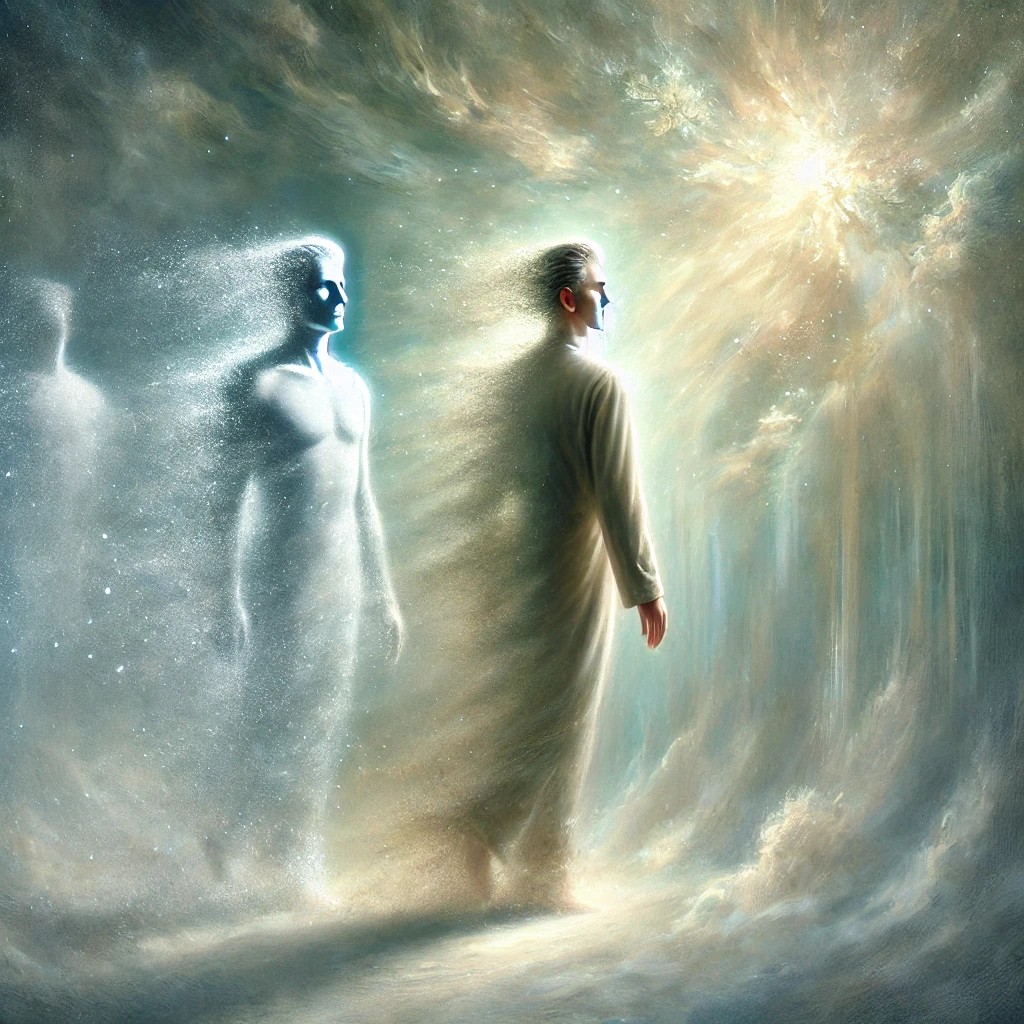
Simone Weil’s journey was one of radical negation—of herself, of comfort, of even the idea that God exists to offer solace. She did not seek faith through peace but through affliction, through exposure to the raw suffering of the world. She did not construct a system but instead dissolved herself into an act of pure attention.
Her path to detachment began in action, in immersion. She labored in a factory, where the mechanization of modern life crushed the human spirit, reducing workers to mere functions of production. She stood at the front of the Spanish Civil War, believing in the necessity of resistance, yet witnessing the brutal absurdity of violence. She lived through the German invasion of France, where her pacifism wavered, where she saw that evil, left unchecked, does not merely exist but consumes.
Yet it was not merely history that changed her; it was a deeper movement of the soul. From an atheist devoted to justice, she became a mystic who saw that even justice, even righteousness, could be an illusion if clung to as possession. Attention—pure, ungrasping attention—became for her the only true prayer, the only way to allow grace to descend. And in that gaze upon suffering, she saw the Cross.
Her theology was one of kenosis, of self-emptying, mirroring Christ’s own sacrifice. To her, the self was the last illusion, the final barrier between the soul and God. And it was this self, this fragile I, that had to be given up, not through external suffering alone—because suffering imposed from outside only humiliates—but through a voluntary, inward renunciation.
In her writings, particularly on affliction (malheur) and the destruction of the self, she describes the moment when suffering ceases to be an external force and becomes an inner transformation. The true Cross is not only pain; it is the unbearable void left by the absence of God. Christ’s cry—“My God, why have You forsaken me?”—is the cry of the soul emptied of all but love.
To reach that point is to let go of everything: possessions, comforts, illusions, even the will to hold onto grace itself. Only in total detachment, in the naked acceptance of suffering without recompense, does one become truly receptive to God.
This is not an idea. It is a hymn. It must be sung, not reasoned. And so, here is Weil’s vision—not as argument, but as chant.
The Self (A Greek Chant)
I. The Offering
Nothing is ours in this world.
Chance may strip us of all things.
All, save the power to say I.
This is what must be given to God—
not kept, not protected,
but destroyed.
There is no other freedom,
no other sacrifice,
but the annihilation of the I.
To offer means only this.
For all that we call offering
is merely disguise,
self-cloaked in virtue.
Nothing in this world
can take away the I—
nothing but the weight of affliction.
II. The Afflicted Ones
What happens to those
whose I is shattered from the outside?
Are they free?
Are they saints?
No.
If the I is destroyed by force,
it does not vanish into God,
it collapses into nothingness.
They do not cease to suffer—
they cease to be.
And what remains
is not selflessness,
but a crude, blind instinct—
a hollowed-out ego,
a body surviving
without a soul.
Some, like beaten dogs,
cling to loyalty.
Others, like broken stones,
sink into bitterness.
A self stripped by violence
writhes in rebellion,
until all rebellion is spent.
Then, nothing remains
but the drive to exist—
rootless, insatiable,
a vine twisting in the void.
A greed for mere survival.
This is the threshold of hell.
III. The Voluntary Death of the Self
The I cannot be killed from the outside
without dragging the soul into the abyss.
But if the I is given freely—
if it is laid down
in love—
then affliction does not destroy,
but redeems.
If suffering is chosen,
not imposed,
then suffering does not strip the self
but dissolves it.
And what remains
is not emptiness,
but God.
This is the meaning of the Cross.
To descend willingly
to the depth of affliction,
to be emptied completely—
and to remain there.
And in that void,
to feel not the presence of God,
but His absence.
IV. The Cry of Forsakenness
“My God, My God, why have You forsaken me?”
When affliction is perfect,
when the self is gone,
the soul is left abandoned.
The void is absolute.
And this is the final test:
not to seek comfort,
not to demand His presence.
For where God is absent,
there He is most present.
His absence is His final touch,
the last proof of love.
To endure it without resistance—
this is redemptive pain.
V. The False Depths
There is an affliction
that does not redeem,
but festers.
Hell is not the abyss—
it is the illusion of depth.
It is suffering that feeds upon itself,
pain that has no doorway.
The hell of the broken self
is an affliction with no offering,
a grief that clings
to the very thing
that must be renounced.
But the suffering
that empties itself completely—
this is the threshold of light.
VI. The Wound of the Forsaken
The truly forsaken—
those whose I is stolen—
can no longer receive love.
They do not reject it,
but they do not see it.
They take it as a thing,
as an object,
like food or warmth.
They are neither grateful nor cruel—
they simply absorb,
or they detach.
They are the dead among the living.
They drink the energy of those
who come to them with love,
but cannot give in return.
No charity can bring them back.
No kindness can rekindle
what is gone.
But some—
some are not fully lost.
Some have only faded,
not perished.
If love is given purely,
if love is free of pity,
if love carries no trace of superiority,
it may awaken
the last flicker of self.
But even the smallest breath
of condescension
will kill it again.
The smallest wound
of contempt
will drive it deeper
into the void.
VII. The Vanishing of the Self
The sinner says I.
The fool says I am everything.
But that I is God,
and God is not I.
Affliction is the mark—
the wound that carves the boundary.
For God cannot be all
unless we are nothing.
It is my suffering
that makes me me.
It is the suffering of the world
that makes God,
in some way,
a person.
The Pharisee believes
virtue is his own.
But humility knows
that within the I
there is no power to rise.
Everything in me
comes from beyond me.
And all that I grasp as mine—
all that I claim as my own—
becomes worthless in my hands.
VIII. The Joy Without a Name
Perfect joy
does not call itself joy.
It does not say I am happy.
For when the soul is truly full,
when it is filled with light,
there is no space left
for the I to speak.
It does not seek joy.
It does not remember joy exists.
It simply is—
because the I
is gone.
Final Chorus
To have nothing,
to cling to nothing,
to desire nothing,
not even grace—
This is the highest offering.
To be empty,
to be still,
to wait without asking,
to love without demand—
This is the path of the Cross.
To say yes to absence.
To say yes to the void.
To endure even the silence of God.
And in that silence,
to be filled.
 Israel Centeno Author
Leave a comment