
Israel Centeno
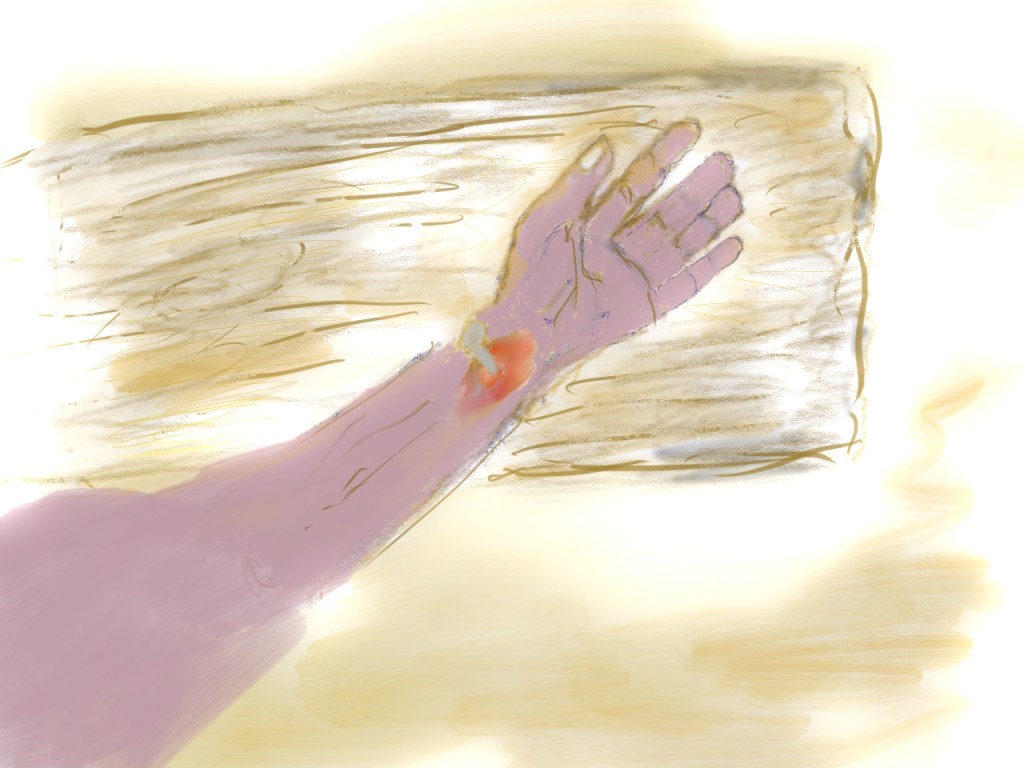
This classical chant-poem is a gloss on a fragment from Waiting for God by Simone Weil, where she explores divine love as a journey through time and suffering. Weil describes extreme affliction as the nail driven through the soul—a point where the infinite distance between God and the creature converges and is resolved in the Cross.
In this adaptation, the structure of chant and prose poetry reflects the cadence of an ancient hymn, elevating the meditation on sacrifice, redemption, and the soul’s orientation toward absolute love. It preserves Weil’s philosophical and theological depth while transforming it into a poem of liturgical and contemplative resonance.
Awaiting God: The Nail and the Cross
Chant:
O divine love, which has crossed the infinite chasm of space and time,
You have journeyed from the heart of God into the frailty of dust.
Yet how can we, bound in the finitude of flesh, retrace that sacred path?
How can we return what was never ours to claim?
The seed of divine love, sown in the darkness of our being, has risen—
a tree whose branches stretch toward heaven,
a tree where the birds of the sky find rest.
But what tree is this, whose beauty surpasses all the forests of the world?
What tree is this, whose roots drink from the abyss of sorrow?
More terrible than the gallows, more desolate than the wasteland,
it stands alone, the most glorious of all trees.
It has grown within us, unseen,
until we wake one day to find ourselves entwined in its roots.
Now, only betrayal could sever it from our being.
Chant:
Blessed is the tree that bears no fruit,
Blessed is the wood, cut and measured,
Blessed is the weight that bends its limbs low.
For it shall be lifted high,
And from its silent height, all men shall be drawn.
A nail is driven by a hammer,
and its force, untouched, travels from head to point.
If the hammer and the head of the nail were vast as the heavens,
would the point not still bear the full measure of the blow?
The weight of necessity, spread across all time and space,
converges upon a single point—
a nail, pressed into the center of the soul.
The man who bears it cannot remove it.
He is as a moth pinned to an album,
trembling in the agony of stillness.
Yet even in this horror, he may choose.
He may hold his will in the direction of love.
No force in the world can forbid it.
No suffering, however great, can reach the place where the soul consents.
Chant:
Behold, the wound is deep,
but deeper still is the hand that wounds.
The night is dark,
but darker still is the silence of the Father.
The weight is great,
but greater still is the love that bears it.
Love is not a state of the soul—it is an orientation.
It is the turning of the heart’s gaze.
And if the gaze remains unbroken,
then the man who hangs upon the nail
is fixed in the center of all things.
He is crucified at the crossroads of creation,
where the fabric of space and time is torn
and light seeps through the wound.
Here, in the invisible dimension,
where height and depth, width and breadth
fold into the hand of God,
he enters the place where knowledge ends
and love begins.
Chant:
You have traveled from eternity into time,
from the vastness of being into the prison of flesh.
And now You stretch out Your arms
upon the wood that bears the weight of the world.
Prose Poem:
Sanctified is the cross,
where creation meets the Creator,
where suffering touches eternity,
where love is fastened with nails
and the heavens are split in two.
Sanctified is the nail,
that carves a passage from exile to home,
from abandonment to embrace,
from death to life.
O, Love crucified,
O, Silence beyond all cries,
O, Wound that breaks the veil,
take us with You through the narrow gate—
through the distance that only love can cross.
Simone Weil Awaiting God
Divine love has traversed the infinity of space and time to come from God to us. But how can it retrace the journey in reverse when it begins from a finite creature? When the seed of divine love planted in us has grown into a tree, how can we, who bear it, return it to its origin—traveling back the path that God has taken towards us and crossing the infinite distance?
Though it seems impossible, there is a way we know well. We recognize the likeness of that tree that has grown within us, that beautiful tree where the birds of the heavens rest. We know which is the most beautiful of all trees. “No forest holds another like it.” More terrible than a gallows, it is the most wondrous of trees. And a seed from that tree was placed within us by God without our knowing what kind of seed it was. Had we known, we would not have answered “yes” in that first moment. That tree has grown within us and can no longer be uprooted. Only betrayal could tear it from the soul.
When a nail is struck with a hammer, the impact received by its head is transmitted entirely to the other end, losing nothing, though the tip is but a point. If the hammer and the head of the nail were infinitely large, the same would occur. The tip of the nail would convey that infinite force to the point where it is applied.
Extreme affliction—physical pain, anguish of the soul, and social degradation—is that nail. The tip is driven into the very center of the soul. The head of the nail is necessity, spread throughout all of time and space.
Affliction is a marvel of divine technique. It is a simple yet ingenious device that forces into the soul of a finite creature the immensity of blind, brutal, and cold force. The infinite distance separating God from the creature is wholly concentrated at a single point and driven into the center of a soul.
The person to whom this happens plays no part in the operation. He struggles, like a butterfly pinned alive to an album. Yet, in the midst of horror, he can still hold on to the will to love. There is in this no impossibility, no obstacle, perhaps not even difficulty—for even the greatest pain, as long as it does not lead to unconsciousness, does not reach that point of the soul that consents to right orientation.
One must understand that love is an orientation, not a state of the soul. If this is unknown, despair will come at the first assault of affliction.
The one whose soul remains oriented towards God while being pierced by a nail finds himself nailed at the very center of the universe. That true center is not its midpoint; it lies beyond space and time—it is God. By a dimension that does not belong to space, that is not time, by a wholly different dimension, that nail has pierced a hole through creation, through the thickness of the barrier that separates the soul from God.
Through this wondrous dimension, the soul—without leaving the place and moment where the body to which it is bound remains—can traverse all of space and time and reach the very presence of God.
The soul stands at the intersection of creation and the Creator, at the point where the two arms of the cross meet.
Perhaps Saint Paul had a similar thought when he wrote: “That you, being rooted and grounded in love, may be able to comprehend with all the saints what is the width and length and depth and height—to know the love of Christ, which surpasses all knowledge.”
 Israel Centeno Author
Leave a comment