Israel Centeno
We live in a time where words have lost their original meaning. They are still used with the same solemnity as in the 20th century, but their content has been emptied—or worse, transformed into something entirely different without most people noticing. One of those words is democracy.
World maps continue to color certain countries in blue, labeling them “full democracies”, as if that title still carried the weight it once did. We are told that these places uphold freedom, transparency, and self-determination. But simply traveling to these countries and seeing reality with our own eyes quickly reveals that the democracy preached is not the democracy practiced.
Take Canada, for example—a country presented as the pinnacle of democracy, yet one that has evolved into a surveillance state. The 2022 trucker protests demonstrated how easily a democratic government can freeze bank accounts, monitor its citizens, and restrict basic freedoms with a simple emergency decree. These were not the actions of a clandestine force or an authoritarian regime operating in the shadows. It was the so-called democratic government itself that did this, without the slightest internal contradiction.
Australia is no different. There, the state has absolute control over private life through technology, taxation, and the regulation of public discourse. Academic intolerance and social media censorship are widespread. Sweden, another country classified as a full democracy, follows a similar model: a system where the state regulates every aspect of life to the point of near-totalitarianism, all in the name of equality and social security.
So when we talk about full democracy, what are we really talking about?
Is it simply the right to vote? Does it mean being able to choose between pre-approved options in a system that, in many cases, has already decided the course of politics regardless of the will of the people? Does it mean freedom of speech, when that freedom is de facto censored through regulations, blacklists, and digital lynch mobs?
Are we confusing democracy with forced equality, an equality that does not lift people up, but flattens and subjugates them?
These are the questions we must ask ourselves as the world reorganizes itself into increasingly intolerant, authoritarian, and hyper-surveilled states.
Because if full democracy means living under the constant supervision of a state that dictates what we can say, think, and do, then 21st-century democracy is no longer what it was in the 20th century.
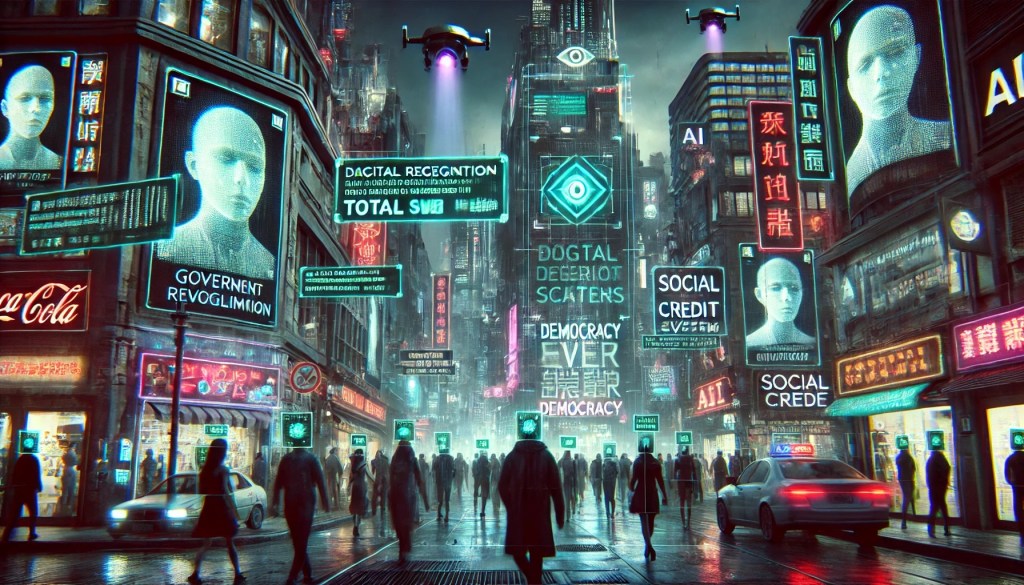
Today, no one is truly outside the surveillance system. Anyone who uses a phone, television, the internet, or social media is monitored in one way or another. Every search, every purchase, every opinion expressed on a digital platform is logged, analyzed, and, if necessary, corrected or erased.
The only way to escape this network of control, in some countries, is to literally disappear from the system. This is what they call living off the grid. And those who truly live off the grid? The homeless—those who have completely abandoned the structure of the modern world.
But opting in or out of surveillance is no longer a choice. In this new order, the algorithms have already placed the mark of the slave on you.
Your face is recorded, your voice has been analyzed, your purchase history has been processed, your opinions have been classified and labeled.
Your thoughts have been reduced to a digital profile, a predictive model of who you are, what you will do, and what will trigger a reaction.
Who is your master?
It is the question no one dares to ask. Because in a world where freedom has become a simulation and slavery is voluntary, no one wants to look too closely at the seal already stamped on their forehead.
Failed States, Digital Tyrannies, and the New Order of Control
When we look at Venezuela, Cuba, and Nicaragua, we see something beyond mere dictatorship. These are not just authoritarian regimes; they are failed states, but with an added dimension—a symbiosis with delinquency, a deep entanglement with organized crime, and an unspoken tolerance from the world’s so-called full democracies.
Oppression in these places is more savage, more primal. It does not rely on sophisticated technology or complex surveillance grids but on raw violence, fear, and the absolute collapse of institutions. These regimes do not function as modern states but as fiefdoms, where the rule of law has been replaced by the law of force. The state and organized crime are often indistinguishable: militias, gangs, and government security forces operate interchangeably, creating an ecosystem where control is not just exerted from above but is diffused into every aspect of daily life through intimidation, informants, and brutal crackdowns.
But these are ancient forms of control—oppression as it was done in the past, where power is maintained through sheer brutality. This is not China.
The Chinese Communist Party (CCP) has evolved into something far more advanced. It does not simply rule through fear—it rules with precision, with artificial intelligence, with the seamless integration of technology into governance. The CCP has developed a digital totalitarianism that punishes, surveils, and rewards its citizens with mathematical efficiency. It is no longer a dictatorship of men, but of algorithms.
The Social Credit System is the prime example: a mechanism through which the entire population is ranked, monitored, and conditioned to behave in ways that serve the state. Through facial recognition, financial tracking, and AI-driven analysis, the government determines who gets access to opportunities and who is blacklisted from society. Dissent is not merely punished; it is systematically erased. The model is terrifying because it reinforces itself: those who conform are rewarded, while those who resist are erased from the system. The goal is not just obedience—it is a society where disobedience is not even an option.
And yet, in Western democracies, a different form of control has emerged—less visible, less brutal, but just as effective.
In the United States, those at the top of the system are not controlled by police or state enforcers—they are controlled by credit.
Financial systems act as invisible chains—your credit score dictates where you can live, what loans you can take, whether you can access housing, education, or even certain jobs. Debt is the modern shackle, keeping people trapped in a system that demands productivity while offering just enough rewards to prevent rebellion. There is no need for government intervention when private financial institutions already determine the boundaries of individual freedom.
The problem is no longer traditional totalitarianism. The real question now lies in the democratic West—not whether totalitarianism will expand, but who will lead the new order. The struggle is not ideological; it is about power—who will dictate the rules of the game in a world where democracy has been emptied of its original meaning?
In this emerging order, sovereign states no longer serve their citizens; they manage them. They regulate thought, control education, and establish the limits of acceptable discourse. Those who step outside the prescribed norms are not confronted by a dictator in uniform—they are punished by algorithms, silenced by automated systems, and turned into digital ghosts in a world where participation is no longer a right, but a privilege granted by the system.
The future of governance will not be determined by parliaments or elections.
Surveillance, automation, and artificial intelligence will rule.
And in this new world, the question is not whether democracy will survive.
The question is who will rule over its ruins.
 Israel Centeno Author
Leave a comment