
Israel Centeno
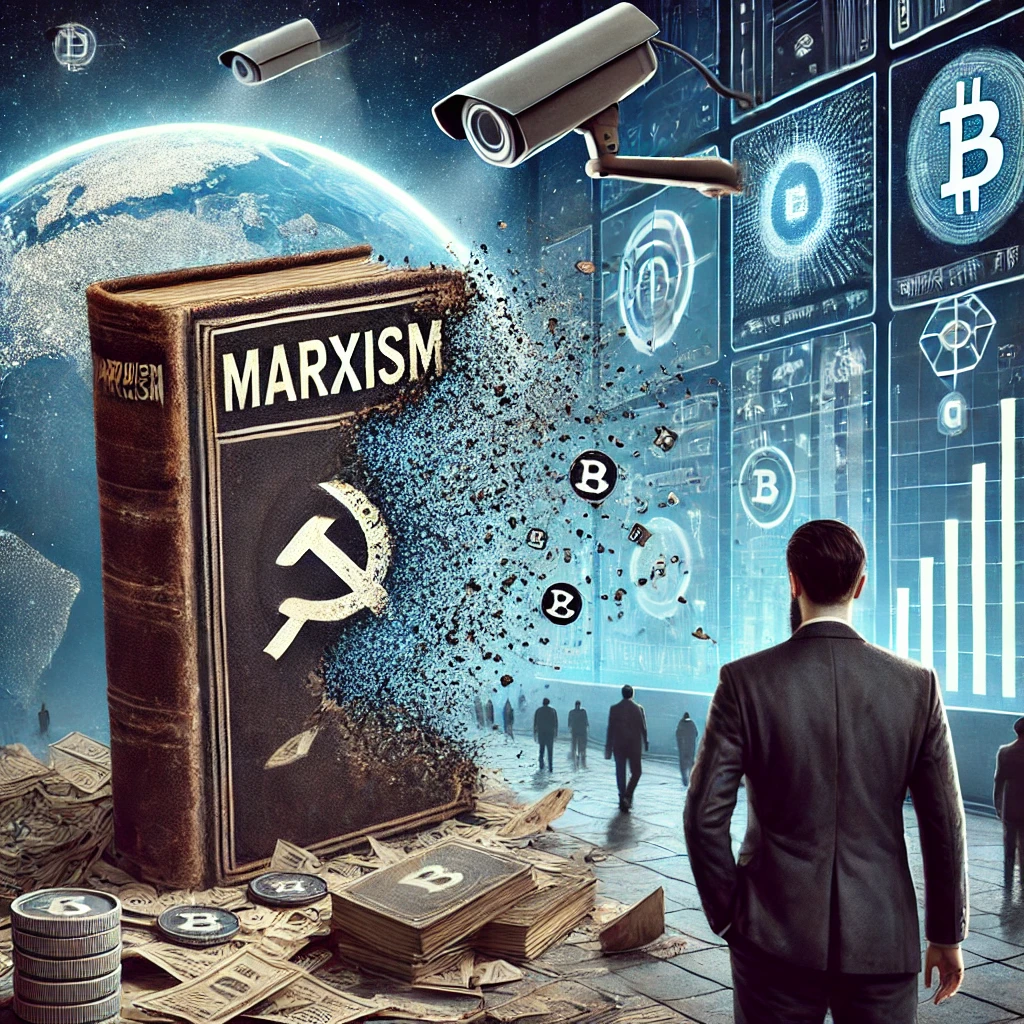
As the world transitions into a post-liberal, multipolar order, the political left remains trapped in ideological anachronism, unable to update itself in response to new power dynamics. It continues to rely on old Marxist manuals, the theories of Gramsci and Foucault, and a class struggle narrative that no longer aligns with the current geopolitical and economic reality.
Unlike capitalism, which has evolved and absorbed elements of technocratic authoritarianism to adapt to new conditions, the left still operates with 19th- and 20th-century frameworks, failing to grasp how to reposition itself in this new order.
1. Marxism: An Obsolete Critique for a Transformed Economy
Classical Marxism emerged in a context of mass industrialization, with exploited proletarians in factories and a nationalist capitalist bourgeoisie. However:
• The industrial proletariat has largely disappeared in the West, replaced by a service-based economy and a precarious middle class that does not fit into the classic class struggle model.
• Transnational corporations no longer function like the old national bourgeoisie → They do not seek to accumulate power within a single state but instead operate globally, shifting capital and production with no loyalty to any nation.
• The concept of surplus value and exploitation has been redefined → Today, capital is no longer accumulated solely through physical labor but rather through data management, biopolitics, and information control.
Marx’s Capital, while revolutionary in its time, is now insufficient to explain power in the age of artificial intelligence, cryptocurrencies, and digital capitalism.
2. Gramsci and Foucault: Control Strategies That Have Lost Relevance
The 20th-century left embraced the ideas of Antonio Gramsci and Michel Foucault to reformulate its struggle. However, these strategies have been absorbed and surpassed by the system they sought to criticize.
• Gramsci advocated for “cultural hegemony” → the idea that power resides in shaping ideological consensus.
• However, capitalism has absorbed all progressive narratives and turned them into mass-consumption products.
• Identity culture, minority struggles, and the deconstruction of the nation-state have not challenged economic power; rather, they have become mechanisms to fragment and control societies.
• Foucault analyzed how power operates in social structures → surveillance, biopolitics, and discourse control.
• But corporations and states have perfected these mechanisms through digitization and artificial intelligence.
• Capitalism has turned surveillance into a marketable product (social media, big data, facial recognition).
Both thinkers believed these forms of control were state-dominated instruments. They did not foresee that the market and corporations would appropriate these tools, rendering traditional leftist resistance strategies obsolete.
3. The Left Has Not Understood the New Power Map
In today’s global realignment, power structures have changed, but the left continues to act as if the enemy were the same as in the 20th century.
• It still attacks “old capitalist elites” but fails to confront the new centers of power:
• Technological corporations and digital capitalism (Google, Amazon, BlackRock).
• Supranational influence networks (Davos Forum, UN, central banks).
• Technocratic states that have surpassed the capitalism-communism dichotomy (China, Singapore, the UAE).
• It still uses outdated terms like “oligarchy” or “bourgeoisie,” even though real power structures have changed.
• The left continues proposing taxes on a “bourgeoisie” that no longer exists, failing to grasp that wealth is no longer concentrated in a single country or traditional bank account.
• Global capital moves in real-time, across digital assets, investment funds, and cryptocurrencies that evade state control.
• It has not developed a coherent narrative to confront global technocracy.
• While the right has adopted an anti-globalist discourse, the left remains stuck in an outdated internationalism.
• Popular sovereignty has been diluted under corporate dominance, but the left still believes the problem is the old national oligarchy.
4. Digital Capitalism: A System the Left Fails to Grasp
Digital capitalism has completely transformed the nature of money and economic control.
• Transactions no longer rely on physical money.
• Wealth is no longer stored in banks or vaults but moves across continents in fractions of a second, unrestricted by physical limitations or national borders.
• Cryptocurrencies have decentralized money but not financial power.
• The left initially thought cryptocurrencies could be a tool of resistance, but major financial entities have already absorbed crypto technology and integrated it into their control systems.
• Central Banks are pushing for digital currencies (CBDCs) to eliminate cash.
• With Central Bank Digital Currencies (CBDCs), governments will be able to monitor every transaction, controlling what is purchased, how, and when.
• This would enable total financial control over the population, yet the left still advocates for “state control of money” as if this were an advantage.
5. Why Hasn’t the Left Been Able to Reinvent Itself?
1. It is trapped in historical dogmas.
• Unlike the right, which has successfully adapted its discourse, the left still views the world through a class struggle lens, refusing to accept that power structures have evolved.
2. Its intellectual structure depends on a co-opted university system.
• Universities, once bastions of critical thought, now produce intellectuals aligned with the system, leaving no room for deep revision of their own paradigms.
3. It has opted for fragmentation instead of unity.
• Liberal progressivism has turned the left into a network of disconnected identity groups, alienating the traditional working class.
4. It has failed to craft a response to technocratic capitalism.
• While the right has absorbed the anti-globalist and pro-sovereignty discourse, the left continues to promote supranational governance, failing to see that this only strengthens corporate elites.
6. Can the Left Survive in the New Global Order?
To remain relevant in the future, the left must abandon 20th-century frameworks and redefine its struggle based on new centers of power.
• It must recognize that digital capitalism and technocracy have surpassed traditional models of exploitation.
• It must abandon superficial progressivism and refocus on economic sovereignty and the control of strategic resources.
• It must develop a vision independent of globalist institutions, which, in the end, are merely tools of financial power.
If it fails to do so, it will remain a marginal force, trapped in its own dogmas while the world restructures itself without it.
 Israel Centeno Author
Leave a comment