
Israel Centeno
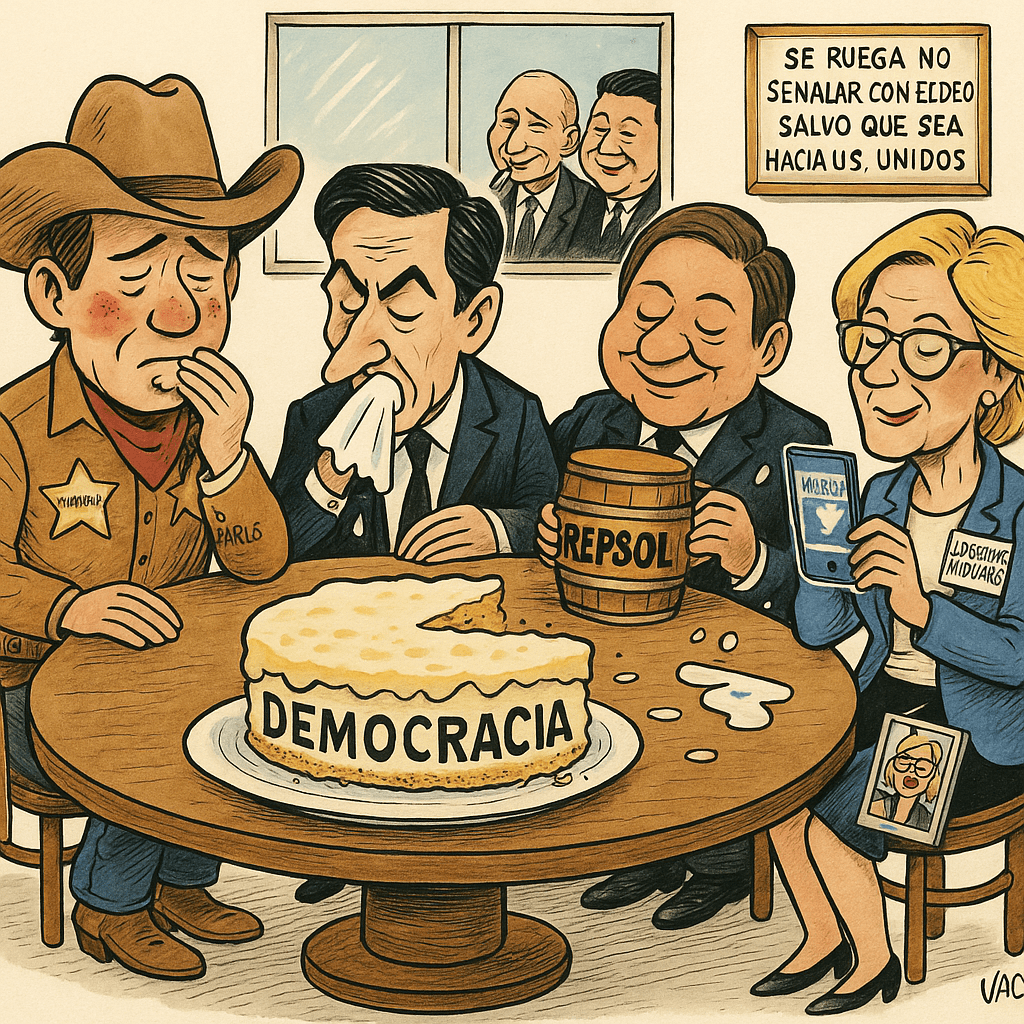
Every time something erupts in the United States—a presidential tweet, a court ruling, an identity war, or a half-hearted election—the entire world gasps, gets scandalized, and tears its garments. As if global chaos had only one ZIP code: 1600 Pennsylvania Avenue. As if the planetary balance were a delicate crystal once again shattered by a clumsy cowboy.
But no. That narrative, however cinematic it may sound, is as worn out as it is false. The monster does not reside only in Washington. And worse: some of its shadowy siblings have been entrenched in Europe for centuries, operating with the hypocritical elegance of those who never get their hands dirty but still collect the commission.
Since Europe was forced to withdraw from its colonial dominance—after World War II, then in Indochina, and later in Africa—the strategy became clear: let others fight the wars they had ignited. The United States inherited Vietnam, but the file came with a French letterhead. The U.S. bears the weight of Iraq, but Europe was doing business with the previous regimes. The U.S. plays the Hollywood villain, but Europe writes the scripts in invisible ink.
Now that democracies are unraveling, public trust is evaporating, and the rule of law creaks under digital surveillance and suffocating taxes, everyone points to Washington as the last cowboy on the global ranch. But that ranch has more tenants, and not all of them wear hats. Some wear robes. Or diplomatic tuxedos.
Where is Paris’s responsibility in Africa? Where is Belgium’s colonial memory in the Congo? What is Spain doing in Latin America, aside from blessing regimes to protect its energy interests? What do Berlin or Brussels say about the comfortable dictatorships in the global South—as long as they help curb migratory waves or buy weapons stamped with European labels?
And let’s not even talk about the discreet complicity with the profitable authoritarian regimes in Latin America. That Repsol operates in Venezuela without remorse while Zapatero visits Maduro as a smiling envoy doesn’t seem to scandalize anyone. That Europe looks the other way when it comes to Nicaragua, Cuba, or bleeding Central America, neither.
So what are we really talking about when we talk about democracy? A British-accented mirage? Scandinavian nostalgia? If anything remains of democracy, it is being shredded not by a single power, but by a swarm of intersecting interests, by elites who preach transparency while drafting laws in fortified offices and signing agreements behind closed doors.
So yes, let’s criticize the United States as much as necessary. But let’s not forget to look into the European mirror. Because while we point a trembling finger at Washington, we hide with the other hand the contracts, silences, and murky alliances that brought us here.
This is not the world of a single monster. It is the result of colonial fabrics and postcolonial interests that have brought us to this point—of intrigues and backroom deals with dictators who export drugs, launder capital, manage migratory flows and slave labor; of diplomatic smiles toward Erdoğan and tremors at the mention of Moscow, while negotiations take place behind locked doors. It may seem as if the world is ruled by a single villain. If only it were that simple—then the issues might be easier to solve. Let’s not forget that Europe—lest we forget—was the cradle of the three most toxic authoritarianisms of the 20th century: Soviet communism, Italian fascism, and German Nazism.
It is a world of many ranch bosses, all playing dirty with a civilized smile on their faces. The global mutation is not the fault of one country. It is the sum of all our shared negligence, alliances, and cowardice.
How lovely it is to have a refined and intelligent showcase like Le Monde and its editorial caricature of the world… but the reality is something else when we lift the crust. Underneath, the pus doesn’t care about accents or flags.
 Israel Centeno Author
Leave a comment