
Israel Centeno
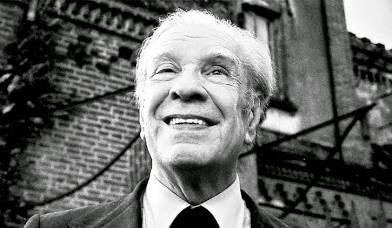
Jorge Luis Borges was an anarchist in the highest sense of the word:
not a destroyer of forms, but a man deeply distrustful of any system that claimed to explain the world definitively.
His anarchy was that of free imagination, the anarchy of one who understood that every human order, every philosophy, every theology, is nothing more than a partial map of an infinite, unknowable territory.
In his poetry and prose, Borges plays with systems—he invents them, subverts them, multiplies them—but he never allows himself to be imprisoned by them.
Each story, each poem, each essay is a celebration of the ultimate mystery that no language can ever fully enclose.
Thus, Borges writes from the essential anarchy of the human before time, chance, and infinity.
But he does so with a mastery that transforms that anarchy into an act of creation, not of despair.
Borges’ anarchy does not lead to chaos; it leads to the search for a higher order.
A secret order, suggested and intuited, that is never imposed dogmatically.
His stories are mysterious clocks: labyrinths where everything seems to disperse, yet every word, every narrative turn, obeys an intimate geometry.
In his poetry, that order manifests through classical meter, through the careful control of imagery, through the serenity of voice.
Borges does not seek a closed system, but an open one: the order of symbols, myths, and the music of ideas.
In his essays—such as those in Other Inquisitions—we see the same passion: a rigorous, elegant, and fervent exploration of the universe as a cipher, as a text we can only partly decipher.
Although he is sometimes accused of coldness or excessive intellectualism, Borges is profoundly shaped by love.
Not the simplistic romantic love, but love as a nostalgia for the lost, as an intuition of the eternal.
There is love for his city—Buenos Aires—love for books, for anonymous heroes, for worthy defeats, for the memory that rescues from oblivion those men who will never have history.
In his most intimate poetry (The Other, the Same, In Praise of Darkness), love appears as a humble recognition:
everything that has truly touched us—a book, a street corner, a fleeting gaze—already belongs to eternity.
For Borges, to love is to affirm the existence of something that, even when lost in time, remains real in the spirit.
The beauty in Borges’ work is never grandiose, nor does it seek immediate applause.
It is a beauty of restraint, of suggestion, of precision.
It is a beauty that arises when language barely grazes the edges of the infinite.
A single line that hints at entire worlds, a symbol that opens more doors than it closes.
In his fiction—The Aleph, Funes the Memorious, The House of Asterion—beauty resides in the way perfect form contains the expansion of wonder.
In his poetry, it is captured in the discreet music of measured words, in images that, without claiming eternity, come close to touching it.
Borges reminds us that beauty does not need to impose itself: it only needs to exist, quietly, to illuminate the world.
In a century that celebrated cynicism and relativism, Borges remained steadfast in his loyalty to essential values:
the dignity of the individual, fidelity to one’s word, reverence for mystery, and silent compassion toward the human condition.
He never adhered to any totalitarian ideology.
He rejected both fascisms and populisms, and he refused the idolatries of the State and of Progress.
His gaze was that of a free man, capable of recognizing that no utopia justifies the humiliation of a single human being.
In his stories—The Book of Sand, Emma Zunz, The Shape of the Sword—and in his essays, Borges proposes, discreetly but firmly, an ethics of individual responsibility and quiet honor.
His values are not those proclaimed from podiums but those lived intimately, faithfully, even when no one else can see.
Anarchy and order, love and beauty, uncompromising values: in Borges’ poetry, fiction, and essays, everything converges toward a single profound truth.
Human life is a labyrinth with no visible exit, but to walk it, to name it, to dream it, is already a form of salvation.
That is why Borges remains.
Not as a monument, but as a silent companion in the infinite adventure of being human:
a man who dared to look into the abyss without ceasing to believe that, somewhere hidden in that abyss, a light still burns.
There is in Jorge Luis Borges a persistent fascination with humanity’s oldest dilemma:
the tension between inevitable mortality and the dream —or nightmare— of immortality.
In his celebrated story The Immortal, Borges imagines a humanity that has conquered eternal life, only to discover that the price of this conquest is the loss of all identity, all meaning.
To be immortal, in Borges, is not to live more: it is to cease truly living.
Deprived of death, his immortals become indifferent, vegetative, incapable of desiring, of remembering, of being.
Immortality, which in so many traditions is the supreme ideal, in Borges reveals itself as an essential degradation.
Death, by contrast, is what gives shape, urgency, and meaning to existence.
Thus, the blind writer, fully conscious of his fragility and the finitude of the human condition, stands with dignity on the mortal side of the mirror.
His work is a homage to that mortality which is not defeat, but rather the condition for beauty, memory, and love.
⸻
In The Garden of Forking Paths, Borges presents another variant of the human dilemma:
the infinite multiplicity of possibilities that open at every instant.
Each choice, each gesture, each word spoken or left unspoken, bifurcates the course of events into parallel worlds.
The labyrinth is not physical: it is temporal and moral.
We are the unconscious architects of infinite alternative realities we will never know.
And at the same time, we are prisoners of a single path traveled, a single thread that can be embroidered into memory.
Faced with this immensity of possibilities, Borges does not offer existentialist anguish or trivial relativism.
He offers the serene contemplation of a mystery:
to live is to choose, and each choice is both an affirmation and a renunciation.
⸻
The figure of Funes the Memorious takes this dilemma to another extreme:
a young man incapable of forgetting anything at all, condemned to remember every leaf of every tree, every shape of every cloud, every nuance of every lived moment.
What might seem to many a divine gift, in Borges becomes a form of torture.
Funes cannot generalize, cannot abstract, cannot think in human terms:
his total memory prevents him from living in the present or projecting the future.
He is buried under an excess of reality.
Thus, Borges suggests that forgetting —the limitation of memory— is not a flaw of human nature, but one of its secret graces.
Man can live because he can forget, because he can abstract, because he can invent anew from loss.
⸻
Finally, Borges’ relationship with power was always ambiguous, distrustful, and skeptical.
He did not love power, nor did he dream of wielding it.
He distrusted grand narratives of collective redemption, charismatic leaders, revolutions that promised paradises and delivered infernos.
In stories like The Shape of the Sword and Theme of the Traitor and the Hero, he explores the moral ambiguity of those who serve or betray higher causes.
Power, for Borges, is not merely external corruption:
it is an intimate corruption, a temptation to which we are all vulnerable in our own hearts.
In his work and in his life, Borges proposed another form of sovereignty:
that of the individual who remains free in his conscience,
who may be defeated in body, but not in soul.
The True Universal Man of Hispanic Literature
Jorge Luis Borges was, in the fullest sense, the universal man of Hispanic literature.
Not because he denied his homeland, but because he carried it to a dimension where the local and the infinite embrace without conflict.
He thought in several languages—English, German, Latin, Old Norse—yet he wrote in Spanish with a clarity, a gravity, and a music that illuminated the language as few have ever done.
His Spanish is a tongue of Anglo-Saxon precision, of German metaphysical resonance, of Scandinavian epic sobriety, but also—and deeply—of unmistakable Río de la Plata flavor.
His bond with Argentine folklore was profound, affectionate, and proud.
The Borges who wrote The Man on the Pink Corner, who celebrated milongas, compadritos, and the silent courage of neighborhood men, was not an exotic Borges: he was an essential Borges.
Tangos, the streets of Palermo, anonymous knife-fighters, and the nostalgia for a lost Buenos Aires run through his work like subterranean rivers feeding his universal imagination.
Macedonio Fernández, his mentor and friend, taught him a paradox Borges made his own:
that metaphysics can spring from a corner café, that eternity can fit inside a trivial gesture, that the highest philosophy can arise from a casual conversation between men who already intuit they are merely dreams of another.
Borges did not need to renounce the dust of his streets to gaze at the stars.
He did not need to reject the shadowy corners of Buenos Aires to speak of the Aleph, of infinity, of the labyrinths of Tlön.
In him, the most Argentine became the most universal.
And the most universal found living roots in the dust, in the courage, in the small nostalgias of his homeland.
Today, as so much literature retreats into narrow trenches of identity, Borges stands as a luminous reminder:
that one who remains faithful to his deepest voice can speak to the entire universe.
That a tango can contain a labyrinth.
That a knife duel can brush against the mystery of eternal archetypes.
That a man, writing in a particular language, can—without betraying it—inhabit all possible tongues.
Jorge Luis Borges was—and remains—the true universal man of the Americas.
The Future That Still Awaits Us
Even today, in the Spanish-speaking world,
neither essay writing,
nor narrative fiction,
nor poetry
have truly caught up with Jorge Luis Borges.
Most Spanish-speaking writers remain trapped in a geography that Borges left behind decades ago:
a landscape where Latin America is still told through local marvels, folkloric prodigies, narcocorridos, and nostalgic visions of haciendas and jungles.
Latin American literature, for the most part, has not yet escaped the folklorism of the nineteenth century.
Even when it boasts of modernity or rebellion, it continues to recycle the old tropes of regional exoticism.
Borges, however, understood from the very beginning that the true destiny of a writer is not to represent his landscape,
but to transcend it.
He, the profound disciple of Macedonio Fernández, never allowed himself to be trapped by the postcard image or the marketplace of the picturesque.
He elevated literary thought the way one moves from Newtonian physics to quantum mechanics:
he changed the entire framework of understanding.
Borges is to Latin American literature what quantum physics is to classical physics:
a silent, yet irreversible rupture.
While others filled their pages with magical realism, mythical missions, and rural fatalism,
Borges dreamed of metaphysical labyrinths, infinite libraries, melancholic immortals, men who were the dreams of other men.
Thus, his universality is not a betrayal of his origin,
but its highest fulfillment:
to be Argentine to the marrow,
and at the same time, to be one of the few truly universal writers that the Americas have produced.
Borges does not belong to the past: he belongs to a future we have yet to reach.
His literature is not a finished answer: it is an infinite question.
He continues to await us, somewhere in the folds of centuries yet to come,
as a voice that reminds us that true literature does not adorn, does not represent, does not entertain,
but reveals the mystery of being alive beneath a sky we will never fully comprehend
 Israel Centeno Author
Leave a comment