
Israel Centeno
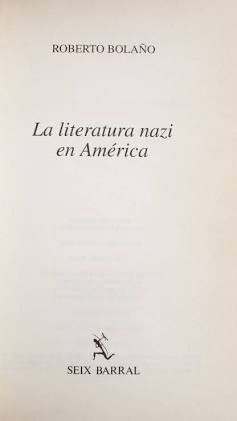
Pedro Bolaño —for that was once his name, before becoming the author of himself— seriously considered writing his first book of short stories not as Nazi Literature in the Americas, but as its mirror reversal: Communist Literature in America. The idea kept him awake one night in Blanes, while he smoked a stolen cigarette and looked out at the sea as if expecting an answer.
Before the narrator abandoned entirely the notion of Communist Literature in America, he reviewed —as one leafs through yellowed index cards— the catalogue of American writers who had once flirted with communism in earnest, with naiveté or calculation. Hemingway, with his posture of an amateur revolutionary; Dos Passos, disillusioned by the bureaucratic corpse of hope; Langston Hughes, forced to swallow his enthusiasm for Moscow with increasingly cautious verses; Richard Wright, horrified by the silence the Party imposed on Black voices. They had each taken two bold steps forward, like a clumsy attempt at leaping, only to stop, resigned, before jumping the fence.
It wasn’t enough to name what had already been named. The act of writing couldn’t simply be re-writing —though that would have been more faithful to Borges. Pedro Bolaño chose to descend one step further: to create the apocryphal biographies of Nazi authors in America, men whose work could only be traced in forgotten pamphlets, provincial supplements, or torture manuals signed with literary flair.
He imagined a gallery of communist writers: ghosts who had once militated fervently on the barricades, written leaflets on yellowing paper, read Lenin in censored editions, handed out manifestos, signed petitions, and then —after some inevitable failure, of history or of language— had slipped into obscurity, their names unquoted, forgotten.
What if he revived them? What if he took those real —or nearly real— lives and rewrote them as stories? Not as homage, but as experiment. Like Pierre Menard rewriting Don Quixote, but this time not from ironic levity, but from the sweat of utopia. Would that be betrayal? Or a second chance?
He imagined, for instance, a biography of Roque Dalton written as if it were a Kafka fable. Or the secret life of Jorge Ricardo Massetti, the guerrilla journalist, recast as a detective tale. He thought of a story about a certain Galo Galarza —an Ecuadorian poet who never existed— who had written a poem titled Lenin in Macondo, powerful enough to shake the editors at the KGB. He imagined apocryphal authors attending writers’ congresses in East Berlin, where dialectics, vodka, and metaphysics were discussed with the same tedium.
But soon he realized the problem. To write Communist Literature in America he’d have to do something he hated: repeat. Not just repeat stories already told, but repeat the tone, the gestures, the defeated ethics. It would be like writing from inside a mausoleum, as if literature were exhumation, not invention. A pious gesture, yes —but one without risk. And Bolaño knew that without risk, literature is nothing but ash. So he descended another step. Took a step aside. What if, instead of redeeming the defeated, he explored those who had been doubly defeated: the obscure, the ridiculous, the unnamable? That’s how the idea of Nazi Literature in the Americas was born. An encyclopedia of frauds, resentful dreamers, aesthetes of horror, provincial writers lost in their belief in the Reich the way others believe in horoscopes. Marginal figures, yes —but by choice, not by accident. Traitors of a betrayal.
It was his way of doing justice —not to communism, but to language. Because writing about the communists meant rewriting what had already been said. Writing about Nazis in America, on the other hand, meant reinventing everything.
And Bolaño —Pedro, Roberto, whoever he was— always preferred heresy to hagiography. Even if only he knew it.
 Israel Centeno Author
Leave a comment