
Israel Centeno
Sometimes the soul awakens late in life. And it does so as if for the very first time, from a quiet corner where time has ceased to hurry. That’s how I found myself, almost unintentionally, following the trail of two women who rekindled in me a passion for something I once believed belonged to others: philosophy.
One of them was Simone Weil, the French philosopher who lived as if every second burned with necessity and grace. Her entire life was a call to attention, in the deepest sense of the word. Not the banal attention of someone listening just to reply, but that which empties the self to truly receive.
“Absolutely unmixed attention is prayer,”
she wrote in her Notebooks. And that phrase shook me. Prayer as attention? Then I had been distracted my whole life.
Weil never officially entered the Catholic Church, though she stood at its threshold. And yet, no one who has read her can deny she was radically committed to Christ. She lived her faith incarnately, with an austerity that bordered on scandalous. She once said she could not receive the Eucharist while others were denied it, could not live fully within a Church where the poor were voiceless. Her encounter with Christ—whether in a small Portuguese chapel or while reading the Bhagavad Gītā—reveals a mysticism pierced through by reason, or rather, reason redeemed by suffering.
The other woman was Edith Stein, also known as Saint Teresa Benedicta of the Cross. A Jewish philosopher, disciple of Husserl, and rigorous phenomenologist, she converted to Catholicism after reading the autobiography of Saint Teresa of Ávila. She left the academic world to become a Carmelite nun, without ever abandoning the life of thought.
Reading The Science of the Cross was like rediscovering the soul of philosophy. In it, Stein delves into the Christian mystical tradition through the work of Saint John of the Cross, weaving Husserl’s phenomenology together with Thomistic theology, revealing a depth that stuns.
“Love is stronger than pain,”
she writes—words made all the more powerful considering she died in Auschwitz for being Jewish, after having embraced the Cross in Christ.
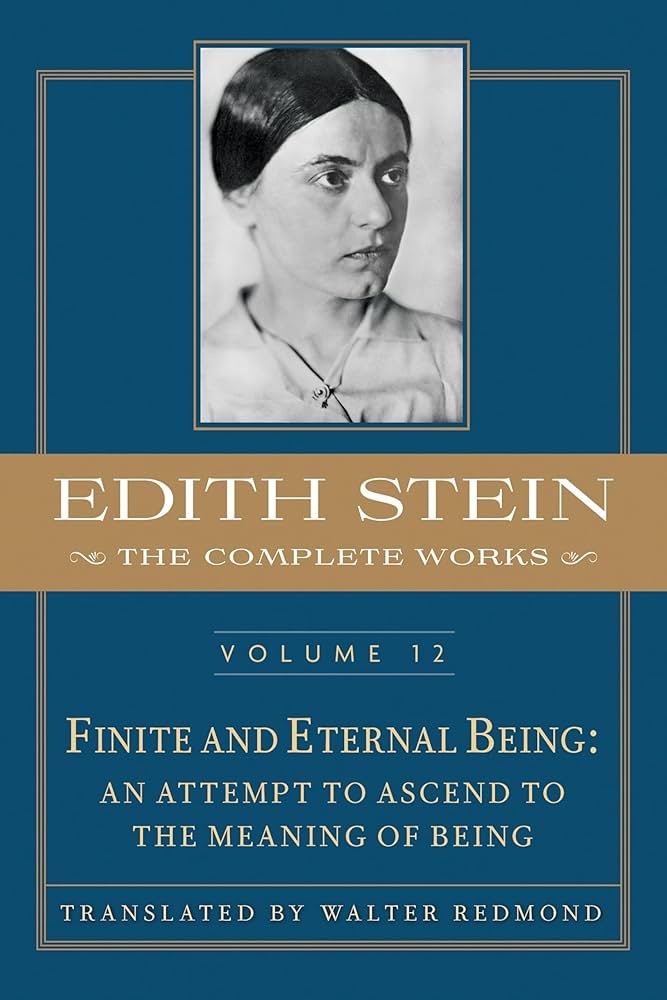
Before this, Stein had explored classical metaphysics in Finite and Eternal Being, a work in which she engages with Plato, Aristotle, Augustine, Pseudo-Dionysius, Aquinas, Scotus, and even Heidegger. She offered a pointed critique of Heidegger’s existential philosophy, which she saw as a metaphysics devoid of hope. Her essay, “Martin Heidegger’s Philosophy of Existence”, included as an appendix in The Science of the Cross, lays bare the stark limitations of a worldview grounded in anxiety rather than grace.
I too had to set aside prejudices. I returned to Kierkegaard, whose anguish turns into a leap of faith; to Pascal, who wrote, “The heart has its reasons of which reason knows nothing”; and even to Hölderlin, whose poetry flirts with the divine through tragedy. I revisited Saint Thomas Aquinas with fresh eyes—not through the dry scholasticism of textbooks, but as a towering thinker who reasoned faith without fearing mystery.
This journey—taken with gray hair and old wounds—has been a gift. A hobby of old age that turned into a re-reading of my life. A way to understand both flesh and soul, the cross and thought, the longing for God and the very human ache that often accompanies it.
Simone Weil and Edith Stein are not merely wise women: they are prophetic signs. In their lives—one standing outside the Church, the other dying as a martyr within it—we see the same thirst: a desire for a kind of thinking that does not exclude the body, nor prayer, nor the suffering of others. They both teach us that faith cannot be cheap comfort, nor an ideology of easy salvation. It is rather a radical form of attention to the mystery of who we are.
“We must love truth more than ourselves.” – Simone Weil
Edith Stein answered with her entire life. I, in turn, simply try—now—to listen.
Everything, perhaps, begins with Heidegger. With the trembling of thought before Being. With that question—What is it to be?—that echoes across centuries of silence. Before faith and beyond dogma, Heidegger invites us to stand at the edge of language, where the world is not yet interpreted, but simply given. It is here that I found myself again, not through abstract metaphysics, but through the radical clarity that comes when existence is stripped to its groundlessness.
In Being and Time, Heidegger writes: “Only because it is ontological, is ontology possible at all.” This line, obscure as it may sound, carried me back to the roots of wonder. It isn’t that Heidegger gave me faith; rather, he cleared a space where faith might speak again—not as tradition, but as encounter.
Reading Edith Stein’s Finite and Eternal Being was, for me, a kind of philosophical re-baptism. Her approach, so deeply rooted in phenomenology and yet ascending into theology, helped me recover an intellectual path to my own faith. Stein writes: “Being is not a genus. It is rather the root of all genera.” This Thomistic insight, combined with her phenomenological training, showed me that theology need not fear precision. Her work engages Aquinas, Augustine, and even her teacher Husserl, but it also contends with the shadows cast by Heidegger’s existential analytics.
But the wound opened by thought found balm not only in metaphysics but in mysticism. Simone Weil entered my life like a strange and necessary interruption. While she never fully entered the Catholic Church, her writings are saturated with mystical urgency. In Gravity and Grace, Weil speaks of “attention” as the purest form of prayer. She writes: “Absolutely unmixed attention is prayer.” That word—attention—struck me like a bell. It was as though faith, which I had long thought belonged only to saints and children, could begin again through the rigorous act of watching, of waiting, of listening without demand.
Weil’s radical compassion and intellectual austerity pushed me back toward Pascal. I revisited the Pensées, finding echoes everywhere. “The heart has its reasons of which reason knows nothing.” There, too, was Kierkegaard, whispering that “truth is subjectivity,” and Thomas Aquinas, patient and crystalline, writing of the actus essendi—the act of being—as the gift that undergirds all things.
From Heidegger’s ontological anxiety to Stein’s metaphysical synthesis, from Weil’s hunger for justice to Aquinas’ harmonies of essence and act, a strange constellation formed above the horizon of my old age. It made me read again. It made me kneel. In a sense, philosophy has become my devotion, not to ideas but to the light they sometimes catch when held at the right angle, with the right humility.
This journey back into philosophy has not been an escape, but a return—what Augustine might call a reductio toward the interior. In a world flooded with noise and ideologies, these voices—Edith Stein, Simone Weil, Martin Heidegger—have become for me guides, not saints perhaps, but witnesses to the mystery of being. I read them now not just as thinkers, but as confessors. And I listen, not to defend or to argue, but to be moved—to think again, to believe again, as if for the first time.
References:
- Edith Stein, Finite and Eternal Being, translated by Kurt F. Reinhardt, ICS Publications, 2002.
- Simone Weil, Gravity and Grace, translated by Emma Craufurd, Routledge Classics, 2002.
- Martin Heidegger, Being and Time, translated by John Macquarrie and Edward Robinson, Harper & Row, 1962.
- Blaise Pascal, Pensées, Penguin Classics, 1995.
- Søren Kierkegaard, Concluding Unscientific Postscript, Princeton University Press, 1992.
- Thomas Aquinas, Summa Theologiae, various editions.
 Israel Centeno Author
Leave a comment