
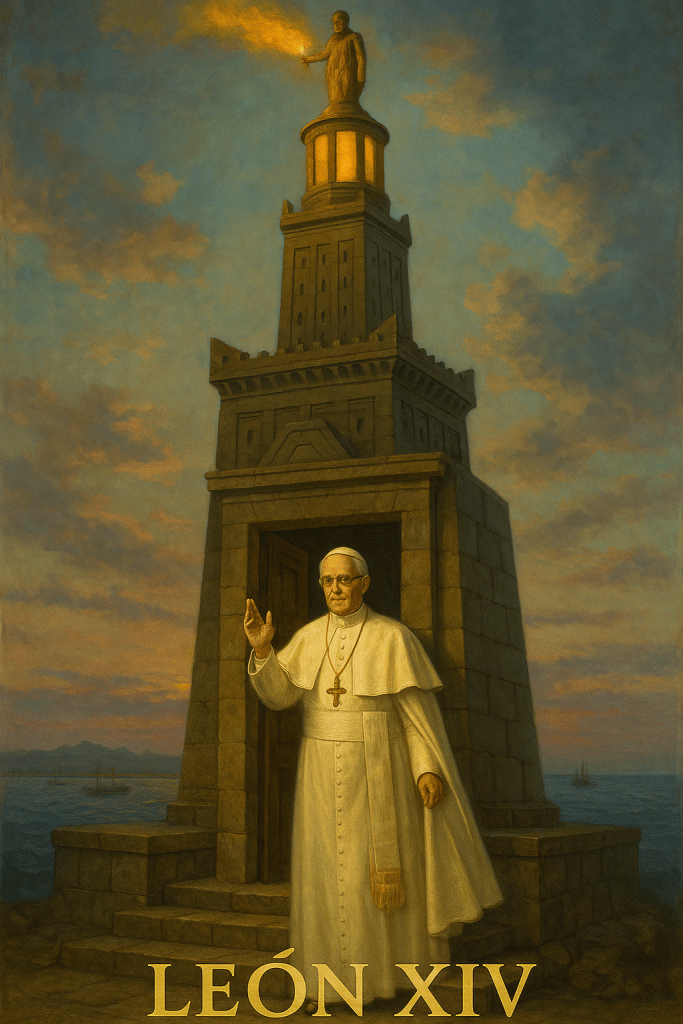
“Dispatches from the Lighthouse of Alexandria
By Israel Centeno | From The Lighthouse of Alexandria
I. The Pontiff of Gestures
Since appearing on the Vatican balcony in 2013, Pope Francis has been hailed as the pope of gestures: the one who abandoned red shoes and golden thrones, who preaches the “field hospital” instead of the doctrinal tribunal. He was embraced by progressive sectors as a hopeful opening of the Catholic Church toward the margins. Yet he has also been targeted from both sides of the spectrum: theological conservatives accused him of laxity; radicals on the left, of timidity.
His pontificate has navigated the tension between symbolic acts and institutional inertia. He spoke of mercy, yet canon law moved slowly. He welcomed migrants and Indigenous communities, yet refrained from publicly naming regimes that imprison and expel their own people.
Nowhere has this ambivalence been more visible than in his relationship with authoritarian regimes in Latin America—Maduro, Ortega, and Díaz-Canel—and in stark contrast, his rhetorical tension with Argentine President Javier Milei. While the former were met with silence or diplomatic caution, the latter became the target of indirect allusions, moral teachings, and finally, a reconciliatory embrace in Rome.
II. Three Dictatorships and a Pastoral Silence
None of the Latin American authoritarian regimes received a direct and public condemnation from Pope Francis. In Venezuela, his stance has been a mixture of humanitarian concern and discreet diplomacy. He sent envoys, welcomed delegations, facilitated dialogue—all of which collapsed. He never directly addressed the tyrannical power of Nicolás Maduro. As famine, persecution, and mass exile unfolded, the Pope called for “dialogue” and “reconciliation.” Victims expected a prophetic voice, not a diplomatic memo.
In Nicaragua, the situation became even more dire. The Ortega regime imprisoned priests, expelled religious orders, banned Catholic processions, and shut down universities. The Church was targeted directly. Still, Francis remained silent until 2023, when he likened the Sandinista regime to a “crude Nazi dictatorship.” By then, the harm was done. The critique came too late to stem the blood or exile.
In Cuba, his tone was even softer. He was instrumental in the U.S.-Cuba thaw, embraced Raúl Castro, and praised the Cuban people. But when the largest spontaneous anti-regime protests erupted in 2021—and repression followed—Francis referred to “difficult moments” and called for peace. He said nothing about political prisoners. His pastoral tenderness avoided direct accusation.
Was this discretion evangelical prudence or structural complicity? Was it bridge-building diplomacy or a disarmed prophetic voice? Some defend his restraint: the Pope should not stoke the flames. Others lament: without truth, charity becomes sentimentality. In either case, the result was suspicion, not moral clarity.
III. Milei: The Libertarian Heresy
The contrast becomes striking when examining Pope Francis’ attitude toward Javier Milei. Not a dictator, not even a sitting president at first, Milei was an economist turned firebrand populist who targeted the Pope as a central enemy in his cultural war.
Milei insulted Francis with ferocity, calling him a “leftist imbecile,” “servant of the devil,” and “communist garbage.” He accused him of peddling liberation theology and enabling socialism. Francis never responded directly. But in homilies and statements, he spoke of an “economy that kills,” of “disposable ideologies,” and of false messiahs. It was clear who he had in mind.
The climax came when Milei, then president-elect, issued a public apology and traveled to Rome. He embraced the Pope, asked for forgiveness, kissed his ring. Francis received him with the warmth of a father who has seen many prodigal sons. He didn’t flatter nor scold, but simply said: “Take care of the poor.”
The episode underscored the symbolic power of the papacy: even a vehement adversary recognized its moral authority. Yet it also left an uncomfortable question: Why was Francis more explicit with a libertarian politician than with ruling dictators?
IV. Leo XIV: A Pope to Restore the Truth
In an age of moral confusion, the Church does not need a manager of consensus—it needs a preacher of truth. If the next Pope takes the name Leo XIV, it will be a sign of continuity with Leo XIII, Pius XII, and John Paul II—not to please the world, but to confront it.
He will face new heresies: transhumanism, the dissolution of the person into virtuality, digital domination of the soul, and the replacement of Christian anthropology by technocratic ideology. He will speak for the poor, but not from the framework of socialism or liberation theology. He will speak from the Church’s Social Doctrine, where justice walks hand-in-hand with truth and freedom finds its measure in the common good.
He will not bless populists or progressives. He will not trade truth for applause. He will not soften the Gospel. He will confront Donald Trump, Javier Milei, Viktor Orbán, and all the new “princes of the world” with the conviction that Christ, not Caesar, reigns.
Leo XIV will be a Pope of moral clarity, Eucharistic centrality, and prophetic boldness. He will reaffirm the foundations: prayer, repentance, truth, beauty, mission. He will remind the world that mercy without truth is illusion, and diplomacy without the Cross is theater.
From the Lighthouse of Alexandria, we await not a Pope of trends, but a Pastor of eternal things. Not a technocrat of inclusivity, but a guardian of the sacred. Not an echo of the times, but a voice that calls them to conversion.
Let the winds howl. Let the waters rise. The Lighthouse must stand
 Israel Centeno Author
Leave a comment