Israel Centeno
La Torre de Alejandria
The new authoritarianism: pleasurable, soft, total
By Israel Centeno
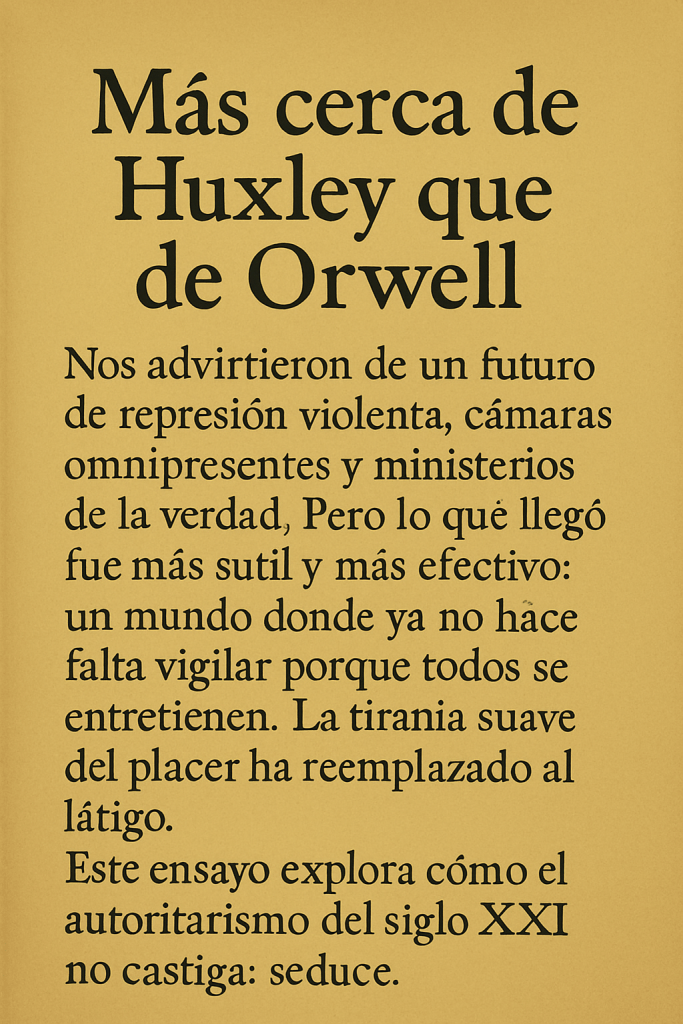
For decades, we were trained to resist an Orwellian dystopia: watchful cameras, thought police, state torture, Ministries of Truth. We were prepared for a regime that would arrive with boots on pavement, public humiliation, and total ideological control. We were told the future would be hard, cold, and brutal.
What arrived—quietly, without fanfare—was something far more effective: a world where repression is unnecessary because desire has already been domesticated.
Aldous Huxley warned us in Brave New World: the most dangerous form of totalitarianism doesn’t impose itself through violence, but through entertainment. It doesn’t coerce—it conditions. It doesn’t punish—it rewards. And it does so with such skill that those under its spell don’t even want to leave.
Today, we are not living in 1984.
We are living in the advanced version of soma.
Instead of Big Brother, we have infinite feeds and dopamine delivered through push notifications. Instead of Ministries of Truth, we have platforms that shape perception through comedy, content, and algorithmic empathy. Truth no longer needs to be outlawed; it simply needs to be irrelevant. Let it drown among a thousand more attractive versions.
So the question is not whether we are being watched, but whether we’ve willingly surrendered our privacy. We don’t need thought police when users themselves denounce others in the name of justice. We don’t need state censorship when everyone already knows what not to say. Self-censorship has become instinctive. Obedience is now moral, not political.
This new authoritarianism doesn’t make you disappear; it makes you go viral. It doesn’t ban books; it floods you with so many that you stop reading. It doesn’t burn ideas; it turns them into memes. It doesn’t crush your body; it trains it with comfort.
The panopticon is no longer a tower—it’s a lifestyle: connected, satisfied, self-monitored.
The new dictators don’t look like Big Brother. They look like your friends, your favorite influencers, your virtual therapists. They don’t wear uniforms—they wear brands. They don’t terrify—they please. And they don’t rule with bayonets—they rule with likes.
Orwell taught us to fear repression. Huxley taught us to fear indifference. Orwell feared pain as a tool of control. Huxley feared pleasure. Orwell imagined a world where reading was forbidden. Huxley imagined one where no one wanted to read. Orwell foresaw surveillance; Huxley foresaw distraction.
And it’s in Huxley’s world that we live.
Not under a boot—but under sedation.
Not in fear—but in fatigue.
Not censored—but overstimulated into apathy.
Huxley was right: the most efficient form of control isn’t the one you resist—it’s the one you crave.
The one that gives you everything… except the freedom to want something else.
Maybe it’s not too late.
Maybe, in the constant hum of content and consumption, we can shut off the screen and ask the question Huxley would demand:
Am I choosing this—or am I consuming it because it’s the only thing I’ve been allowed to choose?
Because in a brave new world, the first act of rebellion isn’t to scream.
It’s to wake up.
 Israel Centeno Author
Leave a comment