
Israel Centeno
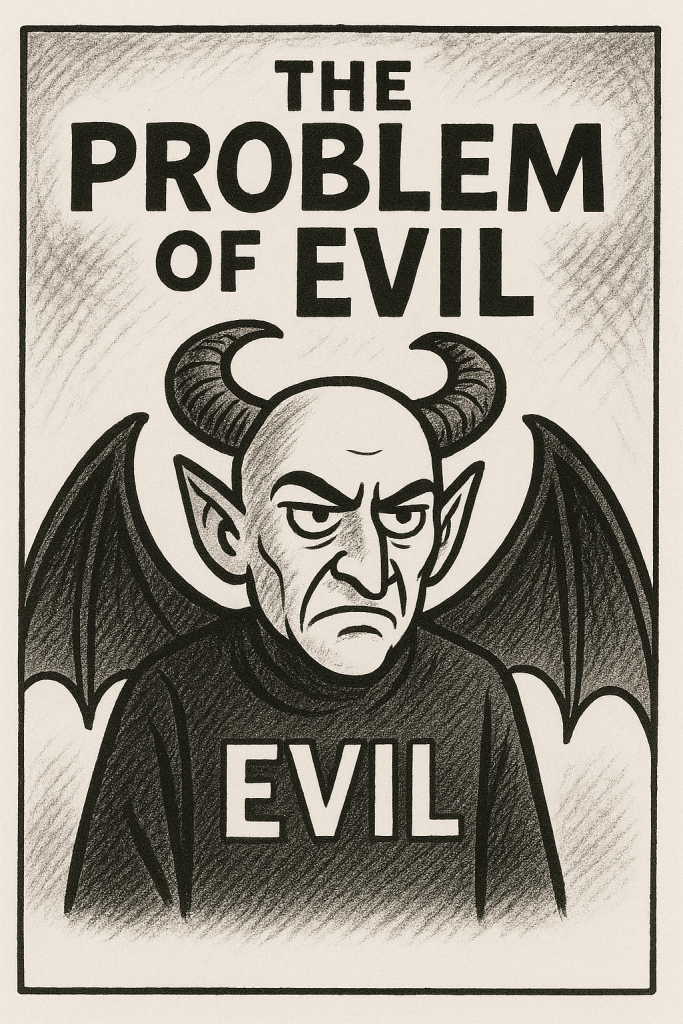
The problem of evil has long been a central concern in Western thought. From antiquity, thinkers and believers have grappled with the paradox of a world created by a good and omnipotent God that nonetheless contains evil and suffering. The so-called Epicurean paradox—if God can prevent evil but doesn’t, He is not good; if He wants to but cannot, He is not omnipotent; if He can and wants to, why does evil exist?—has persisted as an unresolved philosophical dilemma. At its core lies a deeply human assumption: that evil is a scandal requiring explanation, a phenomenon that must have a cause, logic, or purpose.
The Judeo-Christian tradition has offered various responses to this question, from Augustine to Simone Weil. Yet none is as radical as that of Christianity: not a justification of evil, but an Incarnation; not a logical explanation, but divine solidarity that assumes the world’s pain and redeems it from within. For Christianity, evil is not something God eliminates by decree but something He bears in the person of Christ. This response does not remove the scandal of evil but gives it direction—toward the cross and the hope of resurrection.
After abandoning Manichaeism, Augustine posited that evil is not a substance but a privation of good: privatio boni. Everything that exists was created by God as good; evil is not an entity but a wound, a void where fullness should be. It is a disorder introduced by the free creature, not a flaw in the Creator. Yet this explanation, elegant as it is, still leaves unanswered the harrowing pain of the innocent, the world’s injustice, the cries that rise from every Auschwitz and Guernica.
Classical theology, as in Thomas Aquinas, speaks of a “greater good” that God can derive even from evil. From this perspective, God does not will evil but permits it because, in His infinite wisdom, He can integrate it into a plan culminating in a higher order. While this view may console the faithful, it often falls short for those in the midst of suffering. Some evils, from our finite perspective, seem irreconcilable with any greater good. Herein lies Christianity’s profound response: God does not remain in heaven observing our tears; He becomes flesh, suffers, dies, and rises.
From the cross, God does not answer with words but with blood, abandonment, and shared silence. In the crucified Christ, God does not explain evil but lives it. As Simone Weil noted, “God can only save us by sharing our suffering.” God withdraws—not to abandon us but to make space for the creature’s freedom. Creation is not merely an act of power but of renunciation: God restrains Himself, does not impose His will, and allows history to unfold with its light and darkness. Yet He remains present throughout, like a silent heartbeat at the world’s center.
From the divine perspective, the natural cycle—birth, life, death—is not evil. It is the rhythm of created life. The lion devouring the gazelle, the wave engulfing a village, the fire consuming a forest—these are not evils in the ontological order but expressions of the cosmos’s dynamism. From eternity, God views this cycle as part of life’s fabric. There is no evil in a leaf falling from a tree or a body aging and dying. In this sense, true evil is not natural but moral.
What constitutes true drama for God is not the earth’s tremor but the soul’s choice of injustice. Not the hurricane, but deliberate hatred. God created a creature minimal in the cosmic order—humanity—but endowed with an immense gift: freedom. This freedom is, in a way, the divine spark within the creature, the aspect most akin to God Himself. Yet it is a freedom marked by fragility, by an inclination toward evil, by concupiscence. As Weil observed, base passions possess immense energy: pride, envy, greed, the lust for power. Tragically, throughout history, humanity has often chosen these impulses, becoming crueler than jungle predators, for human cruelty is not instinctual but chosen.
From the human sacrifices of the Aztecs to the gas chambers of the Nazis, human history is marked by acts of brutality stemming not from natural necessity but from the corruption of freedom. Entire civilizations have flourished at the edges of volcanoes, beside overflowing rivers, in tornado-prone plains. Humanity challenges nature but often fails to confront its own inclination toward evil. The true cosmic conflict lies in moral decisions, not tectonic shifts.
Could God, in His omnipotence, eliminate evil by removing freedom? Certainly. He could strip humanity of the ability to choose, and moral evil would vanish. But so would love, compassion, virtue, and redemption. What makes goodness authentic is its possibility of not being. God, who is free, desired free creatures, knowing that this freedom could be used to deny Him, to harm, to destroy. This is an unfathomable mystery: God does not glorify evil but accepts the risk of its existence to allow for true love.
In accepting this risk, God does not remain distant. In Christ, God enters history. His omnipotence is not shown by nullifying our freedom but by sustaining it even when we use it against Him. His judgment is not an act of vengeance but the ultimate act of justice: one day, He will judge the living and the dead, revealing hidden goodness and acknowledging every tear. Yet even this judgment is a mystery. If, in the new earth, all will be restored, with no more weeping, death, or sin, then a question arises: will freedom still exist? And if it does, how can evil be prevented from reemerging?
This may be the deepest question: can there be freedom without the possibility of evil? Can redeemed humanity be truly free and yet incapable of sinning? Christian tradition answers affirmatively: true freedom is not choosing between good and evil but choosing good with full awareness, without error or corruption. In the beatific vision, in full communion with God, the soul desires nothing but good. Not because it is forced, but because it has been healed. Just as molten iron no longer remembers rust, so the heart transformed in Christ no longer desires sin. Heaven is not a prison without the option to sin; it is freedom consummated in love.
Yet we are still here, in history. Here, where freedom falters, guilt weighs, and evil—both moral and natural—continues to roar. But in this valley of shadow and tears, Christianity tells us that God has not abandoned us. That in the heart of every pain, He is present. That in every free choice for good, we partake in His glory. That all creation groans awaiting redemption, and that redemption will come, for it has already begun.
Evil has not been explained away. But it has been confronted. God has not eliminated it but has overcome it. And on the cross, the world’s horror has become a path to life. Perhaps our task is not to understand evil fully but to refuse to make peace with it. Not to justify it, but to resist it. And above all, not to let it steal our hope.
 Israel Centeno Author
Leave a comment