
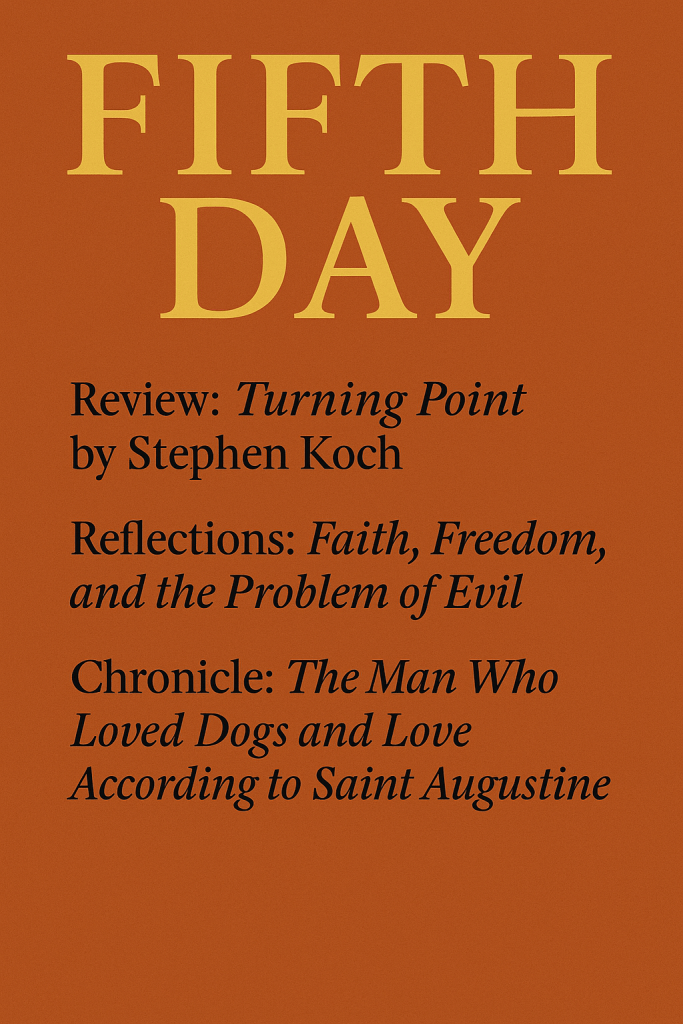
🎉 Launch of The Fifth Day
A cultural supplement, every Sunday
This Sunday marks the launch of The Fifth Day — a weekly dose of thought, criticism, and narrative. It’s not a blog, not just another newsletter: it’s an invitation to pause, to read slowly, and to truly think.
For the first month, all issues will be available for free via Substack and on my personal blog.
Table of Contents – Issue No. 0
• Turning Point
A review of Stephen Koch’s book on propaganda, art, and totalitarianism.
• The Man Who Loved Dogs
A literary chronicle between Padura and Garmabella: two Trotskys, two betrayals.
• Love According to Saint Augustine
A theological reflection on desire, freedom, and interior truth.
🗞 Subscribe now to The Fifth Day on Substack,
or follow it weekly here on the blog.
Because there’s still life beyond the algorithm —
and words left for strange days
Essays, Criticism & Reflections
- Literary criticism and book reviews
- Reflections on theology, philosophy, and politics
- Chronicles, essays, and small acts of narrative
- Cultural commentary drawn from the week’s reading and writing
In parallel, I will also begin releasing my novel The Cocos Corner—part of The Lovecraft Project—in serialized form through the same platform.
Review of Turning Point by Stephen Koch: Hemingway, Dos Passos, and the Spanish Civil War
Stephen Koch, in Turning Point (published in Spanish as La ruptura. Hemingway, Dos Passos y el asesinato de José Robles), explores a critical episode in the lives of two American literary giants during the Spanish Civil War: the bitter rupture in the friendship between Ernest Hemingway and John Dos Passos. Koch reconstructs how the historical context of the war—especially the Siege of Madrid—and specific events such as the disappearance of José Robles sparked ideological and personal tensions between the two writers. The author not only recounts the events but analyzes them across three fundamental dimensions: historical (the role of foreign intellectuals in the conflict and Soviet influence), ideological (the evolution of Hemingway’s and Dos Passos’ political stances under the shadow of Stalinism), and literary (how these experiences are reflected in their work and style). The result, according to critics, illustrates “the danger of writers diving into politics and war” and offers “an unflattering portrait of the committed artist as a ‘useful idiot,’” in Koch’s own words.
What follows is a critical examination of these thematic axes in Koch’s book, cross-referenced with historical and literary sources.
The Spanish Civil War, Intellectuals, and the Siege of Madrid
The Spanish Civil War (1936–1939) drew numerous foreign intellectuals whose pens and voices helped shape international perception of the conflict. From the outset, the war was presented as a clash between democracy (the Republic, supported by leftists, liberals, and Soviets) and fascism (Franco’s Nationalist rebels, backed by Nazi Germany and Fascist Italy). The reality, however, was far more complex. Within the Republican faction coexisted liberal democrats, socialists, Stalinist communists, anarchists, and Trotskyists—often with conflicting visions. This ideological mosaic, along with the covert involvement of the Soviet Union, made the war a stage for political intrigues and internal struggles for ideological dominance.
In this context, Madrid became the symbol of Republican resistance. After the failed military coup of July 1936, Franco’s troops advanced on the capital that fall, triggering the Siege of Madrid. Against all odds, the city withstood the initial onslaught in November 1936 (“¡No pasarán!” became the slogan of the defense) and remained a semi-besieged stronghold for much of the war. As the capital of the Republic, it was soon dubbed the “mecca of anti-fascism” and attracted a steady flow of international visitors eager to witness—and often support—the fight.
Ernest Hemingway, already renowned for A Farewell to Arms (1929), arrived in Madrid in early 1937 as a highly paid correspondent for the North American Newspaper Alliance (NANA). He took up residence at the iconic Hotel Florida, right in the city center, from where he reported on the war and mingled with fellow journalists and literary figures. There he began a romantic relationship with Martha Gellhorn, also a reporter, and welcomed colleagues like John Dos Passos (who came that year to work on a film project) and even Antoine de Saint-Exupéry. The presence of Hemingway in Madrid—as with other writers, journalists, and photographers (including the famed Robert Capa)—not only reflected personal commitment to the Republican cause but also shaped the narrative of the war for international audiences. Indeed, the mere presence of foreign observers often influenced media attention toward specific events: for instance, the bombing of Guernica in April 1937 gained global resonance due to correspondents like George Steer, while other massacres (Durango, Badajoz) received less coverage in the absence of press witnesses.
Within the siege of Madrid, Hemingway played a dual role: on one hand, as a journalist writing chronicles of life in the besieged city and military operations; on the other, as a public figure actively engaged in propaganda efforts supporting the Republic. John Dos Passos, Hemingway’s close friend and a prominent leftist novelist, also traveled to Spain in 1937 with a specific mission: to collaborate on a documentary about the war. That film would become The Spanish Earth (1937), directed by Joris Ivens, a propaganda piece aimed at garnering international support for the Republican side. Dos Passos, acclaimed for his USA trilogy and a leading voice of the American left, had been featured on the cover of Time magazine in 1936 as a symbol of committed literature. Hemingway, although sympathetic to the Spanish cause, had until then been seen as more apolitical, focused on his personal art; he hadn’t published a major novel in years and his literary star from the 1920s was beginning to fade. The Civil War offered him an opportunity to reinvigorate his public image and creative drive, while satisfying his taste for adventure. As Koch notes, Hemingway threw himself into the war seeking, through violence and battlefield glory, a new purpose for his creative life after a period of personal stagnation.
During the defense of Madrid, both writers immersed themselves in the life of the besieged capital. Hemingway, always eager for action, set himself up in a half-ruined building at the front line (which he nicknamed “Old Homestead”), from where he had a direct view of the fighting in the Casa de Campo. There, with binoculars in hand and at personal risk, he observed the clashes and worked closely with Joris Ivens filming battle sequences for The Spanish Earth. His dispatches for NANA described in vivid detail the Nationalist bombings of the capital and the efforts of Republican defenders. Paradoxically, in those reports Hemingway omitted certain key events—for example, he barely mentioned the destruction of Guernica by the Nazi Condor Legion—perhaps due to geography (he was in Madrid, not the Basque Country) or because other journalists had already covered those events. Regardless, Hemingway’s writing helped forge the mystique of Madrid as the “martyr city” of anti-fascist resistance.
Dos Passos, meanwhile, took a more reflective and humanitarian approach. Less enthralled by the epic of war than Hemingway, Dos Passos was drawn to both the human tragedy and the political complexity behind the propaganda. He witnessed firsthand the toll of the siege on Madrid’s civilian population—hunger, bombings, fear, and daily courage—and became attuned to the moral ambiguity concealed beneath revolutionary rhetoric. This difference in temperament—Hemingway being competitive, risk-loving, and fond of projecting a heroic image; Dos Passos more introverted, intellectual, and empathetic—would come to a dramatic head with one defining event during their time in the besieged capital: the mysterious disappearance of José Robles.
The Disappearance of José Robles and the Ideological Split
José Robles, a Spanish intellectual, translator of Dos Passos and friend to both writers, had joined the Republican cause early in the war. He was serving as a liaison between the Spanish government and Soviet military advisors. In late 1936, he suddenly disappeared.
Hemingway and the film crew were told that Robles had been executed as a fascist spy. Dos Passos, deeply disturbed, tried to investigate. What he discovered—or suspected—horrified him: Robles had likely been executed by the Communists themselves, under orders from Soviet agents operating with full impunity in Republican Spain. For Dos Passos, this revelation was shattering. He believed in the Republic, but not in Stalinism. The cold pragmatism of the Communist Party, willing to eliminate even loyal intellectuals for reasons of control or suspicion, exposed the dark underside of the anti-fascist cause.
Hemingway, on the other hand, refused to dwell on Robles’ case. He dismissed Dos Passos’ concerns, called him naïve, and insisted that victory against Franco came first. For Hemingway, the politics of war were necessarily dirty; the goal justified the means. His allegiance was not to a pure ideology but to a heroic narrative—and anything that complicated that narrative was a threat.
The two men clashed bitterly. What had been a friendship forged in literature and adventure now unraveled in moral disagreement. Dos Passos left Spain in silence and heartbreak, convinced that the movement he once believed in had lost its soul. Hemingway stayed behind, completing the film and solidifying his position as the voice of the Republican cause in the English-speaking world.
Koch presents this rupture not simply as a personal falling-out, but as a metaphor for the broader fracture within the left—between those who remained loyal to Moscow and those who could not accept the authoritarian turn of international communism. It is also, in a more intimate sense, a story of betrayal: of friendship, of ideals, of truth.
The Robles case became a turning point—hence the title of the book. It marked not only the end of a friendship, but the beginning of Dos Passos’ ideological departure from the left. In the decades that followed, he would drift toward conservative positions, alienating former allies. Hemingway, meanwhile, would romanticize the war in For Whom the Bell Tolls, filtering tragedy through a lens of heroism. For both men, the Spanish Civil War left a permanent mark.
The Literary Consequences
Koch’s analysis of Hemingway and Dos Passos’ subsequent literary work shows how profoundly the events of the Spanish Civil War reshaped their creative output. For Hemingway, Spain became a mythic landscape. In For Whom the Bell Tolls (1940), written shortly after his time in Madrid, the conflict is transfigured into a heroic epic. The protagonist, Robert Jordan, reflects Hemingway’s ideal of a man shaped by violence, love, and sacrifice. The novel—lyrical, stylized, and politically engaged—was a major success and reinforced Hemingway’s status as the American chronicler of resistance and tragic valor.
Yet Koch argues that this romantic vision masked the moral ambiguities of the war and Hemingway’s own compromises. By transforming the messy politics of Spain into a timeless tale of honor and death, Hemingway crafted a powerful narrative—but one that simplified history. In Koch’s view, Hemingway could only preserve his ideological loyalty to the Republic by turning the war into literature, where contradictions could be resolved by style and sacrifice.
Dos Passos, on the other hand, moved in the opposite direction. Devastated by Robles’ death and alienated from the left, he began to write with increasing bitterness and disillusionment. His postwar novels (Adventures of a Young Man, The Grand Design, Chosen Country) lack the vitality of his earlier USA trilogy. They reflect not only a political shift but a loss of faith in the transformative power of art. As Koch notes, Dos Passos’ prose became more didactic, his characters more schematic. The fire of social commitment cooled into an ideological lament.
In this divergence, Koch sees two opposing responses to political trauma: sublimation through myth versus retreat into mourning. Hemingway reworked the experience into a heroic tale. Dos Passos chronicled its failure.
Koch’s book is not a hagiography. It exposes the seductions and risks of political engagement for writers—how easily literature becomes propaganda, how fragile friendships become casualties. But it also acknowledges the complexity of both men: their courage, their contradictions, and the wounds that never healed.
Ultimately, Turning Point is a meditation on what happens when literature meets history with no safety net. It is a story of two writers, but also of a century. Of bullets and books. Of ideals born in cafés and buried in trenches. A quiet, unflinching account of how a war—like a novel—can change everything.
Second Recommended Book of the Week: Love and Saint Augustine, by Hannah Arendt A descent into the heart of Western affective thought
This is not a minor work, nor a marginal note. It is Hannah Arendt’s doctoral thesis, written in 1929 under the direction of Karl Jaspers, and, perhaps unwittingly, it contains the secret seed of her entire later philosophy. Here, the young Jewish thinker, barely twenty-three years old, plunges into the world of amor, caritas, dilectio, cupiditas—terms Saint Augustine wove into the architecture of the soul. But Arendt approaches them not as a theologian, nor as a believer, but as a thinker of the world. And what she finds is not dogma, but a philosophy of love that marks the birth of what the West would later understand as interiority, will, and the longing for eternity.
The central critique of the book—and its great merit—is that Arendt avoids both devotion and academic sterility. She goes straight to the core: the structure of the human heart as Augustine conceived it, in constant tension between love of the world and love of God. It is in this rupture that Arendt detects the first step in what would later, in her view, culminate in the modern alienation from the political realm. For Arendt, Augustinian love—though legitimate as a spiritual experience—sowed the seed of withdrawal from the world, the renunciation of action and “being-with-others.” Paradoxically, this same “being-with” will become the essential element of humanity in Arendt’s mature political thought.
The book, rigorously translated from the German and reissued by the University of Chicago Press, is brief but dense. Some chapters are philosophical maps of interiority; others brush against mysticism. The influence of Heidegger is palpable in how Arendt reads time, death, and the longing for the eternal. But the most astonishing aspect is how a non-Christian thinker can enter so deeply into the affective logic of a Church Father without reducing or idealizing him.
This is not a book to read hastily. But it is a book to read if one wishes to understand how deeply Christian categories of the soul have shaped the modern idea of the self, of desire, of time, and of the world. It is also, though few would call it so, a tragic book: it reveals how even the purest form of love can lead to a radical distance between the human being and the world.
Highly recommended for those who seek to think of love not as comfort, but as a philosophical problem. And for those who suspect that every political philosophy is, ultimately, born of a conception of the human heart.
Koch’s analysis of Hemingway and Dos Passos’ subsequent literary work shows how profoundly the events of the Spanish Civil War reshaped their creative output. For Hemingway, Spain became a mythic landscape. In For Whom the Bell Tolls (1940), written shortly after his time in Madrid, the conflict is transfigured into a heroic epic. The protagonist, Robert Jordan, reflects Hemingway’s ideal of a man shaped by violence, love, and sacrifice. The novel—lyrical, stylized, and politically engaged—was a major success and reinforced Hemingway’s status as the American chronicler of resistance and tragic valor.
Yet Koch argues that this romantic vision masked the moral ambiguities of the war and Hemingway’s own compromises. By transforming the messy politics of Spain into a timeless tale of honor and death, Hemingway crafted a powerful narrative—but one that simplified history. In Koch’s view, Hemingway could only preserve his ideological loyalty to the Republic by turning the war into literature, where contradictions could be resolved by style and sacrifice.
Dos Passos, on the other hand, moved in the opposite direction. Devastated by Robles’ death and alienated from the left, he began to write with increasing bitterness and disillusionment. His postwar novels (Adventures of a Young Man, The Grand Design, Chosen Country) lack the vitality of his earlier USA trilogy. They reflect not only a political shift but a loss of faith in the transformative power of art. As Koch notes, Dos Passos’ prose became more didactic, his characters more schematic. The fire of social commitment cooled into an ideological lament.
In this divergence, Koch sees two opposing responses to political trauma: sublimation through myth versus retreat into mourning. Hemingway reworked the experience into a heroic tale. Dos Passos chronicled its failure.
Koch’s book is not a hagiography. It exposes the seductions and risks of political engagement for writers—how easily literature becomes propaganda, how fragile friendships become casualties. But it also acknowledges the complexity of both men: their courage, their contradictions, and the wounds that never healed.
Ultimately, Turning Point is a meditation on what happens when literature meets history with no safety net. It is a story of two writers, but also of a century. Of bullets and books. Of ideals born in cafés and buried in trenches. A quiet, unflinching account of how a war—like a novel—can change everything.
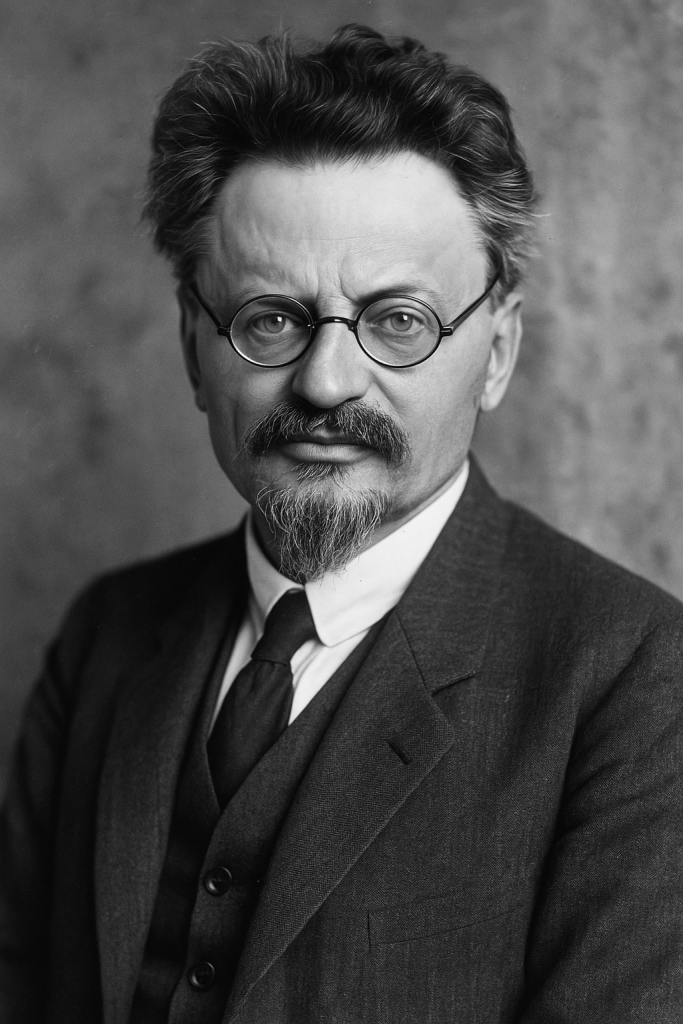
The Scream and the Dogs: A Literary Duel Beneath the Shadow of the Ice Axe
On the afternoon of August 20, 1940, a scream of agony tore through the quiet of León Trotsky’s fortified residence in Coyoacán, Mexico. The Russian revolutionary, fatally wounded by a blow to the head with an ice axe, let out a final cry—more howl than shout, as a chronicler would later clarify. That sound, the last cry of a man who had defied an empire, would echo for decades in the memory of his killer, the young Spanish communist Ramón Mercader. Years later, he would confess to being haunted: “I always hear it, I hear his scream. I know he’s waiting for me in the afterlife.”
Decades later, that final cry still resounds in literature. Two books, published a few years apart, revisit the scene from differing perspectives: El grito de Trotsky (The Scream of Trotsky) by José Ramón Garmabella, and El hombre que amaba a los perros (The Man Who Loved Dogs) by Leonardo Padura. These two works stand face to face like duelists at dusk, measuring their narrative blades over the same historic crime. On one side of the literary ring: Garmabella’s controversial, document-heavy chronicle. On the other: Padura’s polyphonic, morally charged novel. How similar are their thematic and stylistic punches? Can either be accused of throwing a low blow—perhaps even plagiarism?
Let’s examine the bout in detail, in the form of a dynamic, literary chronicle—the kind Hemingway might have penned after a strong Cuban coffee and a long afternoon shadow.
El grito de Trotsky: Garmabella’s Chronicle of a Murdered Myth
The first contender in this literary bout is the book the user originally referred to as El chillido de Trotsky, whose actual title is El grito de Trotsky: Ramón Mercader, el asesino de un mito (The Scream of Trotsky: Ramón Mercader, the Assassin of a Myth). It is a biographical narrative by Mexican journalist José Ramón Garmabella, published by Debate (Random House Mondadori) in 2007.
Garmabella embarked on a rigorous investigation into the life of Ramón Mercader—the man who murdered Trotsky with an ice axe—and the web of intrigue behind this world-shaking crime. The result is a book that delves not only into the conspiratorial threads of Stalinism, but also into the psychological formation of the assassin, painting him as a “faithful product of an era” of blind allegiance to Stalin.
Indeed, El grito de Trotsky has been considered “the most complete biography” of the Catalan communist who killed the exiled Russian leader, thanks to its meticulous documentation and unflinching tone. The book narrates Mercader’s story from his youth as a combatant in the Spanish Civil War, to his recruitment and training by the Soviet NKVD, through to the assassination in Mexico and its aftermath.
The title refers to Trotsky’s scream upon being attacked—a real, documented detail that lends symbolic weight to the narrative. According to the author, Trotsky “screamed when Mercader struck him in the head with the ice axe”, more a primal howl than a simple cry. That sound becomes a kind of phantom that haunts Mercader throughout his life. Garmabella describes how, after serving twenty years in a Mexican prison, Mercader emerged broken, still tormented by the sound of that scream, which echoed through his sleepless nights like a curse.
Garmabella’s thesis is deliberately polemical. His central claim is that Stalin and Trotsky were ultimately the same: two dictators battling for power. In this reading, had Trotsky come out on top, history might have looked strikingly similar—Trotsky repressing rivals, Stalin perhaps exiled as the victim. This revisionist perspective is reinforced by the author’s own assertions throughout the book: that “Stalinism was not, after all, so different from what Lenin and Trotsky imposed immediately after 1917”. Garmabella even calls Stalin the “natural heir” of Lenin and Trotsky.
In this light, Trotsky is demythologized. The assassination becomes not just a political crime, but a grim historical necessity. The title itself, “the assassin of a myth”, signals Garmabella’s intention to strip away Trotsky’s heroic aura.
Mercader, in contrast, is portrayed with a kind of tragic empathy. Not as a hitman or brute, but as a tragic idealist, convinced he was fulfilling a noble mission: saving communism from its traitor. The book underscores that “everything was absolute, blind loyalty to the USSR” in Mercader’s formation. He is shown as a man shaped by his time, an instrument wielded by history.
Not surprisingly, Garmabella’s stance sparked controversy. Trotskyist factions responded with force, denouncing the book as “mean-spirited” and misleading. Critics accused him of omitting key facts—for instance, Trotsky’s refusal to use the Red Army for a coup against Stalin in hopes of preserving Soviet democracy—and of flattening the moral distinction between Trotsky and Stalin. The real offense, they argued, was that Garmabella’s narrative made readers wonder: “What does it matter that Trotsky was killed, if he was just another Stalin in waiting?”
Moreover, Garmabella is said to downplay the crimes of Stalin’s regime, calling brutal figures like prosecutor Vyshinsky merely “unpleasant” and describing the sadistic NKVD chief Beria as “controversial”. Meanwhile, victims like Sylvia Ageloff—Mercader’s unwitting accomplice and lover—are subtly blamed for their naivety.
Still, the book offers valuable insights. Garmabella unearthed many details of Mercader’s later years: his request in 1977 to return to his native Catalonia to die, and how Spanish communist leader Santiago Carrillo demanded in exchange that he write his memoirs and name who ordered the hit on Trotsky—something Mercader never did. These details add depth and human drama to the narrative.
In sum, El grito de Trotsky reads like a historical chronicle tinged with ideological fatalism. It presents itself as a kind of intellectual autopsy of the revolutionary dream. The “scream” resonates not just as Trotsky’s final cry, but as the echo of a century of betrayed ideals, failed utopias, and brutal pragmatism. It is a rough-edged, provocative work—less literary than Padura’s novel, perhaps, but no less daring in its moral implications.
The Man Who Loved Dogs: Padura’s Polyphonic Elegy of Betrayed Utopia
In the opposite corner of this literary ring stands Leonardo Padura, Cuban writer and journalist, with his acclaimed novel The Man Who Loved Dogs (El hombre que amaba a los perros). Published by Tusquets in 2009 (and in Cuba in 2011), this work of historical fiction tackles the same core event—the assassination of Trotsky by Mercader—but does so through a sweeping, polyphonic structure and a very different moral lens.
Padura, best known for his detective novels featuring Mario Conde, here ventures into the domain of “great history” with profound ambition. The novel was a finalist for Spain’s Book of the Year award and has since been recognized as a modern classic, praised for its elegant blend of narrative invention and historical rigor.
Narrative Structure:
The Man Who Loved Dogs weaves three narrative threads into a kind of literary triptych. As Padura himself described it, “three novels in one,” whose greatest challenge was achieving harmony among them.
The first thread follows León Trotsky, using his real name, Lev Davidovich Bronstein, from his exile in Alma-Ata (Kazakhstan, 1929) through Turkey, France, Norway, and finally Mexico, where he meets his end in 1940. Padura paints a detailed portrait of Trotsky’s final years—his isolation, paranoia, intellectual resolve, and the growing realization that Stalin will not rest until he is dead.
The second thread centers on Ramón Mercader, alias Jacques Mornard or Frank Jacson, and traces his transformation from a young Catalan communist in the Spanish Civil War to a trained Soviet agent. We follow his indoctrination by his fanatical mother Caridad and by Soviet operatives, his fabricated identities, and his descent into psychological ambiguity as he prepares to carry out the murder. This thread is the most expansive, occupying nearly half the novel, and reflects Padura’s deep fascination with understanding the assassin from within.
The third thread is the fictional story of Iván Cárdenas Maturell, a frustrated Cuban writer who, after being censored for publishing a “counterrevolutionary” short story, finds himself exiled to a veterinary clinic job in Havana. In 1977, he meets a mysterious Spaniard walking two majestic borzoi dogs on the beach—an enigmatic figure who, over time, begins telling Iván the story of “the man who loved dogs.” Iván gradually realizes that this man is none other than Ramón Mercader, now old, silent, and haunted in his Cuban refuge. Their bond becomes the bridge through which the novel connects past and present, Moscow and Havana, Stalinism and its long, aching shadow over Cuban history.
This triple structure allows Padura to work across temporal, geographic, and emotional dimensions, harmonizing history with fiction, and ideology with intimate loss. The use of alternating chapters—each devoted to one of the three protagonists—creates a contrapuntal rhythm. At times, the stories interweave with eerie symmetry: Trotsky adopts a dog in Mexico; Mercader earns his way into the inner circle of Trotsky’s household by feigning interest in dogs; Iván tends to the borzois of the mysterious “Jaime López.” These shared motifs—especially dogs as symbols of loyalty, submission, or domesticated violence—give the novel its subtle symbolic texture.
Formally, the novel moves between first-person (Iván’s reflections) and third-person omniscient narration for Trotsky and Mercader—although we ultimately discover that Iván is the narrative voice behind all three stories, reconstructing them from research and personal testimony. This device of radical multiperspectivism enables the reader to inhabit multiple subjectivities without losing coherence.
Tone and Themes:
Padura’s style is lucid, immersive, and emotionally charged. Unlike Garmabella’s documentarian prose, Padura offers vividly dramatized scenes—full of sensory detail, psychological nuance, and moral reflection. His goal is not just to inform, but to make the reader feel the tragedy unfolding.
Thematically, the novel is a meditation on betrayed utopias and historical memory. Through Trotsky’s fall, Mercader’s disillusionment, and Iván’s artistic frustration, Padura maps the disintegration of revolutionary hope across the 20th century. He portrays Stalin not merely as a dictator, but as “a genocidal, sadistic monster who destroyed everything and everyone in his path.” Trotsky, by contrast, is treated with deep empathy: not canonized, but rendered human, battered by exile and grief, still intellectually vital, and tragically aware of his coming end.
Even so, Padura does not shy away from Trotsky’s contradictions. He reminds us of Trotsky’s own role as a ruthless military commander during the Russian Civil War, but insists that Stalin’s crimes were of a different order. The novel refuses easy equivalence, emphasizing that Trotsky remained committed to a version of socialism that preserved democratic ideals—however flawed or naïve.
Mercader, too, is shown in complexity. Far from a brainwashed killer, he is a young man whose idealism is manipulated by his mother and handlers. As the novel progresses, Mercader becomes more confused, alienated from his own identity, and—most poignantly—haunted by the very act he was trained to commit. In Padura’s vision, the scream of Trotsky follows Mercader all his life, not just as guilt but as a metaphysical wound.
Iván, the fictional narrator, represents the Cuban intellectual crushed by ideology. His voice is the most direct link between Soviet totalitarianism and the Cuban experience. Through him, Padura criticizes the cultural censorship of the 1970s and reflects on how revolutions devour their artists, writers, and moral conscience.
While Trotsky’s image had long been erased in official Cuban discourse, Padura resurrects him—not to glorify, but to invite reflection. The novel becomes an act of literary memory, bridging eras and ideologies. As critics have noted, the book is “as much about Stalin and Trotsky as it is about Cuba and the cost of silence.”
Reception and Legacy:
The Man Who Loved Dogs was met with international acclaim. Critics praised its ambition, its historical accuracy, and its emotional depth. Alan Woods, a prominent Trotskyist intellectual, called it “an exceptional novel” and “a major literary and political event,” hailing it as “a modern classic.”
Padura himself remarked that the hardest part was getting readers to care about a story whose ending they already knew. But care they did. The novel’s success lies in its ability to transform known history into lived experience, reanimating forgotten voices and reviving long-buried truths. In the character of Iván, readers see not only Mercader’s confessant but also Padura’s literary surrogate—torn between loyalty and lucidity, between silence and witness.
Points of Contact: Echoes of the Same Cry
Despite their differences in genre and tone, The Scream of Trotsky and The Man Who Loved Dogs converge on multiple thematic and narrative axes. Like two paths through the same historical battlefield, these works frequently overlap in their portrayal of the same events, characters, and questions.
1. The Central Historical Event
Both books orbit around the assassination of Trotsky in 1940 and the character of Ramón Mercader, the agent who carried it out. This is their undeniable nucleus. Each reconstructs the conspiracy orchestrated by Stalin to eliminate his rival, and the way Mercader infiltrated Trotsky’s inner circle by posing as a Belgian sympathizer. Both recount the failed May 1940 assault led by David Alfaro Siqueiros, Mercader’s manipulation of Sylvia Ageloff, and the climactic murder scene in Trotsky’s study. These episodes are treated in meticulous detail in both texts, and form the dramatic apex of each.
2. The Moral Question at the Heart of the Story
Beyond the facts, both works pose the same fundamental question:
What drives a man to kill another for an idea?
Is ideology so powerful that it can override humanity?
Garmabella and Padura both seek to explore this moral chasm by entering Mercader’s mind. Garmabella emphasizes his ideological indoctrination, the notion of Trotsky as a traitor to be eradicated. Padura delves deeper into Mercader’s internal doubts and psychic dislocation, portraying a man gradually consumed by the role he has been trained to play.
In both accounts, Mercader is not a sadist or a mercenary, but a zealot, a believer, someone who becomes an executioner in the name of purity. That both authors align on this point—despite their differences—underscores the existential weight of the act. Mercader’s crime was not a spontaneous murder, but the fulfillment of a long, ideological descent.
3. The Cost of Belief and the Collapse of Meaning
Both books explore the devastating consequences of absolute belief. In each, Mercader emerges from prison alienated and broken. In The Scream of Trotsky, he is depicted as psychologically damaged, obsessed by the scream, drifting in silence through his years in the Soviet Union and Cuba. Padura adds more emotional texture to this post-assassination void, showing Mercader as spiritually bankrupt, no longer capable of reconciling what he did with the lies he once believed.
In both narratives, the scream of Trotsky becomes a metaphysical residue—a sound that follows the assassin across decades and oceans. The idea that an act of ideological violence might permanently scar the soul of its perpetrator is central to both works. Mercader is, in a sense, destroyed by the cause he served.
4. Multifaceted Perspective
Though they differ in structure, both texts aim for a panoramic view of history. Garmabella weaves a political and psychological profile through extensive research, offering a historical overview that includes Caridad Mercader, Siqueiros, Beria, and even the postwar Soviet context. Padura goes further, dramatizing events through distinct characters’ perspectives and interlocking timelines.
In each work, the assassin and the victim are portrayed in intimate detail. One may begin by focusing on Mercader, but Trotsky’s life—his writings, his exile, his isolation—inevitably comes into focus. This dual vision grants both books a tragic symmetry, exploring the tension between two visions of revolution: the idealist dreamer and the fanatical executor.
5. Historical Accuracy and Shared Sources
One of the most remarkable features of this literary coincidence is how often the books agree on historical facts, down to small details: the ice axe concealed in Mercader’s coat; the editorial document Trotsky was reviewing when he was attacked; Mercader’s feigned Belgian identity and relationship with Sylvia; the precise layout of the Coyoacán compound.
Both authors clearly researched the same archival sources, memoirs, and biographies. It is likely that Padura, during his five-year research process, consulted Garmabella’s book or similar materials. Though Padura doesn’t explicitly cite sources—his is a novel, after all—the degree of factual convergence is unmistakable. These are two authors working with the same mosaic of truth, each reconstructing it with different tools.
6. Humanization of Historical Figures
Lastly, both Garmabella and Padura avoid the trap of portraying their characters as cardboard symbols. Trotsky, Mercader, and even Caridad are given psychological depth. Garmabella attempts to humanize Mercader by portraying his antifascist youth and commitment, while Padura presents him as a man caught in a machinery far larger than himself, consumed by the mask he was forced to wear.
Padura is more emotionally invested, drawing sympathy for all three of his protagonists—Trotsky, Mercader, and Iván—as victims of different forms of ideological betrayal. But even Garmabella, in his colder style, recognizes the tragedy of a man trained to kill in the name of a cause that ultimately consumed him.
In essence, both books explore the ruin left behind when utopia demands blood, and both ask what happens when the revolutionary dream curdles into dogma.
Contrasts: Two Worldviews Face to Face
Just as they share common ground, these two books diverge dramatically in genre, tone, structure, and worldview. Their differences are as telling as their overlaps, and the tension between them forms the true core of this literary duel.
1. Genre and Narrative Approach
The most obvious contrast is genre: The Scream of Trotsky is a work of nonfiction, a biographical investigation with strong essayistic and journalistic elements. The Man Who Loved Dogs is historical fiction, with a fully realized literary structure. Garmabella writes with a historian’s authority—documented, polemical, often didactic. Padura writes with a novelist’s empathy and craft, constructing characters, dramatizing scenes, and choreographing timelines.
Garmabella’s narrator is a singular, critical voice—the author himself acting as historical interpreter. Padura constructs a polyphonic narrative, blending perspectives, tones, and even narrators (notably Iván, who ultimately becomes the voice that ties the threads together). In short: Garmabella tells what happened; Padura makes us feel how it happened.
Fatalism vs. Moral Reckoning
This may be the most fundamental divergence. Garmabella’s tone is cynical and realist: to him, the revolution devours all, and Trotsky and Stalin were simply different faces of the same authoritarian coin. Trotsky, he suggests, might well have become a dictator himself had he won the power struggle. Thus, Mercader’s crime, while brutal, becomes almost historically logical.
Padura, by contrast, refuses to equate victim and executioner. His novel is animated by a moral and humanist conviction: that utopias may fail, but not all men are tyrants. Trotsky, in Padura’s pages, is a flawed but ultimately noble figure—one who recognized the perversion of the Soviet project and tried to warn the world. Stalin is portrayed as a monstrous, genocidal figure, a man who corrupted the revolution from within and reduced it to a personal cult.
Padura doesn’t romanticize Trotsky’s past—his role as a commander, his harshness—but insists that he was not Stalin, and that his assassination was an unpardonable crime born of totalitarian paranoia. Garmabella’s fatalism leads to a kind of moral flattening. Padura insists on distinctions—between hope and horror, between idealism and its betrayal.
3. Representation of Trotsky
In The Scream of Trotsky, León Trotsky is demystified to the point of deconstruction. Garmabella downplays any moral stature and highlights his past as a potential authoritarian. He calls him, almost mockingly, “a myth”—and Mercader, “the assassin of that myth.” There is little emotional engagement with Trotsky as a man in exile, a grandfather, or a writer; he appears mostly as a figurehead in an ideological argument.
Padura does the opposite. His Trotsky is a fully human character, living with grief, exile, loss, and the crushing awareness of having been erased by the regime he helped build. Padura gives us Trotsky feeding rabbits, playing with grandchildren, and dictating to his wife—all while awaiting the blade of history. He doesn’t ignore his flaws, but he imbues him with dignity. Garmabella pulls the myth down. Padura revives the man beneath it.
4. Portrait of Mercader
Both authors focus intensely on Mercader, but they draw very different psychological and moral portraits.
Garmabella presents Mercader as a tragic product of his era: a young man molded by communist ideology and the trauma of war, loyal to the end, refusing to name those who ordered the murder. There’s almost a dark admiration for his discipline, his silence, his conviction.
Padura’s Mercader is more emotionally complex. At first, he is a believer, like in Garmabella’s version—but as the novel unfolds, we see him crumble. Padura portrays his mental collapse, his fear, his moral confusion. The moment he kills Trotsky is described not as triumph but as trauma, and his post-prison life is marked by insomnia, guilt, and isolation. Padura’s Mercader is not a martyr of ideology, but a man crushed by it. He is not admired but pitied.
5. Narrative Scope and Contemporary Resonance
Garmabella’s book ends with Mercader’s later years and some reflections on Soviet history. Padura expands the timeline further—his story extends into the 2000s, connecting Stalin’s terror to Cuba’s disillusionment.
This is achieved through the character of Iván, who has no parallel in Garmabella’s work. Through Iván, Padura draws a subtle but sharp critique of Cuba’s own authoritarian tendencies, particularly the censorship and repression of the 1970s and 1980s. This dimension is absent in Garmabella, who never touches Cuban politics. In this sense, Padura’s novel is historically and emotionally wider, situating the Trotsky affair as part of a transgenerational trauma.
6. Literary Style
Stylistically, the contrast is stark. Garmabella writes in the tone of a political analyst: often essayistic, expository, and intellectual. His prose delivers information and argument. Padura’s writing is novelistic, full of detail, atmosphere, interior monologue, and narrative rhythm. He builds tension, dramatizes uncertainty, and paints with emotional nuance.
If Garmabella’s style is closer to a court transcript, Padura’s is a Hemingwayesque chronicle—introspective, vivid, and morally engaged. The reader of The Scream of Trotsky learns a lot. The reader of The Man Who Loved Dogs feels everything.
7. Certainty vs. Ambiguity
Finally, their philosophical attitudes diverge. Garmabella writes from a position of certainty: he proposes a thesis, argues it, and concludes it. Padura writes from a place of doubt: he raises questions and leaves the reader to wrestle with them. Where Garmabella seeks to persuade, Padura seeks to evoke reflection.
Padura’s characters suffer, question themselves, hesitate. Garmabella’s characters act with ideological resolve. This distinction gives Padura’s work its emotional depth, while Garmabella’s has analytical clarity.
A Duel in the Literary Ring: Final Bell and Last Echo
Night falls over the literary arena. After several grueling rounds, The Scream of Trotsky and The Man Who Loved Dogs lower their guard. This symbolic duel ends not with a knockout, but with two exhausted contenders, standing upright, each victorious in their own way.
Imagine the scene, Hemingway-style: in the center of the ring lies the bloodied ice axe, embedded in the canvas like Excalibur in history. To one side, Garmabella wipes his brow with the towel of Realpolitik; on the other, Padura, cigar in hand, strokes the head of one of his imagined borzois. Trotsky, the Old Lion, watches from the shadows of the front row, brow still wounded, eyes watchful. Mercader lurks in a darkened corner, fists clenched in his pocket, avoiding his victim’s gaze. In this imagined arena of memory, both books have given their version of the truth: one with a sharp cry, the other with a sorrowful whisper.
Which one prevails? That may be the wrong question.
Because, in truth, each book wins in its own terrain. Garmabella triumphs in the realm of historical provocation: he forces us to face the uncomfortable idea that idealism may mask authoritarian ambition, that no leader is entirely clean. Padura triumphs in the terrain of conscience and humanity: he forces us to feel the cost of betrayal, to empathize with the broken, and to reckon with the ruins of dreams.
In thematic terms, Padura gives us what Garmabella lacks: moral resonance. His novel transcends the specific event to become a reflection on all revolutions lost to corruption. Garmabella, in contrast, leaves us with a bitter aftertaste: a sense that no one was ever innocent, and that the outcome was inevitable.
In stylistic terms, Padura’s novel is a triumph of literary craft: compelling characters, emotional depth, narrative momentum. Garmabella’s book is a feat of documentation and ideological clarity. One cuts with emotional truth; the other with intellectual sharpness. One grips the heart, the other strikes the brain.
As for plagiarism—none exists. Each author brought his own gloves to the ring, and both fought honorably. They may draw from the same historical materials, but their handling is distinctly their own. Garmabella provides dates, archives, and the historian’s telescope. Padura offers a fictionalized microscope that peers into the soul.
And as readers, we are the true beneficiaries. We get to witness the assassination of Trotsky not once but twice—once through the lens of hard history, and once through the fabric of human tragedy. We can read Garmabella to know what happened, and Padura to feel why it mattered.
In the end, all that remains is the echo of a scream and the whisper of distant dogs. Perhaps the ghost of Trotsky still roams the quiet garden in Coyoacán. Perhaps Mercader’s conscience still paces along the Malecón in Havana. And perhaps, thanks to these two books, their stories will continue to echo—not as myths, but as complex, flawed, deeply human truths.
As Hemingway once wrote, “The world breaks everyone, and afterward, many are strong at the broken places.” Trotsky was broken by an axe. Mercader was broken by silence. Iván was broken by disappointment. Even truth, once shattered by propaganda and time, emerges fragmented.
But through literature—through these two dueling, dreaming books—some of those broken pieces have been gathered, polished, and held up to the light.
That’s the real victory. The bell rings. The crowd falls silent. History, once more, has spoken—twice.
 Israel Centeno Author
Leave a comment