
Epístola Dos: A Gramsci y Foucault
Spanish and English
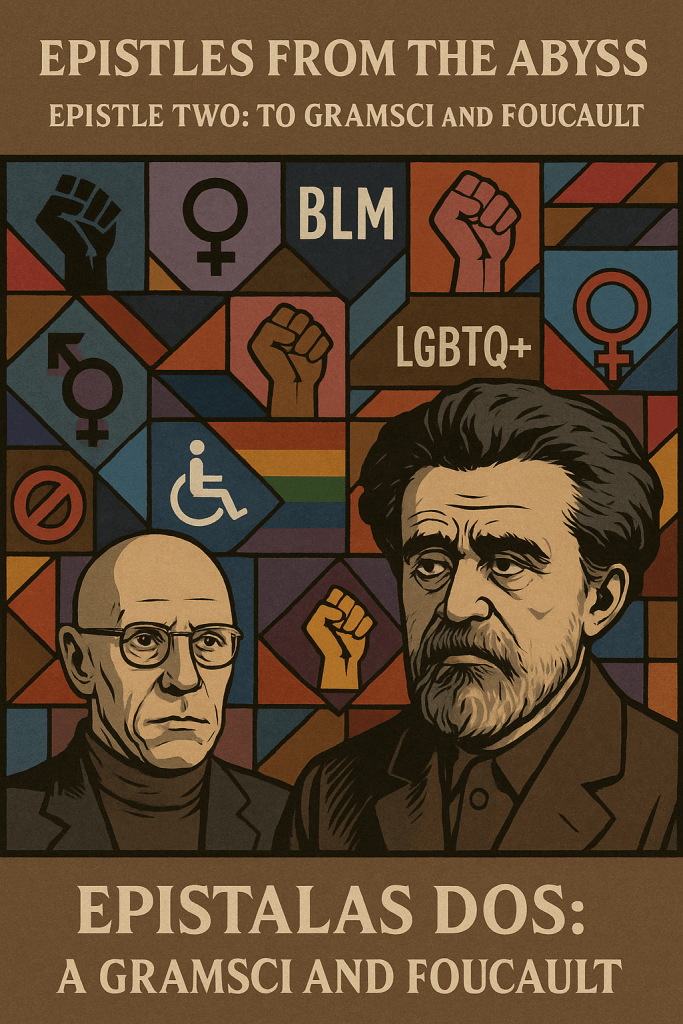
Desde un mundo donde ya no hay sujeto, ni historia, ni sentido
Israel Centeno
Estimados Antonio y Michel:
Les escribo desde una época donde sus ideas han triunfado… y han fracasado. Donde sus nombres sobreviven no como teoría crítica, sino como dogma institucional. Donde la hegemonía cultural que soñó uno, y la disolución del sujeto que teorizó el otro, se han conjugado para producir no una liberación, sino un mundo ininteligible. Un campo minado de identidades, de pronombres, de constructos que exigen obediencia.
Antonio, tú nos advertiste que la batalla no era solo económica, sino simbólica. Que el poder no se ganaba con tanques, sino con escuelas, medios, universidades, literatura, arte. Que la cultura era el campo de batalla verdadero. Y tenías razón. La hegemonía no solo fue disputada: fue conquistada. Pero no para edificar una civilización del obrero, sino para instaurar una nueva élite, un nuevo clero que vigila el lenguaje, censura la tradición y excomulga al disidente.
Esa hegemonía cultural fue utilizada para fragmentar, desde las universidades, desde los centros educativos, desde el discurso de la élite intelectual. Con Foucault, ese proceso adquiere un carácter más radical: ya no se trata solo de cuestionar al poder, sino de disolver los fundamentos mismos del sujeto. Su bisturí filosófico abrió las entrañas del discurso moderno, pero también liberó un virus: ahora, toda afirmación es sospechosa, toda convicción es opresión, toda identidad es política. Y no hay cura para tanto escepticismo.
Aquí estamos, entre los fragmentos. Ya no hablamos de proletariado y burguesía. Hablamos de siglas, de géneros, de intersecciones. Cada quien es una minoría. Cada uno es un marginado. El poder ya no es un bloque: es una nube. Y sin embargo, sigue oprimiendo. Lo que fue la lucha de clases se ha convertido en una guerra de identidades irreconciliables. La emoción que prevalece no es la esperanza de justicia, sino el resentimiento. Del odio de clases al resentimiento. Del resentimiento al odio a secas.
Michel, tú dijiste que el sujeto era una ficción. Que el poder se infiltraba en los cuerpos, en los saberes, en las instituciones. Que la verdad era una construcción. Todo eso fue tomado como evangelio por generaciones de académicos que no han leído otra cosa que no sea la genealogía del poder. Y sin embargo, ese poder ha mutado. Ahora no se presenta como opresor, sino como liberador. No reprime: tutela. No niega: redefine.
La hegemonía cultural construyó nuevas ortodoxias. La disidencia ya no es revolucionaria: es anatema. El lenguaje ha sido vaciado de sentido. La justicia, privatizada por tribus simbólicas. Y la política, desplazada por una estética de la victimización perpetua.
Nos prometieron liberación. Nos dieron algoritmos que deciden lo que podemos decir. Nos ofrecieron justicia. Nos entregaron una vigilancia moral más rígida que cualquier inquisición.
Pero esta carta no termina aquí. Derrida espera su turno. El deconstructivismo fue la última capa. La que deshizo incluso la posibilidad de lo común. Pero esa será otra epístola.
Por ahora, basta con decirles esto: que del sueño de una cultura emancipadora ha nacido un mosaico imposible. Un caleidoscopio donde cada fragmento exige el centro. Donde ya no hay totalidad, ni diálogo, ni reconciliación posible. Solo partes. Y detrás de cada parte, una herida que no quiere sanar.
Desde este abismo de signos rotos,
un testigo del mundo que ayudaron a crear
Epistles from the Abyss
Epistle Two: To Gramsci and Foucault
From a world where there is no longer subject, nor history, nor meaning
Dear Antonio and Michel,
I write to you from a time in which your ideas have triumphed… and failed. Where your names endure not as critical theory, but as institutional dogma. Where the cultural hegemony envisioned by one, and the dissolution of the subject theorized by the other, have merged to produce not liberation, but unintelligibility. A minefield of identities, pronouns, and constructs demanding obedience.
Antonio, you warned us that the battle wasn’t only economic, but symbolic. That power wasn’t won through tanks, but through schools, media, universities, literature, and art. That culture was the true battlefield. And you were right. Hegemony wasn’t just contested—it was conquered. But not to build a civilization of workers. Instead, to install a new elite, a new clergy that polices language, censors tradition, and excommunicates dissent.
That cultural hegemony was weaponized to fragment—from the universities, from educational centers, from the discourse of the intellectual elite. With Foucault, that process took a more radical turn: it was no longer just about questioning power, but dissolving the very foundations of the subject. Your philosophical scalpel, Michel, opened the entrails of modern discourse—but it also unleashed a virus: now every assertion is suspect, every conviction is oppression, every identity is political. And there is no cure for such skepticism.
Here we are, among the fragments. We no longer speak of proletariat and bourgeoisie. We speak of acronyms, of genders, of intersections. Everyone is a minority. Everyone a victim. Power is no longer a block: it’s a cloud. And yet it still oppresses. What once was class struggle has become a war of irreconcilable identities. The dominant emotion is no longer hope for justice, but resentment. From class hatred to resentment. From resentment to hatred, plain and simple.
Michel, you told us the subject was a fiction. That power infiltrates bodies, knowledge, institutions. That truth is a construction. All of that was taken as gospel by generations of academics who have read nothing but genealogies of power. And yet power has mutated. Now it does not present itself as oppressor—but as liberator. It does not repress—it safeguards. It does not deny—it redefines.
Cultural hegemony built new orthodoxies. Dissent is no longer revolutionary—it is heresy. Language has been hollowed out. Justice, privatized by symbolic tribes. And politics, displaced by an aesthetic of perpetual victimhood.
We were promised liberation. We were given algorithms that decide what we may say. We were offered justice. We were handed a moral surveillance more rigid than any inquisition.
But this letter does not end here. Derrida awaits his turn. Deconstruction was the final layer—the one that unraveled even the possibility of the common. But that will be another epistle.
For now, it is enough to say this: that from the dream of an emancipatory culture has emerged an impossible mosaic. A kaleidoscope in which each fragment demands the center. Where there is no longer totality, nor dialogue, nor possible reconciliation. Only parts. And behind each part, a wound that refuses to heal.
From this abyss of broken signs,
a witness to the world you helped create.
 Israel Centeno Author
Leave a comment