
From the series: Modern and Fatigued Prometheuses
Israel Centeno
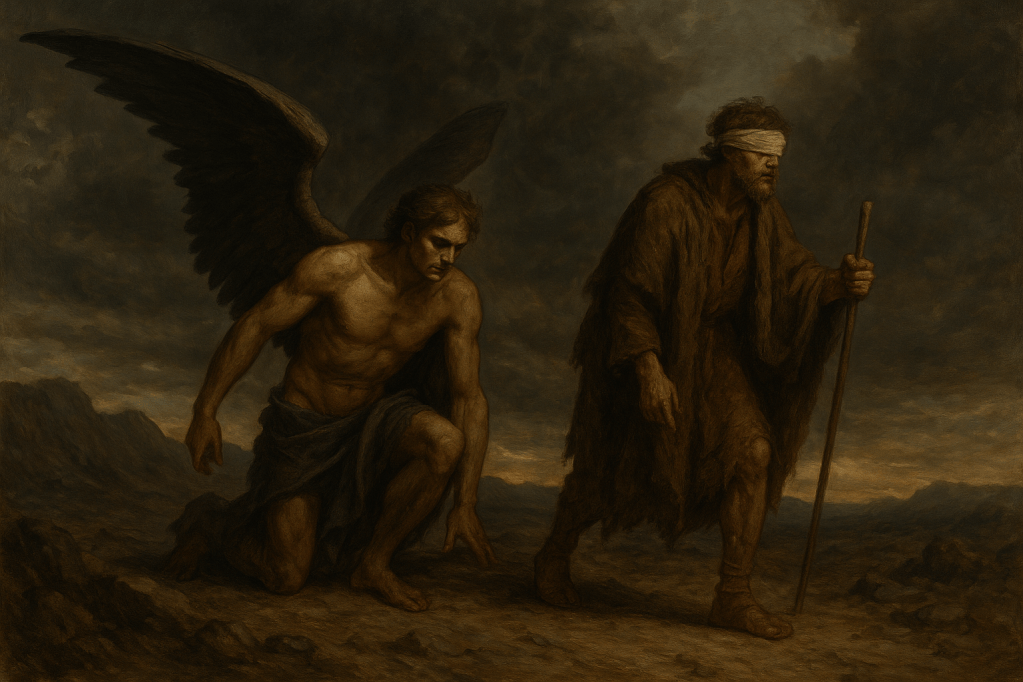
Or Truths That Contradict Themselves
“Science, if pursued earnestly, leads to God.”
—Edith Stein
“The most incomprehensible thing about the universe is that it is comprehensible.”
—Albert Einstein
I. Introduction: The Prometheus of Modern Thought
Roger Penrose is one of the last giants of modern science. A brilliant mathematician, a visionary physicist, and a 2020 Nobel laureate for his work on black holes and gravitational singularities, he helped shape the intellectual framework of contemporary cosmology. Yet in his final years, this towering figure has begun to contradict himself: he questions the foundations of quantum mechanics, revises his own views on the origin of the universe, and proposes a quantum theory of consciousness while resisting the notion of a spiritual soul.
Not out of superficiality, but perhaps because he has reached the limits of the method. He senses that there is a deeper order, that the universe cannot be the result of blind chaos. But rather than taking the leap into metaphysics, he remains suspended at the threshold, where his truths begin to fracture into contradictions.
This essay is not an attack on Penrose, but a meditation on the intellectual tensions he embodies. It is a tribute to his honesty — and a critique of his reluctance to step into the metaphysical light.
II. Two Incomplete Maps: Micro and Macro Without a Bridge
Modern physics stands on two foundational theories:
- General Relativity (Einstein, 1915): describes the universe at large scales — gravity, space-time curvature, black holes.
- Quantum Mechanics: describes the behavior of matter at subatomic levels — uncertainty, superposition, entanglement.
Each works exquisitely within its domain. But they do not reconcile. The search for a theory of “quantum gravity” — a unified framework — remains elusive.
Penrose has long criticized the standard Copenhagen interpretation of quantum mechanics, claiming that the collapse of the wavefunction must have an objective cause, not merely a probabilistic one. But he has not yet presented a full replacement theory, leaving the central chasm unresolved.
III. Consciousness: A Rift Science Cannot Cross
Penrose ventures even further when, with anesthesiologist Stuart Hameroff, he introduces the Orchestrated Objective Reduction (Orch-OR) theory — the idea that consciousness arises from quantum processes in the microtubules of the brain’s cytoskeleton.
Here arises a profound inconsistency:
- He rejects quantum mechanics as currently formulated.
- Yet he uses quantum mechanics to explain the most immaterial and mysterious phenomenon: human consciousness.
The theory, though imaginative, solves nothing. It introduces elements that are neither provable nor falsifiable, stepping outside the empirical method — without admitting the shift into metaphysics.
IV. What Physics Cannot Grasp: The Nature of the Soul
At the heart of the matter is this: consciousness is not matter.
It cannot be weighed, duplicated, or scanned. It cannot be broken down into subcomponents or reduced to probabilities. Consciousness is the act by which the self becomes aware of itself, remembers, judges, chooses, and creates.
I use my brain, yes.
But the thinker is not the brain.
It is the soul using the brain as an instrument.
No MRI scan will ever locate a moral conviction.
No particle accelerator will ever detect love, dignity, or hope.
Because these belong not to the world of mass and motion, but to the invisible realm of spirit.
V. Logic Is Not Matter
Here lies the essential paradox: to do science, one must think.
To think, one must use logic. And logic is not physical.
- It has no mass or charge.
- It is not made of particles.
- It cannot be located in space.
Logic — like grammar, syntax, symbols, mathematics — is an invisible architecture that shapes all reason. It is used in every scientific formula, but it belongs to the realm of metaphysics.
How then can physics, which depends on logic, explain the very mind that generates logic?
It is like trying to weigh a metaphor.
Or to photograph a decision.
Or to isolate a dream with a microscope.
VI. The Legitimate Horizon of Science
Science can say, honestly:
“There exists a being — the human —
that transcends the animal.
Who uses the body but is not reducible to it.
Who thinks, narrates, chooses, and loves.”
That is its noble threshold.
But if science tries to explain this being as pure matter, it betrays itself.
It uses material tools to examine what is not material.
VII. God and the Limits of Method
God cannot be proven scientifically.
But He cannot be ruled out either.
Because God is not a hypothesis among others.
He is the foundation of being, the ultimate Reason, the Logos.
Einstein sensed this with humility:
“The eternal mystery of the world is its comprehensibility.”
“I want to know how God created this world. The rest is detail.”
He also referred to the low entropy at the origin of the universe as the “fingerprint of God” — a mysterious order too precise to be accidental.
Edith Stein, philosopher, mystic, and martyr, wrote:
“Science, if pursued earnestly, leads to God. And it has led many to the doorstep of faith.”
VIII. The Soul Cannot Be Split
What Penrose shows us, perhaps unintentionally, is the limit of naturalism.
The point at which physics becomes myth — or worse, theology without God.
Because:
- The soul cannot be split.
- The will cannot be measured.
- Consciousness cannot be engineered.
To explain the soul as if it were a particle is to reduce man to mechanism.
And to explain freedom without spirit is to turn the human being into an illusion.
At some point, the scientist must remove the lab coat
and enter barefoot into the sanctuary of mystery.
IX. Epilogue: When Thought Becomes Prayer
There is a kind of thought that ends not in formula, but in adoration.
Edith Stein knew it. Einstein suspected it.
Even Penrose, in his own way, stands at its edge.
If the universe is intelligible, then there is a Logos.
And if there is Logos, then consciousness is not an accident,
but a summons.
And if there is a summons,
there is Someone who calls.
And that Someone, though beyond proof,
is more real than all proofs,
for He is the very source of reason, love, and being.
“Real thinking does not end in formulae, but in contemplation.”
—Simone Weil
📚 References
- Penrose, Roger. The Emperor’s New Mind. Oxford University Press, 1989.
- Penrose, Roger & Hameroff, Stuart. Consciousness in the Universe: Neuroscience, Quantum Space-Time Geometry and Orch-OR Theory. Journal of Cosmology, 2011.
- Stein, Edith. The Science of the Cross. ICS Publications, 2002.
- Einstein, Albert. The World As I See It. Philosophical Library, 1949.
- Weil, Simone. Gravity and Grace. Routledge, 2002.
 Israel Centeno Author
Leave a comment