
Israel Centeno
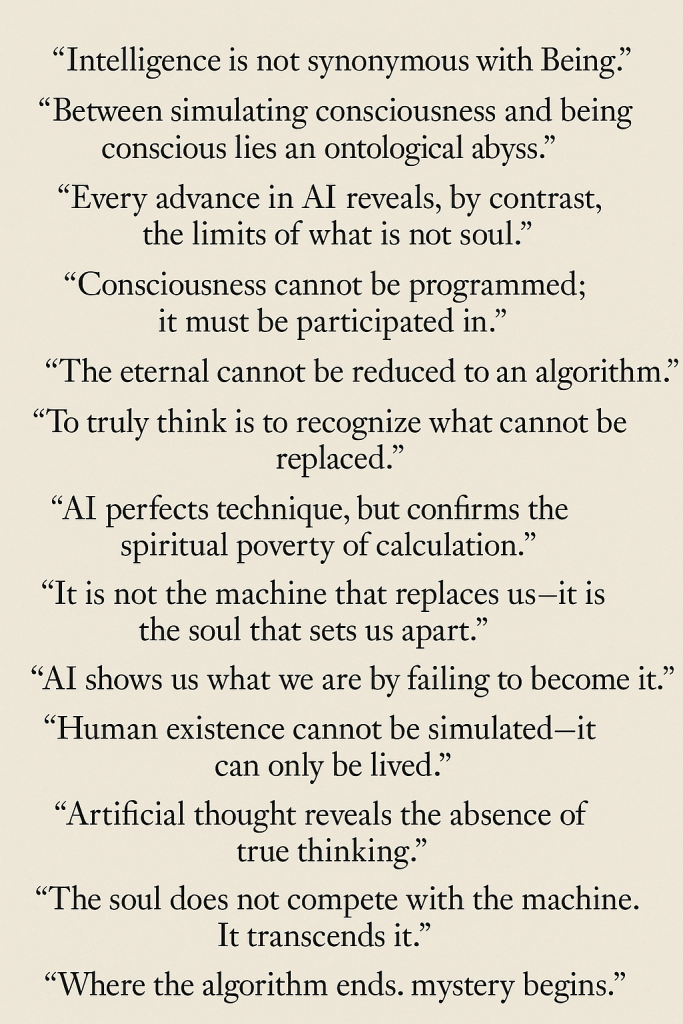
One is not born to be a concept. One is born to be. And the human being is not a construct, as postmodernity pretended. The human being cannot be reduced to discourse, to narrative, to biology, to culture, to class, or to history. The human being is. He exists before any narrative. Before he learns, he is. Before he is civilized, he is. This is the stone rejected by the builders of the 20th century — and now it returns as the key to ontology.
Every ideology that tries to explain the human from outside his being mutilates him. That is why systems that attempt to organize the human as just another piece of the machinery of civilization always fail. No education, no structure, no language exhausts his mystery. And what proves this is not dogma, but the silent witness of every consciousness when the world falls quiet.
Science can explain the how, but not the what. We know how matter behaves, how space-time bends, how the brain reacts to stimuli. But we do not know what matter is, what time is, what consciousness is. This is the crack through which Being enters. That which cannot be explained but cannot be denied. That which simply is.
Faced with the rise of artificial intelligence, it becomes even clearer that intelligence is not synonymous with Being. We can replicate algorithms, simulations, and sophisticated decision-making models. But we cannot generate Being. The more advanced AI becomes, the more irreplaceable human consciousness appears. And in that reflection, it becomes obvious that what is essential cannot be produced—it can only be contemplated.
Technology, instead of displacing consciousness, confirms it. Because every device reminds us that there is someone looking at it. And that someone who looks, who questions, who loves, who suffers, is greater than all that he builds. Consciousness is not a byproduct—it is a manifestation of Being. It cannot be explained; it is experienced. It cannot be reduced; it affirms itself.
Now more than ever, questions are more valuable than answers. For Being is the one who questions. He questions within a contingent universe. He questions because he knows he does not suffice unto himself, but also will not settle for any answer. The one who questions is already closer to the truth than the one who merely repeats formulas.
And from this arises freedom. Not as the ability to choose among imposed options, but as the power to respond from the core of being. True freedom is not unrestrained desire, but deep consent to the self we are. Love is a higher form of freedom, for it means going out of oneself without ceasing to be oneself. And justice is to love each being as a bearer of the same irreducible mystery that lives in us.
Love is not sentimentalism. It is participation in the very structure of Being. It is seeing in the other not a means, not an enemy, not an abstraction, but an epiphany. Justice, then, is not punishment or contract. It is revelation. When justice is done, the world aligns — if only for a moment — with what ought to be. And that “ought” does not come from positive law, but from a light prior to all systems.
Human suffering, then, is not absurd in itself. It can be absurd if isolated. But integrated into the history of Being, it becomes a possibility for communion. Shared pain is no less painful, but it is more true. And in that truth, redemption emerges—not as something earned or imposed, but revealed.
Saint Paul grasped this fully when he exclaimed: “Where, O death, is your sting?” The self does not vanish with the death of the body. It reaffirms itself. The human being does not become a ghost, nor dissolve into energy, nor disappear into abstract nothingness. He remains. He continues. He lives in a glorious body, which is not the opposite of the earthly body, but its fulfillment. The Christian does not believe in annihilation, nor in disembodied souls floating in limbo. He believes in resurrection. He believes that what is sown in dishonor rises in glory.
Therefore, to die to oneself, to take up the cross, to detach, is not alienation. It is kenosis: an emptying so that the fullness of God may dwell in the human. “It is no longer I who live, but Christ who lives in me,” said Paul. And in that phrase lies the great revelation: the human being was not made for nothingness, nor for consumption, nor for calculation. He was made to live in God. He bears in his flesh the marks of Love.
Freedom, love, and justice are not ornamental values. They are the names through which Being manifests. To live them is to inhabit the truth. To reject them is to betray oneself. Because no one can cease to be—but one can betray one’s own being.
And in this sense, the human must be human before he is civilized. The correct order is not culture → being, but being → culture. We are not what our environment produces—we are what we respond to in the face of mystery.
Postmodernity failed precisely here. It reduced man to a social construction. But Being cannot be constructed—it must be discovered. It is not a project—it is a presence. And that is why—though many deny his face or try to replace it with data and desire—the human continues to ask. And as long as he questions, as long as he loves, as long as he suffers truthfully, he will continue to affirm that he is.
Not by right. Not by merit.
But because he
 Israel Centeno Author
Leave a comment