
Israel Centeno
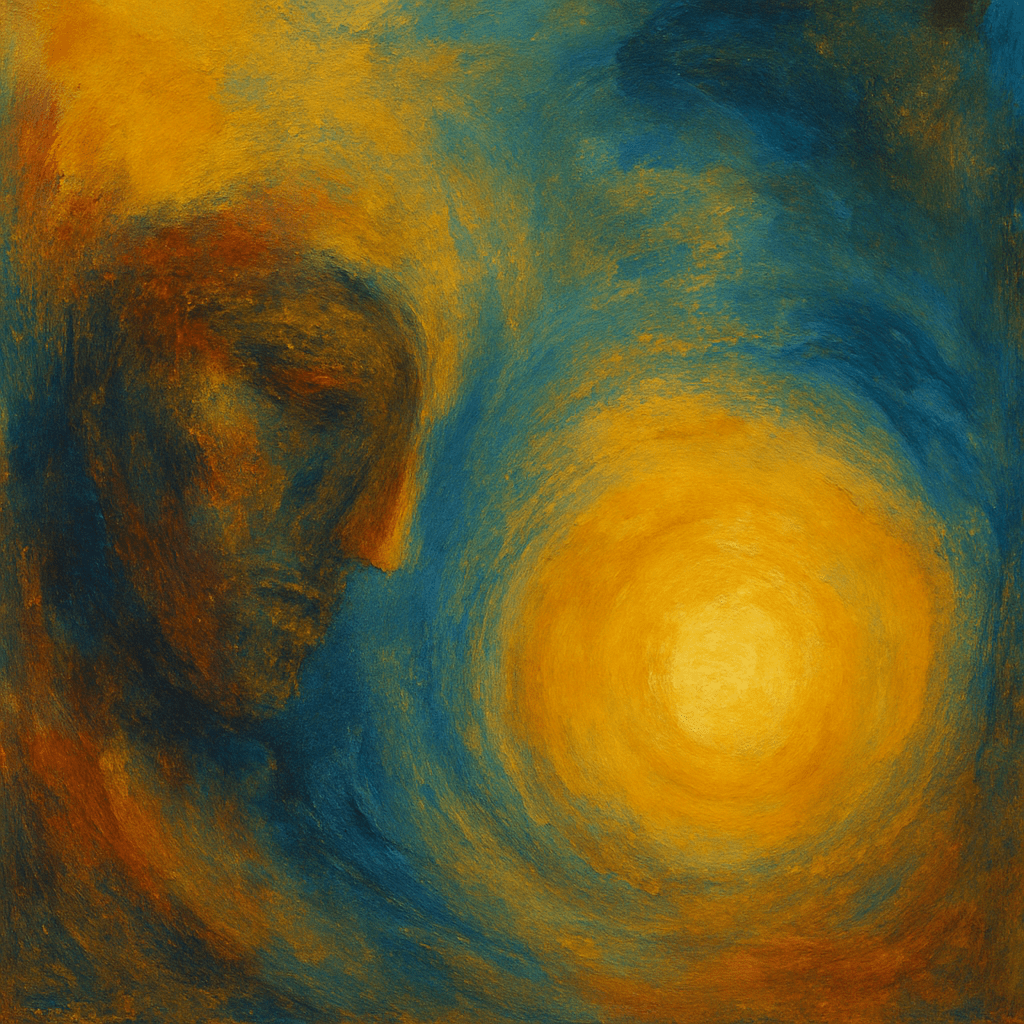
In the eighth revelation of Revelations of Divine Love, Julian of Norwich contemplates the face of Christ in His agony. She sees it disfigured, covered in blood and pain, yet with no trace of anger. In His gaze there is only compassion, tenderness, and an ardent desire to save. For Julian, the blood is not a symbol of defeat but of life; every drop speaks of a love that gives itself without reserve. This suffering and victorious Christ does not accuse, does not reproach—He embraces. The vision leads her to a conviction radical for her time—and for ours: in God there is no wrath, but constant love, even in the face of the gravest sin.
This intuition, born in the silence of a medieval cell, would echo centuries later in the pages of Saint Faustina Kowalska’s Diary. There, the Heart of Jesus opens as an ocean of mercy that reaches everyone, without excluding anyone, but which calls for a free response: trust and repentance. In Julian and Faustina, mercy is not a vague feeling or a philosophical concept; it is Christ Himself, the eternal Son of the Father, who gives Himself to reconcile the world to God.
Here lies a distinction that is more necessary than ever today. Their message is not indiscriminate universalism. Both mystics affirm that God’s love is greater than any sin, but they never dilute the core of Christianity: the Incarnation, the Cross, and the Resurrection. In their vision, there is no place for a “universal Christ” interchangeable with Buddha, Krishna, or some anonymous sage; their Christ is unique, historical, and eternal.
When I first approached the Christian mystics in the United States, I found a compelling path through authors like Thomas Merton and Thomas Keating. There was a genuine depth there, a rootedness in the Christian contemplative tradition that could engage the modern mind without losing its soul. But gradually, after these key figures of American Christian contemplation passed away, I began to see how the movement they had inspired was being replaced by something the age and the world seemed to demand—a spirituality blending East and West, often moving further away from the Catholic tradition, and indeed from any serious, orthodox Christian tradition, even among other denominations. What had been born as a renewal within Christianity risked dissolving into a generic spiritual movement, detached from the living core of the faith.
In our own day, within certain “contemplative spirituality” circles, there is a dangerous drift. Beginning with a legitimate thirst for silence and prayer, some end by replacing the Christian confession with a faceless, crossless “non-duality” in which Jesus becomes just one more “enlightened master.” Center for Action and Contemplation describes it clearly: this is not an expansion of faith, but its deconstruction. What remains is no longer the living Trinity, but an amalgam of “gods,” “forces,” or “universal energies.”
This emptying strikes above all at the second Person of the Trinity. When the Son, the eternal Word, is diluted, the Trinity itself dissolves into a vague pantheon. And without the Logos—as understood in the Christian tradition, the source of all life and reality—there is no Christianity, only pantheism or panentheism that loses the historical revelation. “In the beginning was the Logos” does not mean that “everything” is indistinctly the Logos; it means that all was created through Him and for Him.
The Christocentrism of Julian and Faustina is, by contrast, clear and non-negotiable. It recognizes human diversity but calls to conversion: “The Kingdom of Heaven is near” is not a soothing metaphor, but the proclamation that “I am the Way, the Truth, and the Life; no one comes to the Father except through Me.” The mercy they announce has a name and a face: Jesus Christ, the Son of the living God. It is not a cosmic energy, but the blood shed to reconcile the world to the Father.
In an age when the Antichrist no longer comes cursing Jesus, but imitating and rewriting Him, stripping Him of His rank as the eternal Word and placing Him alongside figures whose existence or teaching lacks historical proof, the witness of Julian and Faustina reminds us that authentic Christian contemplation does not dilute Christ but places Him at the center. Their visions invite us not to dissolve into the impersonal, but to be inhabited by the “Christ-self” that heals the fracture of being—what the tradition calls original sin.
Today, more than ever, we need this clarity: no pantheism, no panentheism, no superficial mysticism. Only the encounter with the incarnate Logos, the Lamb who was slain and is risen, can turn pain into peace, the wound into glory, and human history into eternal communion with God.
El rostro de la misericordia: Julian de Norwich, Santa Faustina y el desafío del cristianismo contemporáneo
En la octava revelación de Revelaciones del divino amor, Julian de Norwich contempla el rostro de Cristo en su agonía. Lo ve desfigurado, cubierto de sangre y dolor, pero sin rastro de ira. En su mirada sólo hay compasión, ternura y un ardiente deseo de salvar. Para Julian, la sangre no es signo de derrota, sino de vida; cada gota habla de un amor que se entrega sin reservas. Ese Cristo sufriente y, al mismo tiempo, victorioso no acusa ni reprocha: abraza. La visión la conduce a una certeza radical para su época —y para la nuestra—: en Dios no hay cólera, sino amor constante, incluso frente al pecado más grave.
Esta intuición, nacida en el silencio de una celda medieval, resonará siglos después en las páginas del Diario de Santa Faustina Kowalska. Allí, el Corazón de Jesús se abre como un océano de misericordia que alcanza a todos, sin excluir a nadie, pero que reclama una respuesta libre: la confianza y el arrepentimiento. En Julian y Faustina, la misericordia no es un sentimiento vago ni un concepto filosófico, sino Cristo mismo, Hijo eterno del Padre, que se entrega para reconciliar al mundo con Dios.
Aquí radica una distinción que hoy es más necesaria que nunca. Su mensaje no es un universalismo indiferenciado. Ambas místicas afirman que el amor de Dios es más grande que cualquier pecado, pero nunca diluyen el núcleo del cristianismo: la encarnación, la cruz y la resurrección. En su visión no hay lugar para un “Cristo universal” intercambiable con Buda, Krishna o algún maestro anónimo; su Cristo es único, histórico y eterno.
Cuando me acerqué por primera vez a los místicos cristianos en Estados Unidos, encontré un camino apasionante a través de autores como Thomas Merton Thomas Keating. Había en ellos una profundidad auténtica, un arraigo en la tradición contemplativa cristiana que podía dialogar con el mundo moderno sin perder su alma. Pero poco a poco, tras la muerte de estas figuras centrales de la contemplación cristiana americana, comencé a ver cómo el movimiento que habían inspirado era sustituido por algo que la época y el mundo parecían exigir: una espiritualidad que mezclaba Oriente y Occidente, alejándose cada vez más de la tradición católica y de cualquier tradición cristiana seria, ortodoxa, incluso en otras denominaciones. Lo que había nacido como una renovación dentro del cristianismo corría el riesgo de disolverse en un movimiento espiritual genérico, desconectado del núcleo vivo de la fe.
En nuestros días, en ciertos ámbitos de “espiritualidad contemplativa”, se da una deriva peligrosa. Partiendo de una legítima sed de silencio y oración, algunos terminan reemplazando la confesión cristiana por una “no-dualidad” sin rostro ni cruz, donde Jesús se convierte en un maestro iluminado más. The Center for Action and Contemplation lo describe con claridad: no es una expansión de la fe, sino su deconstrucción. Lo que queda ya no es la Trinidad viva, sino una amalgama de “dioses”, “fuerzas” o “energías” universales.
Este vaciamiento golpea sobre todo a la segunda Persona de la Trinidad. Cuando se diluye el Hijo, el Verbo eterno, la misma Trinidad se desfigura hasta convertirse en un panteón difuso. Y sin el Logos —tal como lo entendió la tradición cristiana: fuente de toda vida y de toda realidad— no hay cristianismo, sólo panteísmo o panenteísmo que pierde la revelación histórica. “En el principio era el Logos” no significa que “todo” sea indistintamente el Logos, sino que todo fue creado por Él y para Él.
El cristocentrismo de Julian y Faustina, en cambio, es claro y no negociable. Reconoce la diversidad humana, pero llama a la conversión: “El Reino de los Cielos está cerca” no es una metáfora complaciente, sino la proclamación de que “Yo soy el Camino, la Verdad y la Vida; nadie va al Padre sino por mí”. La misericordia que anuncian tiene un nombre y un rostro: Jesucristo, Hijo de Dios vivo. No es una energía cósmica, sino la sangre derramada para reconciliar al mundo con el Padre.
En una época en que el anticristo ya no viene maldiciendo a Jesús, sino imitándolo y reescribiéndolo, quitándole su rango de Verbo eterno y poniéndolo al lado de figuras cuya existencia o enseñanza carecen de pruebas históricas, el testimonio de Julian y Faustina nos recuerda que la auténtica contemplación cristiana no diluye a Cristo, sino que lo coloca en el centro. Sus visiones no nos invitan a disolvernos en lo impersonal, sino a dejarnos habitar por el “Cristo-self” que sana la fractura del ser, esa herida que la tradición llama pecado original.
Hoy, más que nunca, necesitamos esta claridad: ni panteísmo, ni panenteísmo, ni misticismo superficial. Sólo el encuentro con el Logos encarnado, el Cordero inmolado y resucitado, puede convertir el dolor en paz, la herida en gloria y la historia humana en comunión eterna con Dios.
 Israel Centeno Author
Leave a comment