
Israel Centeno
English and Spanish version
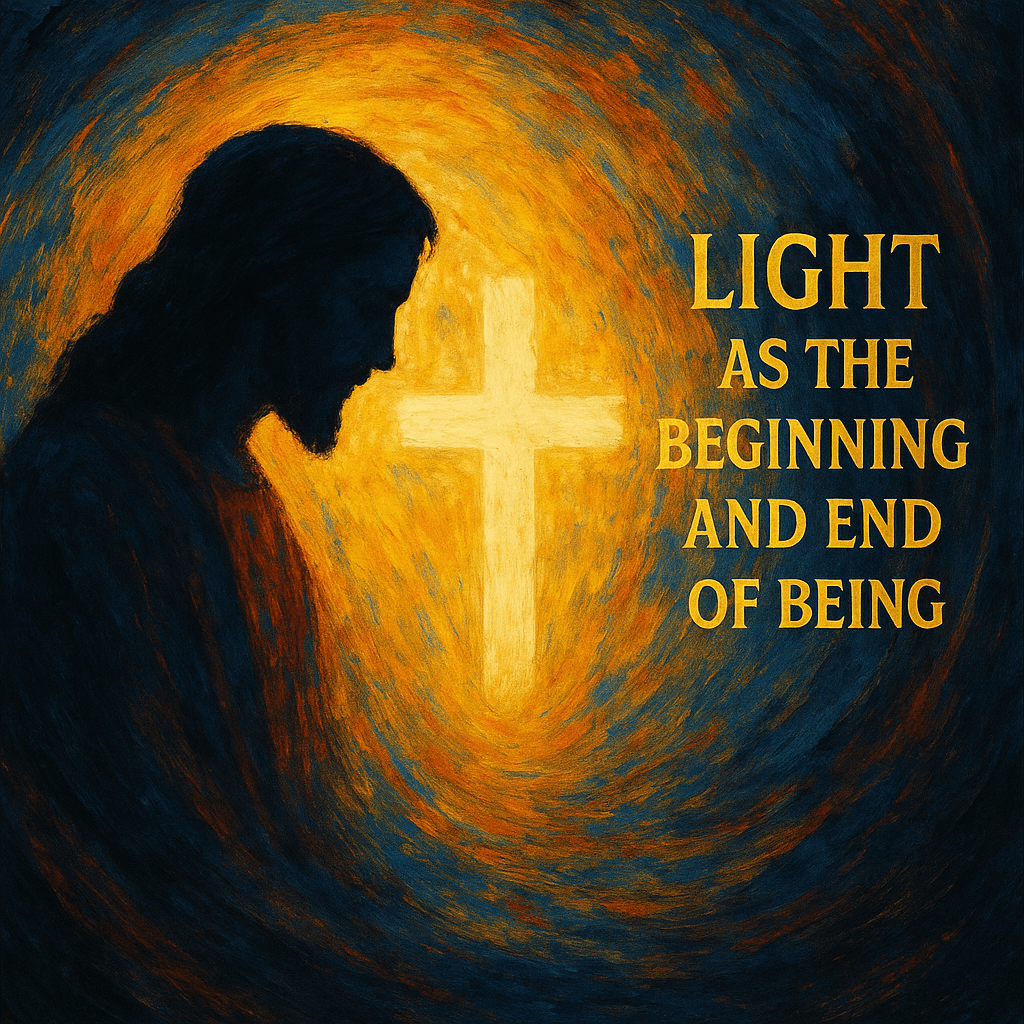
The prologue of the Gospel of John is perhaps one of the most sublime texts in all of Scripture: “In the beginning was the Word… in Him was life, and the life was the light of men. The light shines in the darkness, and the darkness has not overcome it” (Jn 1:1,4–5). Here the Christian faith recognizes not merely a symbol, but an ontological truth: Christ is the Light.
Modern physics offers us an intuition which, far from contradicting, seems to resonate with this mystery. Light—in its physical reality, photons—is that which does not experience time as we know it. At the speed of light there is no succession of instants; there is no “before” and “after.” In some sense, one touches an eternal present. Theology names this eternity: an absolute now, without measure or decay.
When John proclaims that Christ is the Light of the world, he is affirming that in Him the eternal now of God has broken into history. Whoever receives this Light enters already into contact with the eternal. Whoever turns away from it remains in darkness, which is death. There is no third realm—no gray between light and shadow—for all that has been created is ordered toward the Light. All was created by the Light and for the Light. What does not participate in it is not another principle, but nothingness. Darkness is not an opposing force; it is the radical absence of that which gives existence.
For this reason, the ultimate end of human life can be nothing other than to enter into the Light. The Incarnation is precisely this: the eternal Light made flesh, the Word who assumed our temporality to open for us the way into eternity. As John says: “The true light that enlightens every man was coming into the world” (Jn 1:9). The destiny of all existence is not dispersion but irradiation; not decline, but consummation in clarity. The entire universe, with its galaxies and its silences, was created for the Light. And the history of every person, with its wounds and longings, finds its final horizon in that radiance which does not fade.
This is why the Apocalypse proclaims: “I am the Alpha and the Omega, the first and the last, the beginning and the end” (Rev 22:13). Alpha and Omega are not mere letters: they are the whole alphabet of creation, the origin and its fulfillment. To say this is to affirm that in Christ all begins and all reaches completion; that in Him there is no unfolding of time, but the eternal now where God Himself declares: “Here I am; I made all things, and you may live here with Me.”
This invitation is a call to love. Yet here love is not a fleeting passion, but a free act of the will: the decision to choose the true Light. It is not to love the brightness streaming through my window, nor the artificial brilliance the world produces and extinguishes, but to love the Light with a capital L, Christ incarnate, who asks us to live as He lived—humble, compassionate, obedient to the Father.
But illusions abound. There are lights which are not light, fleeting glimmers crafted by finite means for finite ends. They captivate and enslave. Behind them lies a prince—the prince of this world—whose reign is illusion and shadow. The soul, placed before this choice, hears the inner call: either choose the Light that never fades, or surrender to the shadow of the mirage.
The mystics knew this well. St. John of the Cross spoke of the “Living Flame of Love,” the Light that burns without consuming, that transforms the beloved into itself. St. Teresa of Ávila wrote of the “most interior light” that expands and dilates the soul within its dwelling. There, in the innermost depths, the Light does not dazzle but kindles; it does not annihilate but recreates.
In Christ, the incarnate Light, the Alpha and the Omega, humanity discovers the path into God’s eternal now. Eternity is not endless time, but the fullness of life in the Light. And to love this Light is already to begin to inhabit eternity within time.
La Luz como Principio y Fin del Ser
El prólogo del Evangelio de Juan es, quizá, uno de los textos más sublimes de toda la Escritura: “En el principio era el Verbo… en Él estaba la vida, y la vida era la luz de los hombres. La luz brilla en las tinieblas, y las tinieblas no la vencieron” (Jn 1,1.4-5). Aquí la fe cristiana reconoce no sólo un símbolo, sino una verdad ontológica: Cristo es la Luz.
La física moderna nos ofrece una intuición que, lejos de contradecir, parece resonar con este misterio. La luz —en su realidad física, los fotones— es aquello que no conoce el tiempo tal como lo conocemos nosotros. A la velocidad de la luz no hay sucesión de instantes; no existe un “antes” y un “después”. Se toca, en cierto modo, un eterno presente. La teología llama a esto la eternidad: un ahora absoluto, sin medida ni caducidad.
Cuando Juan proclama que Cristo es la luz del mundo, lo que está afirmando es que en Él ha irrumpido en la historia ese eterno ahora de Dios. Quien recibe esa luz entra ya en contacto con lo eterno. Quien se aparta de ella queda en tinieblas, es decir, en la muerte. No se trata de que haya un tercer espacio —un gris entre la luz y las tinieblas—, sino de que todo lo creado está ordenado hacia la luz. Todo fue creado por la luz y para la luz, y lo que no participa de ella no es que esté en otra categoría, sino que está en la nada. La oscuridad no es un principio opuesto, sino la ausencia radical de lo que da existencia.
Por eso, el fin último de la vida humana no puede ser otro que entrar en la luz. La Encarnación es precisamente esto: que la Luz eterna se hizo carne, que el Verbo asumió nuestra temporalidad para abrirnos la entrada en la eternidad. Como dice Juan: “La luz verdadera, que ilumina a todo hombre, venía al mundo” (Jn 1,9). El destino de toda existencia no es la dispersión, sino la irradiación; no es el ocaso, sino la consumación en la claridad. El universo entero, con sus galaxias y sus silencios, fue creado para la luz. Y la historia de cada persona, con sus búsquedas y heridas, tiene como último horizonte ese resplandor que no se apaga.
De aquí se entiende también lo que proclama el Apocalipsis: “Yo soy el Alfa y la Omega, el primero y el último, el principio y el fin” (Ap 22,13). Alfa y Omega no son solo letras: son el alfabeto entero de la creación, el principio y el fin en una sola presencia. Decir esto es afirmar que en Cristo todo comienza y todo culmina; que en Él no hay tiempo desplegado, sino un eterno ahora en el que Dios mismo declara: “Aquí estoy; yo hice todas las cosas, y tú puedes vivir aquí conmigo”.
Esa invitación es un llamado al amor. Pero el amor aquí no es emoción pasajera, sino acto libre de la voluntad: un decidirse por la Luz verdadera. No se trata de amar la claridad que se filtra por la ventana, ni los destellos finitos del mundo, sino de amar a la Luz con mayúscula, Cristo encarnado, que pide de nosotros un comportamiento semejante al suyo: humildad, compasión, obediencia al Padre.
Los espejismos abundan: hay luces que no son luz, fulgores que fascinan y esclavizan. Tras ellos se esconde un príncipe —el príncipe de este mundo—, cuyo reino es la ilusión y la tiniebla. El alma, puesta ante esta disyuntiva, escucha el llamado interior: o eliges la Luz que no declina, o te entregas a la sombra del espejismo.
Los místicos han visto en este llamado la consumación del alma. San Juan de la Cruz lo expresó en su Llama de amor viva: la Luz que incendia sin consumir, que transforma en sí misma al amado. Teresa habló de la “luz tan interior” que ensancha y dilata el alma en su morada. Allí, la Luz no deslumbra, sino que enciende; no destruye, sino que recrea.
En Cristo, Luz encarnada, Alfa y Omega, el ser humano encuentra el acceso al eterno ahora de Dios. La eternidad no es un tiempo sin fin, sino la plenitud de la vida en la Luz. Y amar esa Luz es comenzar a habitar ya la eternidad en medio del tiempo.
 Israel Centeno Author
Leave a comment