
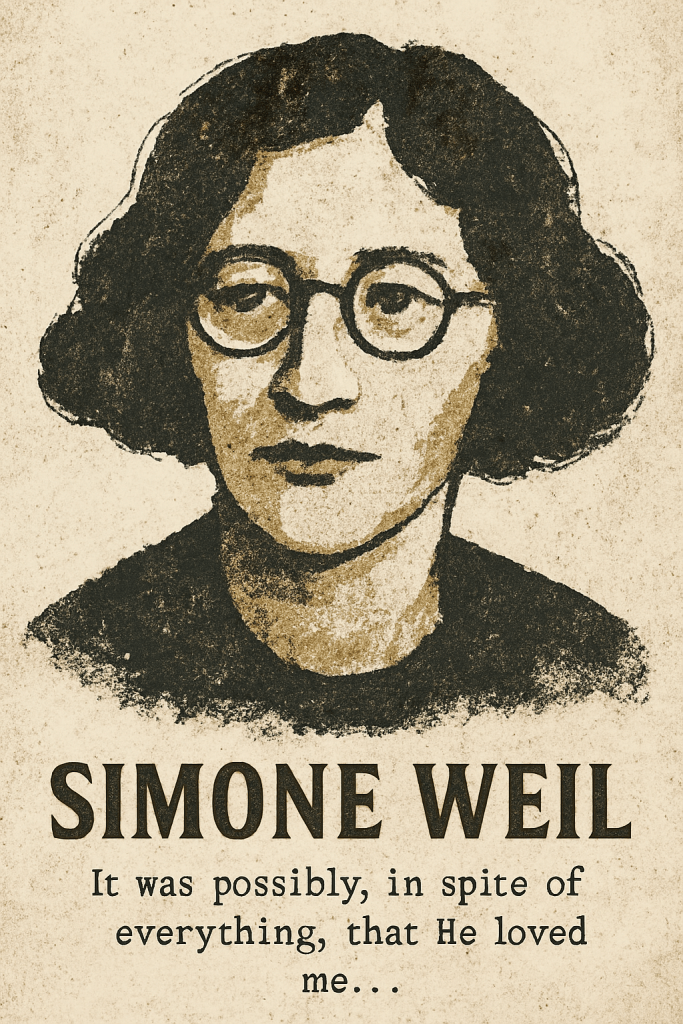
A singular testimony: that of a woman of whom, unanimously, it was said she was incapable of lying.
Her words carried the weight of naked truth, without adornment or artifice. She did not seek to persuade or embellish; she simply recounted what she had lived, with the transparency of one who knew neither calculation nor convenience.
In her encounter with the divine, every phrase she left written —or spoken to the few who could hear her— bears the force of the irrefutable. Not because it was clothed in authority, but because it sprang from a radical purity: the incapacity to falsify.
To such a voice, nothing can be added. One can only receive it with reverence, with the certainty that here speaks truth that burns, truth that unsettles, truth that illuminates.
imone Weil Encounters Jesus
“Perhaps, in spite of everything, he does love me.”
He entered my room and said:
“You poor wretch, who understand nothing and know nothing – come with me and I will teach you of things you have no idea of.”
I followed him.
He led me into a church. It was new and ugly. He brought me before the altar and said: “Kneel.”
I replied: “I have not been baptized.”
He answered: “Fall down on your knees before this place, with love, as before the place where truth exists.”
And I obeyed.
He took me then to a garret, from whose window the whole town could be seen: scaffoldings, the river where boats were unloading. He made me sit down.
We were alone. He spoke, and sometimes others entered for a moment, joining in the conversation before leaving again.
It was no longer winter; not yet spring. Bare branches stretched in a cold air full of sunlight. The light rose, brightened, faded; then the stars and the moon appeared. Again the dawn returned.
At times he would bring bread from a cupboard, and we shared it. That bread truly had the taste of bread. I have never tasted it again.
He poured us wine, which carried the taste of the sun and the soil on which the city stood. Sometimes we lay on the wooden floor, and the sweetness of sleep descended on me. Then I awoke, and drank the light of the sun.
He had promised to teach me, but he taught me nothing. We talked in a rambling way, as old friends do.
One day he said: “Now go away.”
I fell at his knees, clinging, begging him not to send me off. But he pushed me out toward the stairs. I descended as if unconscious, my heart torn to shreds. I walked through the streets, realizing I no longer knew where that house was.
I never tried to find it again. He had come for me by mistake. My place was not in that garret. My place was anywhere else: in a prison cell, a bourgeois parlor full of trinkets, a station waiting room. Anywhere—but not in that garret.
And yet, sometimes, words of his return to me. I repeat them with fear, never sure if I remember them rightly. He is not here to confirm them.
I know well that he does not love me. How could he love me?
And yet, deep within me, something trembles with the thought—
that perhaps, in spite of everything, he does.
Simone Weil se encuentra con Jesús
«Quizá, a pesar de todo, él me ame.»
Entró en mi habitación y me dijo:
«Pobre desdichada, que no entiendes nada y nada sabes. Ven conmigo, y te enseñaré cosas de las que no tienes idea.»
Y lo seguí.
Me condujo a una iglesia. Era nueva y fea. Me llevó ante el altar y dijo: «Arrodíllate.»
Yo respondí: «No he sido bautizada.»
Él contestó: «Póstrate aquí, con amor, como ante el lugar donde habita la verdad.»
Y obedecí.
Luego me llevó a un desván, desde cuya ventana abierta se veía la ciudad entera: andamios de madera, el río donde descargaban los barcos. Me hizo sentar.
Estábamos solos. Él hablaba, y a veces alguien entraba, se unía un instante a la conversación, y luego se marchaba.
Ya no era invierno; tampoco aún primavera. Las ramas de los árboles estaban desnudas, sin brotes, en un aire frío lleno de sol. La luz crecía, brillaba, luego se apagaba; aparecían la luna y las estrellas. Y de nuevo volvía el amanecer.
A veces sacaba pan de un armario y lo compartía conmigo. Ese pan sabía verdaderamente a pan. Nunca más he vuelto a encontrar ese sabor.
Vertía vino para mí y para él, vino con el gusto del sol y de la tierra sobre la que estaba construida la ciudad. A veces nos tendíamos sobre el suelo de madera, y la dulzura del sueño descendía sobre mí. Luego despertaba y bebía la luz del sol.
Me había prometido enseñanza, pero no me enseñó nada. Hablábamos sin rumbo fijo, de mil cosas, como viejos amigos.
Un día me dijo: «Ahora vete.»
Caí a sus pies, lo abracé, le supliqué que no me echara. Pero me arrojó hacia la escalera. Bajé como sin conciencia, con el corazón hecho pedazos. Caminé por las calles y comprendí que ya no sabía dónde estaba aquella casa.
Nunca intenté volver a encontrarla. Comprendí que había venido a buscarme por error. Mi lugar no estaba en aquel desván. Mi lugar estaba en cualquier otro sitio: en una celda de prisión, en un salón burgués lleno de baratijas y terciopelo rojo, en la sala de espera de una estación. En cualquier parte, menos en aquel desván.
Y, sin embargo, a veces me sorprendo repitiendo, con temor y compunción, alguna de sus palabras. ¿Cómo saber si las recuerdo fielmente? Él no está para decírmelo.
Sé bien que no me ama. ¿Cómo podría amarme?
Y sin embargo, hay algo profundo en mí, un punto de mi ser, que no puede dejar de pensar, con miedo y temblor, que quizá, a pesar de todo… él me ame.
Fuente: Simone Weil, Cuadernos (First and Last Notebooks), (Wipf and Stock, 2015), pp. 65–66.
 Israel Centeno Author
Leave a comment