
bilingual
🇺🇸🇪🇸
Israel Centeno
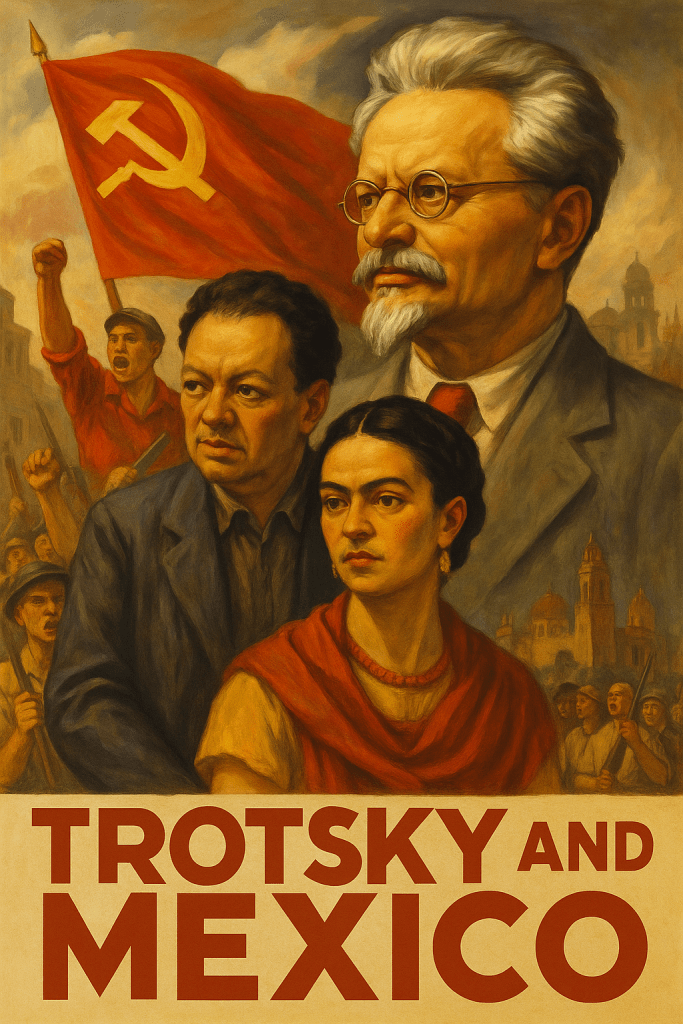
Los archivos de aquel exilio se leen como fragmentos mal encuadernados, páginas arrancadas y reescritas sobre el mismo papel, con tachaduras y huellas de sangre. Trotsky sale de Turquía con la esperanza aún viva: en París la Cuarta Internacional conspiraba con su hijo Lev para preparar el regreso. Stalin, desde Moscú, le respiraba en la nuca.
La muerte de su hija lo quebró, aunque nunca lo admitiera. Los expedientes dicen que fue entonces cuando supo que no volvería a Rusia. Europa se cerraba. El asilo en México fue, al mismo tiempo, salvación y sentencia.
Los testimonios cruzados coinciden en una paradoja: el país que lo acogió se convirtió en el escenario perfecto de la tragedia. México, santuario de artistas, muralistas, poetas y asesinos. Allí, en la Casa Azul, Frida Kahlo y su hermana entraron en el juego: un triángulo amoroso con Trotsky. El rumor se volvió archivo, el archivo mito.
Un guardaespaldas insinuó después que los Rivera tenían vínculos con la KGB, que el santuario era una trampa. No hay pruebas definitivas, pero el dato se filtra como sombra persistente. Tras la ruptura con Diego y Frida, Trotsky se mudó frente a la Casa Azul. Fue allí donde ocurrió el primer atentado. Y no es casual: entre los atacantes estaba David Alfaro Siqueiros. Artistas plásticos convertidos en sicarios del siglo.
El segundo atentado, el definitivo, vendría después, con el piolet que entró por la nuca. Pero antes de eso, en la recámara donde Trotsky durmió, Frida pondría más tarde un busto de Stalin. Autocrítica o burla, no lo sabemos. Solo sabemos que la botella de este archivo flota todavía.
Lo que queda es un eco: la certeza de que Trotsky fue acogido por México y traicionado en México, que el amor se cruzó con la política y la política con la pintura, que hasta las medias verdades se convirtieron en palimpsestos.
Palimpsest Found in a Bottle
The archives of that exile read like poorly bound fragments, pages torn out and rewritten on the same paper, with erasures and traces of blood. Trotsky left Turkey still clinging to hope: in Paris, the Fourth International, with his son Lev, plotted a return. Stalin, from Moscow, breathed down his neck.
The death of his daughter broke him, though he never admitted it. The files suggest that was the moment he knew he would never set foot in Russia again. Europe shut its doors. Mexico’s asylum was at once salvation and sentence.
The overlapping testimonies reveal a paradox: the country that sheltered him became the perfect stage for tragedy. Mexico, sanctuary of artists, muralists, poets, and assassins. At the Casa Azul, Frida Kahlo and her sister entered the game: a love triangle with Trotsky. Rumor turned to archive, archive to myth.
One of his bodyguards later hinted that the Riveras had ties to the KGB, that the sanctuary itself was a trap. No definitive proof, but the suspicion lingers like a shadow. After breaking with Diego and Frida, Trotsky moved across from the Casa Azul. It was there that the first attempt took place. And not by chance: among the attackers was David Alfaro Siqueiros. Visual artists turned hired guns of the century.
The second attempt, the fatal one, would come later, with the ice axe driven into his skull. But before that, in the room where Trotsky once slept, Frida would later place a bust of Stalin. Self-criticism or mockery—we’ll never know. We only know the bottle of this archive still drifts.
What remains is an echo: the certainty that Trotsky was sheltered by Mexico and betrayed in Mexico, that love crossed with politics and politics with painting, that even half-truths became palimpsests.
 Israel Centeno Author
Leave a comment