
Israel Centeno
Spanish and English

El nacimiento del nacionalsocialismo no puede entenderse sin el eco de la experiencia italiana. Mussolini, antiguo socialista, convertido en Duce, inventó una gramática nueva: camisas uniformadas, desfiles, símbolos arcaicos convertidos en banderas modernas, violencia callejera elevada a virtud política. Hitler lo observaba con fascinación. En los primeros años de su carrera, veía en Mussolini al modelo de lo que Alemania necesitaba tras la humillación de Versalles: un líder que fuera a la vez profeta, soldado y organizador de masas.
Pero dentro del nacionalsocialismo había fisuras. Ernst Röhm, jefe de las SA, representaba el ala “socialista” del movimiento: veteranos de guerra, obreros desclasados, militantes que soñaban con un nazismo anticapitalista, un socialismo de cuartel. Esa visión chocaba con la necesidad de Hitler de pactar con la élite militar y empresarial alemana.
En 1934, la tensión estalló. Röhm y las SA fueron acusados de conspirar contra Hitler. La “Noche de los cuchillos largos” fue la purga decisiva: Himmler y las SS, junto con la Gestapo, aniquilaron a Röhm y a sus hombres. El ala socialista del nazismo fue decapitada; el partido quedó como maquinaria centralizada en torno al Führer, más dependiente de industriales, banqueros y generales. El socialismo en el nacionalsocialismo quedó reducido a una palabra en la bandera.
Los orígenes del fascismo, paradójicamente, están ligados al propio Partido Socialista Italiano. En sus filas se formó Mussolini, periodista, agitador sindical, que durante años se consideró marxista revolucionario. El PSI era un hervidero de corrientes: reformistas, maximalistas, sindicalistas revolucionarios. Lo que los unía era el odio al viejo orden liberal, monárquico y burgués. Lo que los dividía era el cómo: ¿reforma parlamentaria o insurrección violenta? ¿Internacionalismo proletario o reivindicación nacional?
La ruptura definitiva llegó en 1914. Mussolini defendió la entrada de Italia en la Gran Guerra como una “revolución nacional” que uniría obreros y soldados en la sangre de las trincheras. El Partido lo expulsó. De ahí nacería el fascismo: un movimiento que conservó estética y retórica revolucionaria, pero las puso al servicio de un nacionalismo absoluto.
La relación entre socialistas y fascistas fue siempre de espejo deformado: los unía el lenguaje de masas, el culto a la acción, la violencia contra el orden burgués. Los separaba el objeto de esa violencia: los socialistas querían destruir el capitalismo en nombre del proletariado; los fascistas reconstruir la nación en nombre de una comunidad mística. El amor/odio venía de ahí: hijos de la misma matriz, condenados a matarse.
En paralelo, comunistas y socialdemócratas repetían esa dinámica fratricida. Para un comunista, el socialdemócrata era un “traidor de clase”. El recuerdo de la socialdemocracia alemana votando los créditos de guerra en 1914 y reprimiendo a los espartaquistas en 1919 selló la enemistad. Rosa Luxemburgo y Karl Liebknecht fueron asesinados con la complicidad de ministros socialdemócratas. Desde entonces, “socialtraidor” fue insulto común en la boca comunista.
El siglo XX político europeo nació así: de una escisión interna que parió monstruos gemelos, fascismo y comunismo, y los condenó a una dinámica de amor y odio donde matar al hermano era prueba de lealtad.
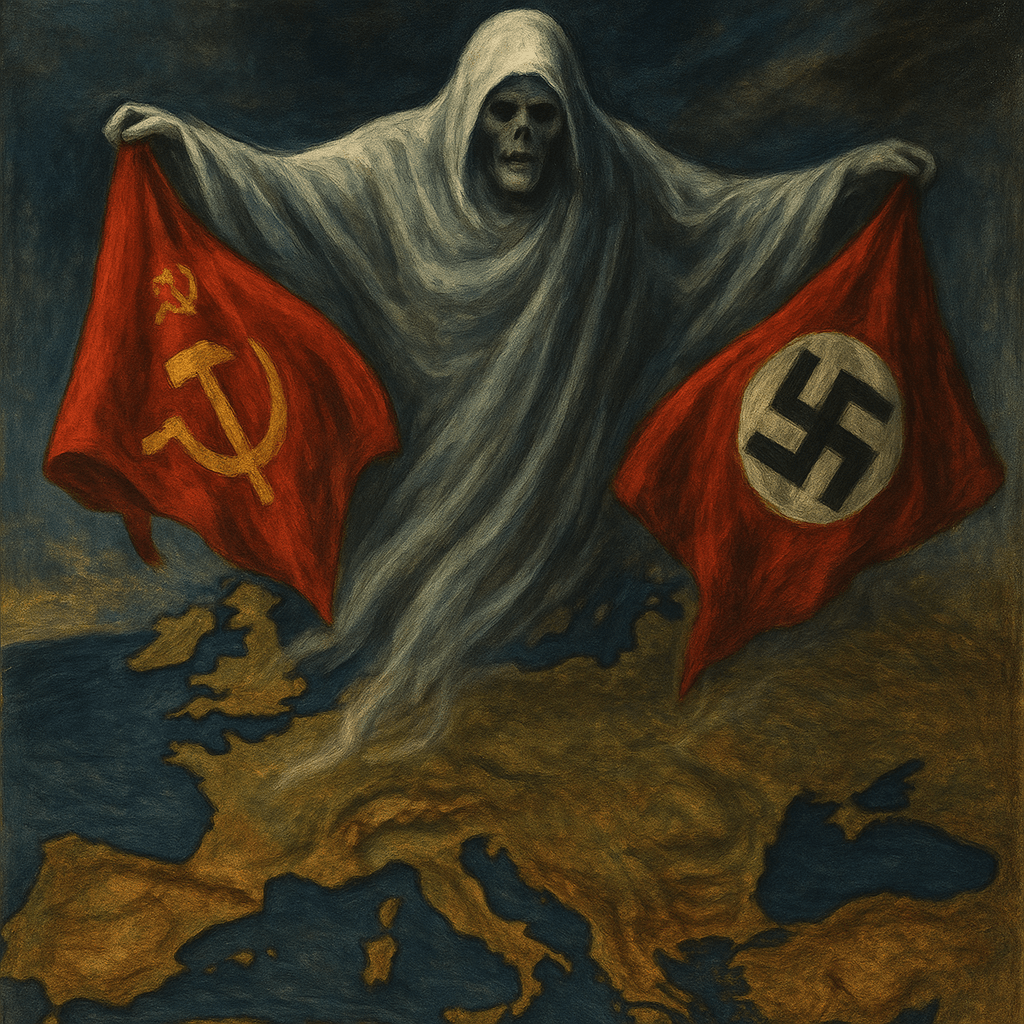
Lo que compartían, pese a su enemistad irreconciliable, era un odio común: el odio al liberalismo. Ambos despreciaban la democracia parlamentaria, el pluralismo de partidos, las libertades individuales. Ambos rechazaban al “hombre burgués”, acusado de débil y decadente. De ese odio nacieron los dos grandes totalitarismos de Europa.
En Moscú, Stalin consolidó un comunismo de Estado nutrido de purgas, colectivización forzosa y culto al líder. En Berlín, Hitler edificó el Reich sobre el racismo biológico y la obediencia absoluta. Ideologías opuestas en la superficie, pero idénticas en la práctica: control total, represión sistemática, aniquilación del individuo.
El pacto Molotov–Ribbentrop de 1939 fue la consecuencia natural de ese odio compartido. En secreto, ambos regímenes acordaron repartirse Polonia, demoler la frágil arquitectura liberal de Versalles y ganar tiempo. Hitler esperaba que Stalin le cubriera la espalda mientras aplastaba a Occidente. Stalin, en cambio, confiaba en que las democracias y el Reich se desgarraran entre sí, para luego él recoger los frutos con el peso demográfico y el tiempo de su lado.
Pero Hitler no podía esperar. El triunfo sobre Francia lo embriagó de confianza. En junio de 1941 lanzó Barbarroja, convencido de que debía aplastar a Stalin antes de que el tiempo inclinara la balanza. Stalin quedó paralizado, incapaz de creer lo que leían sus informes: que Hitler rompía el pacto tan pronto.
La ironía final es que los dos dictadores habían sellado un pacto para ganar tiempo contra el liberalismo. Para Stalin, el tiempo era paciencia estratégica. Para Hitler, urgencia de conquista. El tiempo fue el campo de batalla invisible. Y al final, el mismo tiempo que Hitler quiso acortar se volvió su verdugo: el invierno, la vastedad, la resistencia infinita de la Unión Soviética.
Europa ardió entre esas dos potencias iliberales. Y en medio de esa hoguera quedó el siglo XX: un paréntesis brutal en la historia de la civilización, donde el tiempo decidió lo que las ideologías habían prometido destruir.
Tal vez el tiempo sea el verdadero protagonista de esta crónica. Mussolini y Hitler quisieron domarlo con símbolos y conquistas; Stalin, con paciencia helada y demografía. Ninguno lo poseyó. El tiempo, como un dios ciego, destruyó pactos, borró fronteras, devoró ejércitos. Lo que los hombres llaman ideología no fue más que un disfraz para aplazar lo inevitable: que toda voluntad de eternidad acaba convertida en ceniza. El siglo XX, al final, fue un paréntesis de hierro y sangre, escrito en el margen de un libro que el tiempo ya había empezado a pasar.
Illiberalism and Time
Israel Centeno
The birth of National Socialism cannot be understood without the echo of the Italian experience. Mussolini, a former socialist turned Duce, invented a new grammar: uniformed shirts, parades, archaic symbols turned into modern banners, street violence elevated to political virtue. Hitler watched with fascination. In the early years of his career, he saw in Mussolini the model Germany needed after the humiliation of Versailles: a leader who was at once prophet, soldier, and mass organizer.
But within National Socialism there were fissures. Ernst Röhm, head of the SA, embodied the “socialist” wing of the movement: war veterans, declassed workers, militants who dreamed of an anti-capitalist Nazism, a barracks-style socialism. That vision clashed with Hitler’s need to ally with Germany’s military and industrial elites.
In 1934, the tension erupted. Röhm and the SA were accused of plotting against Hitler. The “Night of the Long Knives” was the decisive purge: Himmler and the SS, along with the Gestapo, annihilated Röhm and his men. The socialist wing of Nazism was decapitated; the party was consolidated into a centralized machine around Hitler, more dependent on bankers, industrialists, and the army. Socialism in National Socialism was reduced to a word on the flag.
The origins of fascism, paradoxically, are tied to the Italian Socialist Party itself. Mussolini grew up within its ranks — a journalist, a fiery union agitator who for years considered himself a Marxist revolutionary. The PSI was a cauldron of factions: reformists, maximalists, syndicalist revolutionaries. What united them was hatred of the old liberal, monarchical, bourgeois order. What divided them was the method: parliamentary reform or violent insurrection? Proletarian internationalism or national rebirth?
The definitive rupture came in 1914. Mussolini supported Italy’s entry into the Great War as a “national revolution” that would forge a new people, uniting workers and soldiers in the blood of the trenches. The Socialist Party expelled him. From that expulsion, fascism was born: a movement that retained revolutionary aesthetics and rhetoric but placed them at the service of absolute nationalism.
The relationship between socialists and fascists was always that of a distorted mirror: they shared mass language, the cult of action, street violence against bourgeois order. But they differed on the target of that violence: socialists sought to destroy capitalism in the name of the proletariat; fascists to rebuild the nation in the name of a mystical community. The love/hate came from that shared origin: children of the same matrix, condemned to kill each other.
In parallel, communists and social democrats repeated this fratricidal dynamic. To a communist, the social democrat was a “traitor to the class.” The memory of the German social democracy voting war credits in 1914 and repressing the Spartacist uprising in 1919 sealed the enmity. Rosa Luxemburg and Karl Liebknecht were murdered with the complicity of social democratic ministers. From then on, “social traitor” became a common insult in the communist vocabulary.
Thus was born the political twentieth century of Europe: from an internal split that gave birth to twin monsters, fascism and communism, and condemned them to a dynamic of love and hate where killing the brother became proof of loyalty.
What they shared, despite being mortal enemies, was a common hatred: hatred of liberalism. Both despised parliamentary democracy, party pluralism, individual liberties. Both rejected the “bourgeois man,” accused of weakness and decadence. From that hatred arose Europe’s two great totalitarianisms.
In Moscow, Stalin consolidated a state communism fed by purges, forced collectivization, and the cult of the leader. In Berlin, Hitler built the Reich on biological racism and absolute obedience. Opposing ideologies on the surface, but identical in practice: total control, systematic repression, annihilation of the individual.
The Molotov–Ribbentrop Pact of 1939 was the natural outcome of this shared hatred. In secret, both regimes agreed to carve up Poland, demolish the fragile liberal architecture of Versailles, and buy time. Hitler expected Stalin to guard his back while he crushed the West. Stalin, in turn, hoped that the democracies and the Reich would bleed each other, allowing him to collect the fruits with demography and time on his side.
But Hitler could not wait. Victory over France intoxicated him with confidence. In June 1941 he launched Operation Barbarossa, convinced that he had to crush Stalin before time tipped the balance. Stalin froze, unable to believe what his reports said: that Hitler had broken the pact so soon.
The final irony is that both dictators had signed the pact to gain time against liberalism. For Stalin, time was strategic patience. For Hitler, it was urgency of conquest. Time became the invisible battlefield. And in the end, the same time Hitler tried to shorten became his executioner: winter, vastness, the endless resistance of the Soviet Union.
Europe burned between these two illiberal powers. And in that fire, the twentieth century itself: a brutal parenthesis in the history of civilization, where time decided what ideologies had promised to destroy.
Perhaps time is the true protagonist of this chronicle. Mussolini and Hitler tried to tame it with symbols and conquests; Stalin with frozen patience and demography. None of them owned it. Time, like a blind god, destroyed pacts, erased borders, devoured armies. What men call ideology was nothing more than a mask to postpone the inevitable: that every will to eternity ends as ashes. The twentieth century, in the end, was a parenthesis of iron and blood, written in the margin of a book whose pages time had already begun to turn.
 Israel Centeno Author
Leave a comment