
“The true Light, which enlightens everyone, was coming into the world.
He was in the world, and the world was made through Him, yet the world did not know Him.
He came to His own, and His own received Him not.
But to all who received Him, who believed in His name, He gave the power to become children of God.”
(Gospel of John 1:9–12)
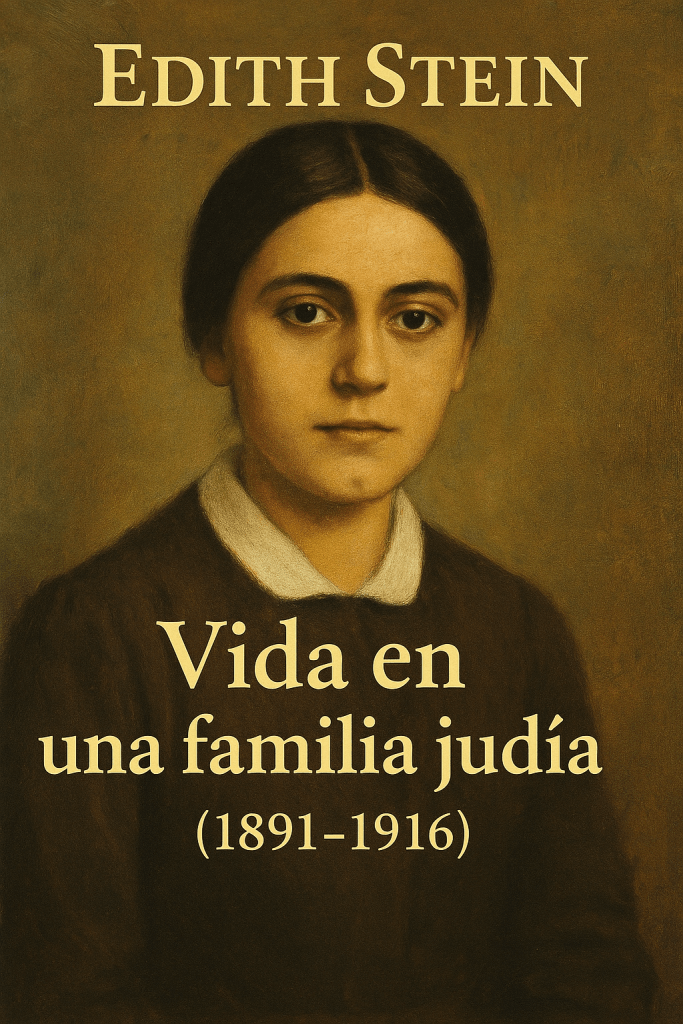
If one wishes to understand the philosophical and spiritual thought of an author, few paths are as fertile as the autobiographical one. In the case of Edith Stein (1891–1942), Life in a Jewish Family is the essential entry point to both her mind and her soul.
Written between 1933 and 1939, after her conversion and entrance into the Carmelite convent in Cologne, the book retraces her childhood and youth up to shortly after her baptism. More than a memoir, it is a testimony of search — an interior phenomenology of consciousness and faith.
Stein reconstructs the world of early 20th-century Central European Judaism — cultivated, ethical, rational — with both affection and critical distance. From this cultural matrix arose her understanding of truth, interiority, and transcendence. What she offers is not a nostalgic recollection, but a philosophical autobiography, in which life becomes material for contemplation.
Far from confessional sentimentality, Stein writes with the precision of a philosopher and the tenderness of one who contemplates her own history as revelation.
Thus, Life in a Jewish Family is not merely an introduction to her life but the existential foundation of her entire philosophy. Within it lie the seeds of her mature thought: empathy, the structure of the person, community, being, and the transformation of the self.
To read it is to accompany a consciousness in ascent — from psychology to ontology, from reason to spirit, from knowledge to love.
🧭 Methodology for Studying Edith Stein’s Thought
A comprehensive study of Edith Stein requires moving through four complementary stages: biography, phenomenology, metaphysics, and mysticism.
I. Phenomenological Formation and the Search for the Self
Core Texts:
- Life in a Jewish Family
- On the Problem of Empathy
- The Concept of State (doctoral dissertation)
Themes: the self, consciousness, intersubjectivity, empathy as openness to the other.
II. From Phenomenology to Ontology
Core Texts:
- Finite and Eternal Being
- Potency and Act
- The Structure of the Human Person
Themes: analogy of being, finitude, participation, the act of creation.
III. Christological Synthesis and the Science of the Cross
Core Texts:
- The Science of the Cross
- The Prayer of the Church
- Essays on Woman
Themes: union with God, redemption, vocation, and the person as called to love.
IV. Pedagogy, Community, and Spirit
Core Texts:
- The Education of Man and Woman
- Letters and Diaries
- Collected Works (Edith Stein Institute, Louvain / Madrid)
Themes: education, community, ethical responsibility, holiness in daily life.
Suggested Reading Path
- Begin with life: Life in a Jewish Family as existential foundation.
- Move to method: On the Problem of Empathy as entry into phenomenology.
- Advance to metaphysics: Finite and Eternal Being for her mature synthesis.
- Conclude with mysticism: The Science of the Cross.
- Revisit everything in unity: life, philosophy, and contemplation as a single path.
Reseña de Vida en una familia judía, de Edith Stein, y metodología para el estudio de su pensamiento
«La luz verdadera, que ilumina a todo hombre, venía a este mundo.
Estaba en el mundo, y el mundo fue hecho por Él,
pero el mundo no lo conoció.
Vino a los suyos, y los suyos no lo recibieron.
Pero a todos los que lo recibieron,
a los que creen en su nombre,
les dio poder de llegar a ser hijos de Dios.»
(Jn 1, 9–12)
🇪🇸
Si queremos comprender el pensamiento filosófico y espiritual de un autor, pocas vías son tan fecundas como la de su autobiografía. En el caso de Edith Stein (1891–1942), Vida en una familia judía es la llave de entrada a su itinerario humano y filosófico.
Escrita entre 1933 y 1939, tras su conversión y su ingreso en el Carmelo de Colonia, esta obra recorre sus años de infancia, juventud y primera madurez, hasta poco después de su bautismo. No es solo un relato de vida, sino un testimonio de búsqueda, una reflexión lúcida sobre la formación del yo, la conciencia y la fe.
En sus páginas, Stein reconstruye el mundo del judaísmo centroeuropeo de su tiempo —culto, ético, racional— con una mirada de gratitud y distancia. Ese entorno formó su comprensión de la verdad y su anhelo de absoluto. Lo que se revela, más que una narración íntima, es una fenomenología del alma: el despertar del espíritu que busca comprender el sentido último del ser.
El texto, lejos de la confesión sentimental, posee el rigor de la filósofa y la delicadeza de quien contempla la propia historia como materia de revelación.
Por eso, Vida en una familia judía no debe considerarse solo una introducción biográfica, sino el fundamento existencial de toda su obra filosófica. En ella se hallan, en germen, los temas que recorrerán su pensamiento posterior: la empatía, la relación entre persona y comunidad, el misterio del ser y la transformación interior.
Leer este libro es acompañar el tránsito de una mente brillante que pasa de la razón al espíritu, del yo psicológico al ser personal, del pensamiento al amor.
🧭 Metodología para estudiar el pensamiento de Edith Stein
Estudiar a Edith Stein exige un recorrido que una biografía, fenomenología, metafísica y mística. Se puede organizar en cuatro etapas complementarias:
I. Formación fenomenológica y búsqueda del yo
Textos clave:
- Vida en una familia judía
- Sobre el problema de la empatía
- El concepto de Estado (tesis doctoral)
Ejes: el yo, la conciencia, la intersubjetividad, la empatía como apertura al otro.
II. De la fenomenología a la ontología
Textos:
- Ser finito y ser eterno
- Potencia y acto
- La estructura de la persona humana
Ejes: la analogía del ser, la finitud, el alma como participación, el acto creador.
III. La síntesis cristológica y la mística de la cruz
Textos:
- La ciencia de la cruz
- La oración de la Iglesia
- Sobre la mujer
Ejes: la unión con Dios, la redención, la persona como vocación al amor.
IV. La pedagogía del espíritu y la comunidad
Textos:
- La formación del hombre y de la mujer
- Cartas y diarios
- Obras completas del Instituto Edith Stein (Louvain, Madrid)
Ejes: educación, comunidad, responsabilidad, santidad cotidiana.
Sugerencia metodológica
- Comenzar por la vida: Vida en una familia judía como raíz existencial.
- Seguir con el método: Sobre el problema de la empatía y la fenomenología husserliana.
- Pasar a la metafísica: Ser finito y ser eterno.
- Culminar en la mística: La ciencia de la cruz.
- Releer en conjunto: biografía, pensamiento y contemplación como unidad.
 Israel Centeno Author
Leave a comment