
Israel Centeno
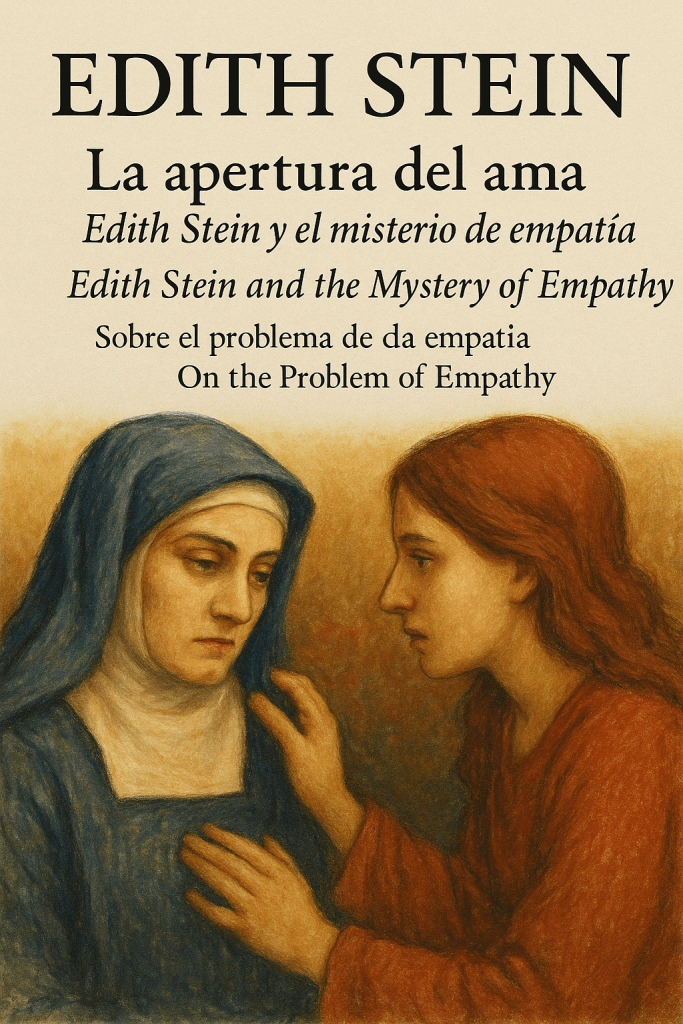
Hubo una hora en la vida de Edith Stein en que la razón, empujada hasta el límite, se inclinó hacia el misterio. Esa hora no fue un colapso de la inteligencia, sino su transfiguración. Quien había sido discípula rigurosa de Husserl, capaz de desmontar las arquitecturas de la conciencia con la precisión de un cirujano del espíritu, comenzó a presentir que en el corazón de la experiencia había un centro más hondo que la lógica y el concepto: el lugar donde un alma toca a otra, donde el yo se abre al tú. A ese fenómeno —tan cotidiano y tan inexplicable— lo llamó empatía.
No es un sentimiento, ni una simpatía moral, ni una emoción contagiosa. Es algo mucho más radical: el modo en que el otro se me da como viviente. Ver un rostro, una mirada, una herida; reconocer en ese gesto no una figura externa, sino una interioridad que se revela sin mostrarse por completo. La empatía, en su sentido más puro, es el milagro cotidiano de la presencia del otro. Es la puerta por la que el alma humana deja de ser un espejo que se mira a sí mismo y se convierte en un espacio abierto.
En su lenguaje riguroso, Stein dirá que la empatía es una presentificación no originaria de una vivencia originaria ajena. Yo no vivo el dolor del otro como mío, pero su dolor se da en mí de manera inmediata, sin mediaciones conceptuales. No lo deduzco ni lo imagino; lo experimento como presente, como una realidad que acontece “allí” y que, sin embargo, me alcanza “aquí”. La empatía no destruye la distancia, la ilumina. Es la experiencia de la alteridad viviente, el fundamento invisible del amor.
Con esa intuición, Edith desmonta siglos de equívocos. Frente a quienes pensaban que comprender al otro era copiar su gesto interior, imitarlo o deducirlo por analogía, ella muestra que esas explicaciones reducen al otro a una sombra. Ninguna teoría causal puede explicar la evidencia del rostro. Antes de preguntarnos cómo se origina la empatía, debemos reconocer qué es: un fenómeno irreductible, un modo de verdad. La fenomenología —esa ciencia de lo evidente— se convierte así en un acto de humildad: mirar el alma humana tal como se da.
Stein explora cada pliegue del acto empático con el rigor de quien camina por un territorio sagrado. Distingue los grados de la experiencia: primero el aparecer del gesto; luego la inmersión silenciosa por la que uno se deja conducir hacia la vivencia que el gesto revela; finalmente, la comprensión plena en la que el otro se me presenta como otro, sin confusión ni fusión. Empatizar es estar cabe el otro, a su lado, mirando con él el horizonte de su mundo. No es absorberlo ni disolverlo, sino acompañarlo en su ser.
Esa compañía funda el “nosotros”. En ella el yo y el tú se reconocen sin perderse; en ella nace la comunidad, la compasión, la caridad. En ella el amor deja de ser apropiación y se vuelve contemplación activa, respeto, adoración. Sin empatía no hay humanidad, ni Iglesia, ni comunión.
Cuando dialoga con las teorías de su tiempo —la imitación interna de Lipps, la asociación de Prandtl, la inferencia por analogía de Mill—, Stein las somete a una prueba simple y devastadora: ninguna de ellas logra explicar que yo vea en el otro una vida. Solo la fenomenología, libre de prejuicios y de mecanismos, puede dar cuenta de esa evidencia viva. “Antes de explicar el origen de algo —escribe— hay que saber qué es.” Así, su pensamiento no busca causas, sino sentido; no disecciona el alma, la contempla.
En su diálogo con Scheler la discusión se vuelve más profunda. Scheler había hablado de una “corriente indiferenciada de vivencias” de la que brotarían lo propio y lo ajeno. Stein le responde con firmeza y ternura: no hay vivencia sin sujeto. No existe una masa espiritual anónima. Cada acto es un acto de alguien, cada sentimiento tiene un centro. Por eso, aunque la empatía y la “percepción interna” compartan el mismo ámbito del alma, son diferentes: en mí, la vivencia es originaria; en la empatía, es no-originaria pero verdadera. En el acto empático, el otro se manifiesta en mí, y su originariedad se transparenta sin confundirse con la mía. Es una comunión sin fusión, un reflejo sin pérdida.
Incluso los engaños del sentimiento —el amor prestado del adolescente que imita a Romeo, el odio heredado de una tradición, la emoción transmitida por contagio colectivo— sirven para mostrar el fondo de su descubrimiento. Allí donde hay imitación o inautenticidad, la conciencia carece de raíz originaria; no hay acto genuino del yo. La empatía, en cambio, es siempre apertura auténtica, transparencia viva. Es la forma más pura del conocimiento del otro porque nace del amor a la verdad del ser.
Cuando finalmente cita a Münsterberg, que define la empatía como el acto en que “el querer ajeno entra en el mío y sin embargo permanece el del otro”, Stein asiente: esa fórmula toca algo esencial. Pero la amplía. No solo la voluntad, sino toda la vida del alma —el dolor, el júbilo, la nostalgia, el temor— es accesible a la empatía. Su campo no se reduce al querer, abarca la totalidad de la persona. Y el descubrimiento decisivo de Stein es que esa totalidad solo se hace visible a la luz del amor.
Por eso, su fenomenología no se queda en la teoría de la mente, sino que anticipa una antropología espiritual. La empatía es el modo en que Dios ha inscrito en nosotros la posibilidad de reconocer su imagen en cada rostro humano. En esa apertura hacia el otro se anuncia ya el misterio cristiano: el Verbo que se encarna y comparte la condición humana.
De la discípula de Husserl nacerá la santa del Carmelo; de la lógica de la conciencia, la ciencia de la cruz. Edith Stein descubrió en la empatía la ley interior de toda comunión: comprender es participar, y participar es amar.
🇬🇧The Opening of the Soul: Edith Stein and the Mystery of Empathy
(Prologue to a Bilingual Edition of On the Problem of Empathy*)
There was a moment in Edith Stein’s life when reason, carried to its furthest limits, leaned toward mystery. It was not a collapse of intellect, but its transfiguration.
A brilliant disciple of Edmund Husserl, capable of dissecting the architecture of consciousness with almost surgical precision, she began to sense that within every act of knowing lay something irreducibly human —the trembling contact between one soul and another. At that threshold where thought meets compassion, she found the phenomenon she called empathy.
Empathy, for Stein, is not a mood, nor a moral sentiment, nor a sentimental echo of another’s pain. It is far more radical: the way another being is given to me as living. To see a face, a glance, a gesture, and to recognize in it not a physical form but an inner life that reveals itself without being consumed —that is the heart of empathy. It is the daily miracle of the other’s presence, the quiet passage through which the human soul ceases to be a closed mirror and becomes an open space.
In precise phenomenological terms, empathy is a non-original presentation of an original experience belonging to another.
I do not live your sorrow as my own, yet your sorrow appears within me immediately, without inference or simulation. I do not deduce it, nor imagine it; I encounter it, as present, as real, yet not mine. Empathy preserves the distance that separates us, and in that very distance, it builds the bridge. It is not fusion, but luminous proximity —the encounter with a living alterity.
With this intuition, Stein dismantled centuries of confusion. Against those who thought that understanding the other was an act of imitation, or an internal mimicry, or a reasoning by analogy, she argued that such models reduce the other to a shadow. No psychological mechanism explains the sheer fact that I perceive a living consciousness before me. “Before one explains the origin of a thing,” she wrote, “one must know what it is.”
Empathy, then, is not a causal process but a phenomenon of revelation: the other becomes manifest to me, and in that manifestation I perceive the dignity of a soul.
She describes its unfolding with both scientific discipline and spiritual reverence.
First, the appearance —a voice, a gesture, a trace of expression.
Then, the immersion, where my awareness follows that trace inward, toward the life it signifies.
Finally, the comprehension, in which I grasp that life as belonging to another center of consciousness.
Empathy means standing beside the other, sharing orientation, seeing the world from the edge of their horizon. It is not absorption, but accompaniment. In this way, empathy becomes the seed of we, the moment when the I and the Thou no longer oppose one another, but coexist without confusion.
When Stein turns to the psychological theories of her age —Lipps’ “inner imitation,” the associationist models, or the logical “inference by analogy”— she exposes their blindness.
They may describe reactions, but not revelation. They speak of movements of the body or ideas of resemblance, but they never reach the event of presence. None of them can explain how another’s joy or despair is given to me as real. Only phenomenology, the discipline of the evident, can clarify that mystery.
Her dialogue with Max Scheler goes deeper still. Scheler had imagined a “stream of undifferentiated experience” out of which the self and the other gradually emerge.
Stein admired his intuition, yet refused his metaphysics: there is no experience without a subject. Every act is an act of someone.
Scheler’s undifferentiated flow, she argues, is a beautiful abstraction that abolishes the living center of the person. For her, the I is not born from the flux; it is already there —the luminous witness of every act of consciousness.
Thus she distinguishes between reflection and inner perception:
reflection is the absolute awareness of a living act (it cannot be false);
inner perception, as Scheler uses it, is an apperception of the psychophysical individual, of the biographical “me.”
Only in reflection do I grasp the indubitable act of loving, fearing, or remembering.
If I err, it is not because the act deceives me, but because my valuation or interpretation of it falters.
So-called “idols” of emotion —inherited hatreds, borrowed loves, second-hand enthusiasms— are not illusions of consciousness but failures of originarity: passions without roots in the free center of the person.
Empathy, on the contrary, is always original in its structure, even though what it reveals is non-original in me. In it, the originarity of the other shines through my non-original experience. It is a reflection of light, not a fusion of flames.
When she cites Münsterberg’s definition of empathy —“the other’s willing enters into mine and yet remains the other’s”— Stein recognizes its beauty, but insists that empathy is not limited to acts of will. It includes the entire field of the soul: moods, affections, griefs, silences, joys. Through empathy we do not merely understand the other’s intention; we participate in their existence, while preserving the sacred difference that lets love remain love.
In this light, Stein’s phenomenology reveals itself as more than an analysis of consciousness; it is an anthropology of communion.
Empathy is the law of the soul’s openness: the way in which the divine image in one person becomes visible to another. Through it, the world ceases to be a collection of objects and becomes a network of living presences.
When Edith Stein later entered the Carmel and wrote The Science of the Cross, this same intuition blossomed into mysticism: the Cross itself is God’s empathy with the suffering world.
The philosopher had uncovered, beneath the logic of experience, the grammar of love.
To understand another is already to serve them;
to serve is to share their being;
and to share, finally, is to redeem.
Notes
- Originario / Originarity:
En fenomenología, lo que se da “originariamente” es lo vivido en su presencia inmediata; “no-originario” es lo vivido de manera mediada o representada (como el recuerdo o la empatía).
In phenomenology, something given “originally” is experienced in direct presence; “non-original” denotes what is given mediately or representationally (as in memory or empathy). - Presentificación / Presentification:
Acto por el cual algo ausente se hace presente en la conciencia (recordar, imaginar, empatizar).
The act by which what is absent becomes present to consciousness (to remember, to imagine, to empathize). - Reflexión / Reflection:
No mera introspección psicológica, sino el acto absoluto en que la conciencia se vuelve sobre su propio vivenciar y lo capta como tal.
Not mere introspection, but the absolute act by which consciousness turns upon its own experiencing and apprehends it as such. - Percepción interna / Inner perception:
En Husserl y Stein, se refiere a la apercepción del yo empírico o biográfico, no al darse absoluto del acto.
In Husserl and Stein, refers to the apperception of the empirical or biographical self, not the absolute givenness of the act.
 Israel Centeno Author
Leave a comment