
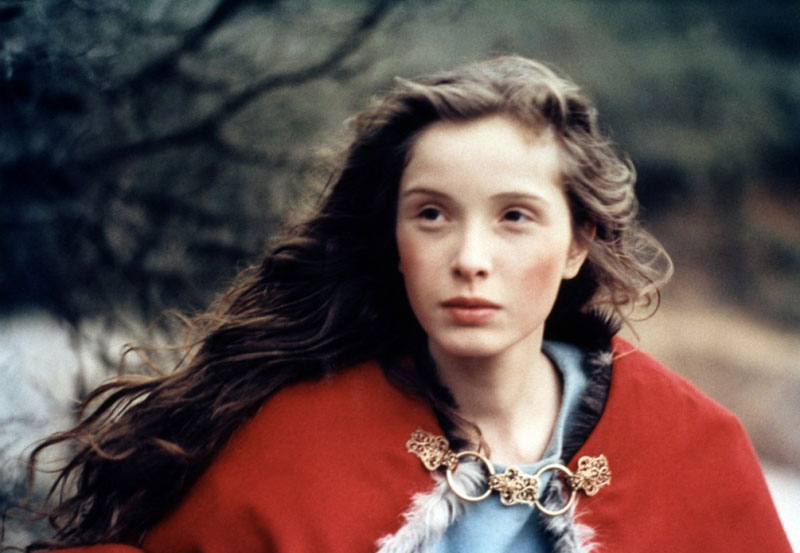
Confieso que llegué a La Passion Béatrice por pura terquedad. Estaba revisando la oferta de cine francés en línea, tratando de romper mis propios prejuicios contra ese discursivo solemne que tanto les gusta —ese Foucault colándose por las rendijas como filtración de aguas servidas— y pensé: «vamos, dale una oportunidad; quizá has sido injusto».
Así que escogí Béatrice. ¿Por qué no?
La vi completa, lo admito. Hasta el final. Pero fue como cargar un peso muerto. No una cruz —no quiero blasfemar— porque la cruz al menos tiene sentido; aquello era una roca sin símbolo, sin luz, sin propósito. Era como si alguien hubiera reconstruido la Edad Media únicamente desde los capítulos más oscuros del manual del pesimismo y hubiese concluido: «así vivían».
Lo que me golpeó no fue la violencia ni la crudeza —que existieron, claro— sino la ausencia total de horizonte. Ni un matiz. Ni una grieta. Ni una pregunta. La película se regodea en la miseria como si fuera una tesis, como si la condición humana fuera solo ruina, como si cada hombre y mujer medieval hubiese vivido sin dignidad, sin fe, sin esperanza, sin esa mezcla de sombra y luz que verdaderamente configura lo humano.
Ese es su problema profundo: no es cine histórico, es cine ideologizado. Una Edad Media moldeada a martillazos, sin monasterios que preservan manuscritos, sin Hildegarda, sin Bernardo, sin Francisco, sin místicos, sin juristas, sin campesinos que ríen y trabajan, sin arte, sin alma.
Intenté colocar la historia en su marco verdadero: la caída del Imperio, la atomización de los reinos, el esfuerzo por reconstruir un orden civilizatorio roto. El papel del cristianismo introduciendo estructura, dignidad y propósito en territorios donde el vacío lo devoraba todo. Pero La Passion Béatrice no quiere historia: quiere tesis.
Incluso los diálogos —interminables, fatigados, subrayados— parecen escritos para demostrar algo, nunca para revelar a alguien. Y cuando llega el final, tan absurdo y mecánico como la vida sin propósito que propone, uno entiende que la tragedia no es la historia: la tragedia es la falta de alma.
Y hay algo más. La película se llama La Passion Béatrice, pero no hay pasión —al menos no en el sentido cristiano, redentor, transformador. La «pasión» que muestra no eleva, no conduce, no ofrece camino. Es solo un pozo. No hay redención para nadie: ni para Béatrice, ni para su hermano, ni para los aldeanos, ni para la bruja acusada porque la miseria siempre necesita un chivo expiatorio.
Todo se derrumba, pero nada renace.
Y uno se pregunta: ¿cómo llegamos desde allí al futuro?
Si todo es pura oscuridad, ¿cómo nace el Renacimiento? ¿Cómo surge la escolástica? ¿Cómo aparece la arquitectura gótica, la música sacra, los códices iluminados, la ciencia monástica, la poesía trovadoresca?
La película nunca se lo plantea, porque para planteárselo tendría que aceptar que incluso en los tiempos más duros existe un principio de sentido, un resplandor mínimo que sostiene lo humano. La Edad Media real, con toda su brutalidad, tenía monasterios fundando hospitales, visionarias escribiendo teología, artesanos perfeccionando oficios, peregrinos caminando hacia Compostela, pecadores arrepintiéndose, santos levantándose entre ruinas.
Nada de esto existe en la película.
Su Edad Media es un callejón sin salida, un invierno sin primavera, un mundo cerrado donde la miseria es inevitable y la redención es imposible. Una antropología desesperada en la que la humanidad no puede más que repetirse y destruirse.
Pero si el pasado hubiese sido realmente así —tan absolutamente muerto, tan absolutamente cerrado— la historia no habría seguido. No estaríamos aquí.
Por eso La Passion Béatrice no es solo una mala lectura de una época: es la negación de aquello que hace posible que exista civilización alguna. Es un relato donde todo colapsa… y aun así, misteriosamente, llegamos al futuro.
Ese misterio —la capacidad humana de recomenzar, de levantarse, de redimir— es precisamente lo que la película se niega a mirar. Y es también lo que hizo que la Edad Media, con toda su dureza, no fuera un pozo sino un puente.
🇺🇸 The Middle Ages According to La Passion Béatrice: a flat tragedy, a horizonless pamphlet
I’ll admit it: I came to La Passion Béatrice out of sheer stubbornness. I was browsing online French cinema, trying to break my own long-standing prejudice against that solemn, over-intellectualized tone they adore —that Foucault seeping into every frame like wastewater— and I thought, come on, give it a fair chance; maybe you’ve been too harsh.
So I chose Béatrice. Why not?
And yes, I watched it to the end. Truly. But it felt like carrying dead weight. Not a cross —I don’t want to blaspheme— because a cross at least has meaning; this was just a stone: mute, heavy, purposeless. As if someone had reconstructed the Middle Ages using only the darkest footnotes of a pessimism manual and declared, “there, that’s how they lived.”
What struck me wasn’t the violence or the brutality —which did exist— but the absolute absence of horizon. No nuance. No cracks. No genuine human question. The film revels in misery as if it were a thesis, as if human existence were nothing but ruin, as if medieval men and women had lived without dignity, without faith, without that mixture of shadow and radiance that truly defines the human condition.
That is its central flaw: it isn’t historical cinema; it’s ideological cinema. A Middle Ages hammered flat, without monasteries preserving manuscripts, without Hildegard, without Bernard, without Francis, without jurists, poets, artisans, pilgrims, mystics, or saints. A Middle Ages with no soul.
I tried to place the story in its real historical frame: the fall of the Empire, the fragmentation of kingdoms, the attempt to rebuild a shattered civilizational order. The role of Christianity in bringing structure, dignity, and purpose to territories threatened by the void. But La Passion Béatrice doesn’t want history; it wants a thesis.
Even the dialogues —long, heavy-handed, labored— seem designed to prove something, never to reveal someone. And when the ending comes, as absurd and mechanical as the purposeless life it depicts, one realizes that the tragedy is not the story: the tragedy is the absence of soul.
And there is more. The film is called La Passion Béatrice, but there is no Passion —not in the Christian, redemptive, transformative sense. What the film shows is not a path, not a journey, not an offering. It is simply a pit. No one is redeemed: not Béatrice, not her brother, not the villagers, not the “witch” condemned because misery always needs a scapegoat.
Everything collapses, but nothing rises.
And one wonders: how do we get from there to the future?
If everything is darkness, how does the Renaissance emerge? How does scholasticism develop? How does Gothic architecture arise, or sacred music, or illuminated manuscripts, or monastic science, or troubadour poetry?
The film never asks, because to ask would require acknowledging that even in the harshest eras, there is a principle of meaning —a minimum radiance— sustaining the human spirit. The real Middle Ages, with all its brutality, had monasteries founding hospitals, visionaries writing theology, craftsmen refining their trades, pilgrims walking to Compostela, sinners repenting, saints rising among ruins.
None of this exists in the film.
Its Middle Ages is a dead end, a winter without spring, a sealed world where misery is inevitable and redemption impossible —an anthropology of despair in which humanity can only repeat and destroy itself.
But if the past had truly been like that —absolutely dead, absolutely closed— history would not have continued. We wouldn’t be here.
That is why La Passion Béatrice is not just a poor reading of an era: it is a denial of the very thing that allows civilizations to exist. It is a story in which everything collapses… and yet, somehow, mysteriously, humanity reaches the future.
That mystery —the capacity to rise, to rebuild, to redeem— is exactly what the film refuses to see. And it is precisely what made the Middle Ages, with all its harshness, not a pit but a bridge.
 Israel Centeno Author
Leave a comment