
by Israel Centeno
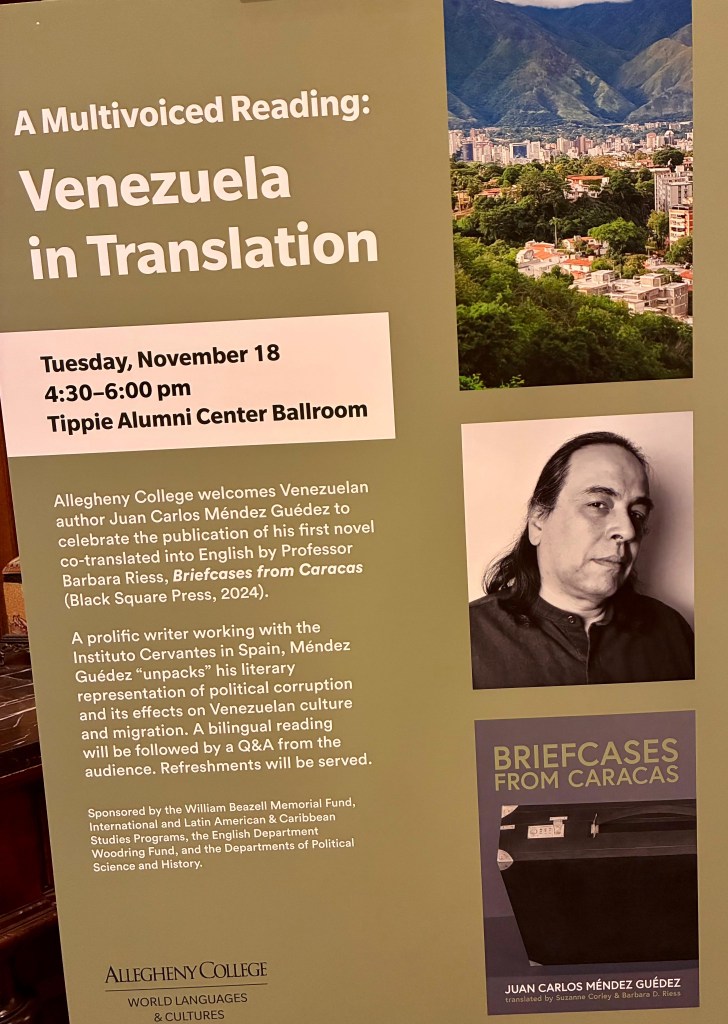
drove from Pittsburgh to Meadville under a gray sky that flattened the afternoon light. The road cut through forests and small towns whose names carried the muted weight of northern Pennsylvania. It was a short trip, but it felt like returning to something that mattered: friendship, time, and a book whose life had already extended far beyond its pages.
I was going to meet Juan Carlos Méndez Guédez and to attend the presentation of Briefcases from Caracas, the English edition of Los maletines. Even before the event began, it was clear that the translation had its own story. Méndez Guédez said it simply: “Writing about how this book was translated would be another novel.” He wasn’t exaggerating.
The English edition credits Suzanne Corley and Barbara D. Riess as translators. Corley began the work. She was already ill — cancer, advancing and unforgiving — but still determined to bring the novel into English. She worked while she could, driven by the conviction that this story deserved new readers. Her illness eventually made it impossible to continue, but she made sure the project did not die with her. She passed the manuscript to people she trusted.
That is how it reached Barbara D. Riess, Professor of Spanish and Translation at Allegheny College. Riess took on the work not as a routine assignment but as a responsibility. She inherited a draft shaped by someone in the last stretch of her life, and she completed it with precision and restraint. The final translation carries both names because both women, in different ways, carried the book.
The presentation in Meadville reflected that shared effort. Professor Wilfredo Hernández, Chair of Hispanic Studies at Allegheny College, led the event with clarity and a sense of purpose. It was more than an academic gathering. It felt like the closing of a long, quiet collaboration among people who cared about literature and about each other.
Reading Briefcases from Caracas with this history in mind adds another layer to the novel, but the book stands strongly on its own.
Méndez Guédez writes a Caracas that operates on the edge: a place where institutions fail, rules bend, and the absurd becomes routine. The novel moves quickly, with sharp dialogue, brief chapters, and scenes that break and reconnect with the logic of a city unraveling. It is a satire, but not a detached one. The humor is a form of survival.
The book has been described as one of the clearest portrayals of Venezuela’s collapse. It earns that description, but it does more. Beneath the noise and corruption, there is a persistent human core. Méndez Guédez does not reduce his characters to symbols of decay. They are contradictory, flawed, afraid, resourceful — people trying to stay upright in a system that no longer hides its rot.
Corruption in the novel is not a political concept. It is a condition of the environment, a pressure that shapes every decision. Yet the narrative avoids melodrama. It relies on sharp observation and on letting events speak for themselves. What emerges is not a diagnosis but a portrait: a country worn down, and individuals who still attempt, in small ways, to hold on to something decent.
Riess’s translation preserves this tone. She maintains the quickness of the prose, the rhythm of the dialogue, the understated humor. She avoids smoothing the book into something generic. The translation keeps the pulse of the original, respecting its edges and its silences.
After hearing the story of the translation in Meadville, the novel’s themes resonate even more. The collapse described in its pages finds a quiet parallel in the lives of the women who worked on the English version — one beginning the translation while facing her own decline, another stepping in to finish the work, and a community of readers and colleagues making sure the book reached the finish line.
Both stories — the fictional and the real — reveal something about endurance. About how people hold on when circumstances fail. About the small, steady acts that allow a work of art to survive.
Driving back from Meadville, the night thick around the highway, what stayed with me was not only the book but the chain of hands that carried it. The novel exposes a society undone by corruption, but the story of its translation shows something different: commitment, loyalty, and the belief that literature still matters enough to protect.
Briefcases from Caracas now moves into the English-speaking world with all of that behind it — the sharpness of its satire, the weight of its truth, and the quiet strength of the people who made sure it crossed over.
Méndez Guédez wrote a fierce novel.
Life added a story of perseverance.
Together they form a single, complete work:
a novel that matters, and a journey that honors it.
 Israel Centeno Author
Leave a comment