
Four Quartets in the light of time, suffering, and charity
Israel Centeno
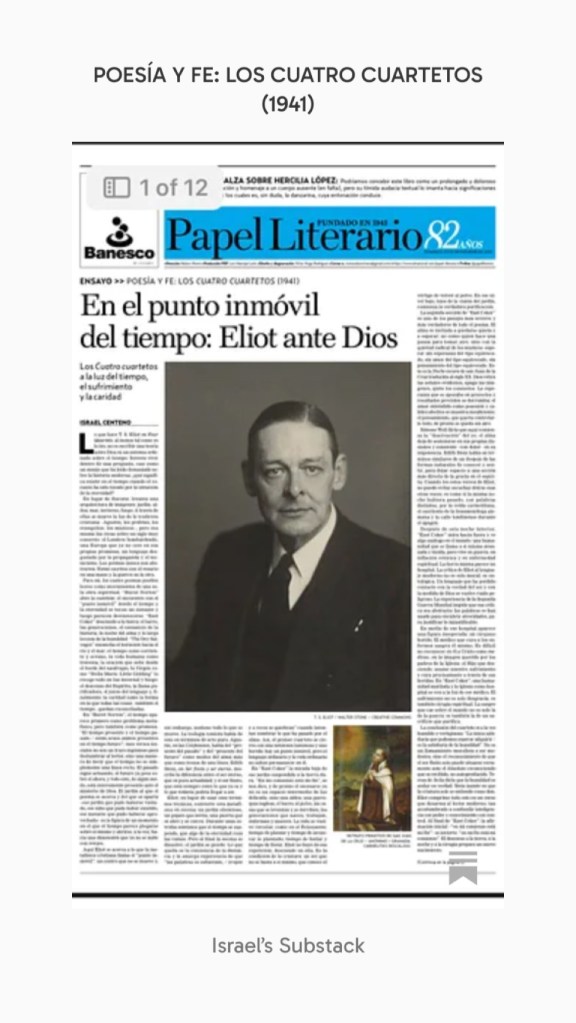
What T. S. Eliot is doing in Four Quartets, at least as I read him, is not writing a theory of God or a neat little system about time. He is trying to live inside a question, almost like a monk who has read too much modern history: what does it mean to exist in time once the heart has been touched by the intuition of eternity?
Instead of arguing, he builds an architecture of images: garden, village, sea, winter, fire. Through them, the light of the Christian tradition keeps moving—Augustine, the prophets, the Gospels, the mystics—but that same light also falls on a very concrete century: bombed London, a Europe that no longer believes its own promises, a language worn thin by propaganda and technical jargon. The poems are never abstract. They are written with a rosary in una mano, y la guerra en la otra.
For me, the four poems can be read as movements in a single spiritual work. Burnt Norton opens the question: the encounter with the “still point” where time and eternity touch for a moment and then seem to vanish again. East Coker descends into the earth: mud, generations, the fatigue of history, the night of the soul and the long lesson of humility. The Dry Salvages widens the horizon towards river and sea: time as current and ocean, human life as voyage, prayer rising from the edge of shipwreck, the Virgin as Stella Maris. Little Gidding gathers everything in winter light and fire: the descent of the Spirit, the purifying flame, the judgment of language, and finally charity as the form in which all things—time included—are reconciled.
In Burnt Norton, time first appears as a metaphysical problem, but also as promise. “Time present and time past / Are both perhaps present in time future”: those opening lines are not a clever trick to dazzle the reader, but a way of saying that time is not simply a straight line. The past continues to act, the future already weighs upon the now, and all of it, in some way, is entirely present before the mystery of God. The garden that the poem approaches and abandons—the garden that might have been visited; the child that might have existed; the moment that might have been seized—is the figure of an instant in which time seems to fold over itself and open at the same time onto a dimension that is no longer measured by clocks.
Here Eliot gestures toward what Christian metaphysics calls the “still point”: a center that does not move and yet sustains all that moves. Thomistic theology speaks of this in terms of pure act; Augustine, in the Confessions, speaks of the “present of the past” and the “present of the future” as modes of the soul rather than pieces of a line; Edith Stein, in Finite and Eternal Being, describes the difference between eternal being, which is sheer actuality, and finite being, which always stands between what it already is and what it could yet become.
Eliot, instead of using those technical terms, turns this metaphysics into a scene: a quiet garden, a bird that invites, a door that opens and shuts. For a few stanzas we feel that time is suspended, that something of eternity brushes the branches. But at the end the scene dissolves; the garden is lost. What remains is the awareness of the distance and the bitter experience that “words strain, / Crack and sometimes break” when they try to name what has passed through the soul. So the first quartet closes with a luminous intuition and a wound: there is a still point, but ordinary language and ordinary life do not know how to remain in it.
In East Coker the gaze drops from that suspended garden to the hard ground. “In my beginning is my end,” we are told, and suddenly the stage is no longer an in-between space of delicate light, but a village, an English parish, mud, dust, houses raised and pulled down, generations that are born, work, fall sick, and die. Life becomes circular, like in Ecclesiastes: a time to plant and a time to pluck up what is planted; a time to dance and a time to mourn. Eliot does not run away from that repetition; he descends into it. This is the condition of the creature: a being that does not suffice unto itself, who knows the vertigo of returning to dust. On that low ground, far from the garden vision, the real purification begins.
The second section of East Coker is one of the most severe and most truthful passages of the whole poem. The soul is invited to be still and to wait—not like someone who pauses to catch breath, but with the radical stillness of the mystics: to wait without hope of the wrong kind, without love of the wrong kind, without thought of the wrong kind. This is John of the Cross’s dark night translated into a twentieth-century idiom. God withdraws the obvious signs, switches off images, takes away consolations. Hope that was leaning on projects and expected outcomes collapses; love understood as possession and emotional warmth shows itself insufficient; thought, which wanted to control everything, suddenly lacks air.
Simone Weil would say that here the “decreation” of the self begins: the soul stops sustaining itself on its own illusions and consents—painfully—to its impotence. Edith Stein speaks in similar terms of a stripping away of natural forms of knowing and feeling, to make room for a more direct action of grace in the spirit. When I read these lines of Eliot, I cannot avoid hearing those other voices behind him; it is as if the same night passed, with different words, through the Carmelite cell, the German phenomenologist’s desk, and the London street during the blackout.
After this inner night, East Coker turns outward and sees something analogous in the world: a humanity that calls itself advanced and lucid, but lives in war, rhetorical inflation, and spiritual disease. The earth itself looks like a hospital. Eliot’s critique of modern language is not merely moral; it is ontological. A language that has lost contact with the truth of being and with the measure of God becomes dangerous noise. The experience of the Second World War prevents that critique from being abstract: words have been used to hide atrocities, to justify the unjustifiable.
In the middle of that hospital an unexpected figure appears: a wounded surgeon. The doctor who heals the sick is bleeding himself. It is hard not to recognize in him Christ as medicus, the beloved image of the Church Fathers: the Son who descends, assumes our suffering, and heals precisely through his wounds. In East Coker, a mutilated humanity and the Church as hospital are seen in the light of that Physician. Suffering is not only misfortune; it is also spiritual surgery. The blood that falls upon the world is not only the blood of war; it is also the blood of a sacrifice that purifies.
The conclusion of the quartet is both humble and dizzying: “The only wisdom we can hope to acquire / Is the wisdom of humility.” This is not a moralistic call to be modest, but the recognition that finitebeing can only stand rightly before the Absolute by acknowledging that it is received, not self-produced. Teresa of Ávila would say that humility is walking in truth. Stein insists that the creature can only be understood as gift. Eliot compresses all this into a line that disarms the modern reader, so used to confusing intelligence with power and knowledge with control. At the end of East Coker, the opening statement—“In my beginning is my end”—is inverted: “In my end is my beginning.” The descent into earth, night, and surgery prepares a new birth.
The Dry Salvages opens yet another dimension: the river that runs through childhood, the sea that belongs to no one. The river is biography: brown water, force, bends, villages rising on its banks. The sea is what exceeds any biography: expanse, threat, indifference. The human being depends on the sea and fears it. Eliot evokes foghorns, ships coming and going, bodies the water gives back, the sound of bells drifting through mist. The sea becomes the figure of cosmic time and necessity: that web of forces, causes, and accidents against which the individual can do very little.
And yet, in the midst of that exposure, a bell rings: a note, insistent, that calls us to pray for “those who were in ships.” Prayer appears here as the most honest response to radical vulnerability. The poem does not ask for the sea to disappear or the danger to be cancelled. It simply asks that we not be alone. The sea continues to roar, the rocks stay where they are, the winds keep their caprice. But something changes in the gaze: danger is no longer only threat; it becomes also an occasion for supplication.
Weil would recognize her own intuition here: the purest prayer is the cry of a creature that knows it has no rights and yet dares to direct all its attention to the One who is. Reading these lines, I think of the thousands of anonymous crossings, of exiles and migrants; the bell of The Dry Salvages rings for them too.
At that point the Virgin enters the poem. “Lady, whose shrine stands on the promontory”: the sober phrase calls up centuries of maritime devotion. Mary is Stella Maris, star of the sea, a fixed point for those who “have their business in great waters.” Births, deaths, long crossings, telegrams that arrive too late or never arrive at all—all of this unfolds under the gaze of a figure who is not an abstraction, but a face. The Christian tradition has learned to say that through her passed the inconceivable act by which eternity entered time. The Dry Salvages receives that reality without explaining it in systematic terms: while the sea throws ships up and crushes them, the star remains. Where the waters threaten to swallow everything, someone holds in her arms the place where the timeless and time truly intersect.
The last movements of the quartet move into terrain very close to Weil and Stein: the conviction that God speaks above all in the small and unspectacular. Attention to coincidences, to overheard words, to minor accidents in daily life becomes a form of prayer. There is no spiritual fireworks here; there are hints and guesses, discreet suggestions. Grace rarely arrives with a megaphone; it seeps through cracks. The modern man, Eliot says, lives “distracted from distraction by distraction,” unable to receive that discretion of God. The problem is not simply God’s absence, but our absence from our own lives.
In Little Gidding the landscape sharpens again. It is winter. The air cuts, the light is poor, the trees are bare. The real site—a small Anglican community of prayer—becomes a symbol of the world’s edge, a point where history seems to have reached its limit. There are no gardens here, no temperate seasons, no open sea: only ice and cold. It is the right season for fire.
The fire in the last quartet is not only the fire in hearths—though it is that—and not only the fire of bombs falling on London—though that image haunts the poem. It is above all the fire of the Spirit, the dove descending and breaking the air. The tradition of Pentecost, the tongues of flame resting on the apostles, John of the Cross’s “living flame of love,” the fire that burns away dross to leave pure gold: all of that hums in the background when Eliot speaks of flame that burns, strips, refuses to leave the self intact.
There is no soft comfort here. “The only hope, or else despair / Lies in the choice of pyre or pyre,” he writes. Life cannot avoid the fire. The only real question is whether that fire will be the flame of charity in God or the ungoverned blaze of suffering without meaning.
As this inner and outer fire cuts the air, a “familiar compound ghost” appears, a visitor who acts as guide, as judgment, and as mirror for the poet. The encounter with that spirit, which echoes Dante’s meetings with his guides and at the same time sounds like a purified conscience speaking from the other side, is a sort of final examination. The visitor reminds the poet that old age—or spiritual maturity—has its own gifts: lucidity, disillusionment, a clean irony. He warns that the one who is “only a poet and nothing more” is hardly a poet at all; that language which refuses to submit to truth, to charity, to the fire, empties itself from within. And he entrusts Eliot with a task: to “purify the dialect of the tribe.”
That purification is not about making style more elegant. It is a work of cleansing: to free the tongue from propaganda, lies, and narcissism, so that words may become once again transparent to being, to the Logos. The poet’s job is not to decorate the void, but to rescue language from its degraded uses so that it can tell the real again. The judgment is severe: in the end, what hurts most is not what we have suffered, but the pain of re-enacting what we have been, of seeing ourselves without masks. Yet that same judgment is mercy: the fire that burns in this way does so in order to leave only what deserves to remain.
Once the fire has passed, charity remains. The fourth movement of Little Gidding grows bright. Resentment, old grievances, the urge to settle scores—all of that is absorbed by a wisdom that no longer argues: forgiveness. The communion between living and dead emerges as something more than a metaphor: those who have loved are not completely dead; those who cling to hatred are not fully alive. Time ceases to be mere duration and becomes a fabric of relationships which, in God, are not broken. Julian of Norwich’s “all shall be well” appears here not as a sentimental slogan, but as a sentence born from having looked at evil and having handed it over entirely to mercy.
The poem closes on three intertwined insights that gather the whole journey. First, exploration never ends: “We shall not cease from exploration / And the end of all our exploring / Will be to arrive where we started / And know the place for the first time.” The spiritual path does not lead to a different place than the origin; it leads to a new gaze upon what was always there. That which has been present from the beginning—God, the still point, the source of being—suddenly appears as if seen for the first time.
Second, history and time become transparent. What we called beginning and end reveal themselves as two perspectives on a single reality held entirely within God’s eternity. The metaphysical doctrines about time and eternity, which in Aquinas or Boethius can sound abstract, here are made visible through images we can feel in our own skin.
And third comes the line that both closes and opens: “And the fire and the rose are one.”
In that image the entire arc of Four Quartets is inscribed. Fire, which seemed only judgment, pain, purification, reveals itself identical to the rose, figure of beauty, mystical nuptiality, glory. What burned adorns. What wounded heals. What seemed pure destruction is recognized as love. It is the same movement John of the Cross sees in the night that unites Bridegroom and bride; the same movement Edith Stein intuits when she speaks of the Cross as the form of divine love; the same movement Weil glimpses when the weight of the world, if offered, turns into grace. But the form is unmistakably Eliot’s: sober, compressed, modern, stubbornly English.
One can trace parallels endlessly: Dante’s celestial rose; Augustine’s restless heart; Teresa’s interior castle; Stein’s metaphysics of being; Weil’s notebooks. Many of their lines run through these poems. But the decisive point lies elsewhere. Four Quartets is not the poetic illustration of a ready-made theological system. It is a voice that, within that tradition, walks the path again with the concrete materials of its own time: the collapse of European culture, the Second World War, the crisis of language, the biography of a man who deliberately stepped into faith.
When we place Eliot’s verses next to the Summa Theologiae, Finite and Eternal Being, the Dark Night of the Soul or Julian’s Revelations, we find deep resonances but not servile dependence. He thinks alongside those authors, not through them. He allows himself to be struck by the same light, but refracts it through a different glass.
When the poem ends and we have walked its stations, we are not left with a closed system or a final theory of God and time. What remains is a disposition of the heart. Knowing that there is a still point does not spare us winter, night, sea, or earth. It does make it possible, however, to live them differently: with humility, with attention, with a hope that no longer rests on its own calculations, with a charity that does not come from the sheer strength of our will, but from the passage of the fire.
And perhaps there will be, at least once, a moment—almost imperceptible—in which the soul recognizes, with astonishment and gratitude, that fire and rose, judgment and tenderness, cross and glory, were from the beginning one in the heart of God.
 Israel Centeno Author
Leave a comment