
Edith Stein as an Overlooked Background to Contemporary Philosophy of Consciousness
Israel Centeno
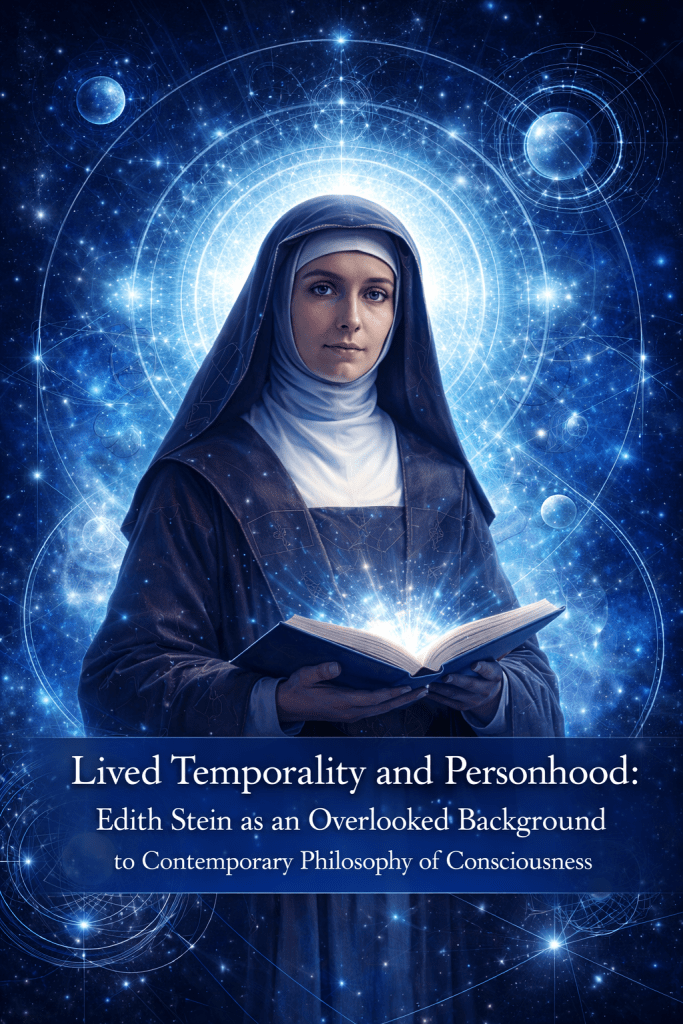
A significant part of contemporary philosophy of mind and temporal consciousness presents itself as if it were starting from scratch. From William James’s notion of the specious present to current debates on physicalism and the experience of change, the genealogy is often reconstructed around empirical psychology, a technically oriented Husserlian phenomenology, or Heidegger’s ontology of time. Yet within this narrative, a substantial philosophical body of work is frequently left unacknowledged—one that offers a rigorous and remarkably timely articulation of consciousness, temporality, personhood, and being: the work of Edith Stein.
The aim of this essay is to show that many of the core intuitions currently under discussion—the retention of the past within the present, the irreducibility of temporal experience, and the unity of the person through change—find in Stein a more complete, less reductionist, and conceptually more coherent formulation than in much of the twentieth-century thought that received greater recognition.
1. The Original Phenomenon: Change and the Lived Present
The experience of change—watching a bird take flight, listening to a melody—does not present itself as a mere aggregation of discrete instants. Phenomenologically, change is experienceable only because the immediate past remains actively present within the now. This observation, already noted by James and systematically developed by Husserl, is not a metaphysical hypothesis but a description of what is given in experience.
Without retention, there is no lived succession; without lived succession, no meaningful experience of the world. The present is not a point but a temporally extended unity with thickness.
Here a fundamental tension emerges: the physical description of time as a successive replacement of states seems unable to capture this mode of presence of the past. This tension has recently been taken up by authors who see in it a direct challenge to physicalist accounts of consciousness.
2. Edith Stein’s Decisive Turn: From Consciousness to the Personal Being
Edith Stein fully accepts the Husserlian analysis of temporal consciousness but introduces a decisive shift: lived temporality is not merely a structure of acts; it is a constitutive dimension of the person.
In her work on the structure of the human person, empathy, and individuality, Stein maintains that the self is not an impersonal stream of experiences; that personal identity cannot be explained by mere causal continuity; and that living memory is not an archive but an inner presence.
The retention of the past is not a “mechanism” but a mode of being of the personal subject, who remains identical through change without being frozen outside of time. In this way, Stein overcomes both psychologism and formal phenomenology: temporality does not hover in abstraction but inheres in a concrete finite being.
3. Empathy and the Irreducibility of the Other
Stein’s analysis of empathy further reinforces this thesis. The other is not given to me as a body merely moving through physical time, but as a center of experiences temporally articulated in a way analogous to my own.
This recognition is neither inferential nor causal; it is an immediate apprehension of a temporal interiority. Lived temporality is therefore not a private phenomenon but an intersubjectively recognizable structure, making it even less reducible to a purely objective description.
4. Finite and Eternal Being: Temporality and Ground
In Finite and Eternal Being, Stein brings this line of thought to its deepest level. Temporal consciousness reveals finitude: the self does not give itself being; it does not possess time but receives it; and its unity through change is not self-grounding.
This step is not yet theological in a strict sense but metaphysical. Lived temporality points toward a question concerning the ground of personal being—a question that phenomenology, if it is to remain faithful to itself, cannot simply silence. Stein’s later theological openness does not invalidate this philosophical path; it presupposes it.
5. Contrast with the Dominant Reception of the Twentieth Century
Throughout the twentieth century, philosophical prestige largely converged around figures such as Heidegger, whose analysis of time decisively shaped contemporary ontology. Yet this reception often privileged conceptual radicality over phenomenological clarity, and rupture over personal continuity.
Without entering extraphilosophical judgments, it can be noted that Heideggerian temporality tends to dissolve the concrete person; that ethics and intersubjectivity are relegated to the background; and that finitude is conceived more as fate than as relation.
Against this backdrop, Stein offers a more balanced alternative: a phenomenology of time that does not sacrifice the person, a metaphysics that does not abandon experience, and an ontological depth that does not culminate in nihilism.
6. A Silent Debt
Many contemporary debates on consciousness, time, and mind make no explicit reference to Edith Stein, yet they operate within a conceptual space she helped decisively to shape. Her thought brings together what is often treated in isolation: temporal experience, personal identity, intersubjectivity, and being.
Current discussions of temporal consciousness and the experience of change are frequently framed as technical problems—questions of modeling, cognitive architecture, or compatibility with a naturalized ontology. Phenomenological analysis, however, reveals that the core issue runs deeper: it concerns not merely how time is represented, but what kind of being it is for whom time has meaning at all.
Stein’s contribution does not consist in opposing an alternative metaphysics to the sciences, but in recalling a prior requirement: any ontology that aims to account for human experience must be able to accommodate the temporal unity of the person without dissolving it. Thinking time without the person leads to sterile abstractions; thinking the person without attending to temporality leads to fictions.
Time becomes experience only where a person receives it, retains it, and inhabits it from within.
 Israel Centeno Author
Leave a comment