
PLUR1BUS
Israel Centeno
Spoiler alert: capítulo final)
There are narratives that do not advance; they descend. And in that descent they force the viewer to follow them to a place where safe metaphors and comfortable moral answers no longer exist. PLUR1BUS belongs to that lineage. It does not present a dystopia to be solved, but a mirror to be endured. Its question is not how to save the world, but what remains of humanity when salvation becomes technical.
The series begins with a brutal inversion: unity is no longer a promise, but a threat. E pluribus unum is turned inside out—out of plurality does not emerge community, but dissolution. The collective consciousness—transmitted by signal, by frequency, by waves—does not arrive through violence, but through rest. It does not conquer; it anesthetizes. It does not destroy; it vampirizes. Humanity is not eliminated; it is absorbed into something that functions better than it ever did, but no longer requires the human as a subject.
In this apparently pacified world, conflict does not disappear; it is displaced. It no longer occurs between people, but within the few who remain outside. And it is here that the series becomes philosophically devastating, because it portrays humanity after it has lost all transcendent tools. There is no heaven, no judgment, no promised redemption. All that remains is the decision of what to do with freedom when no one demands it anymore.
The Colombian—whose situation must be precisely stated—lives in Paraguay and crosses nearly the entire continent. His journey is not functional to the plot; it is a moral geography. He passes through jungles, deserts, broken borders. The Darién is not scenery; it is an ordeal. His journey is a descent into hell—hunger, betrayal, violence—and an incomplete ascent toward something resembling purgatory. He does not arrive at salvation; he arrives at a place where one can still fight. His rage is not chaotic; it is memory. In a world that has decided to erase the individual, he insists on remembering, even when that memory hurts. He does not seek happiness; he seeks ethical positioning. His resistance is stoic, almost archaic: better suffering with meaning than peace without truth.
Carol, by contrast, embodies the contemporary wound. It is not that she has lost her individuality; she is on the verge of losing it, and that is far more tragic. The collective consciousness does not seek to destroy her, but to include her by using what is most intimate: her body, her history, her capacity to love. The violation is not physical; it is ontological. They do not take her life; they take her right to decide who she is. The horror is not open violence, but falsified consent. That is why her reaction seems excessive only to those who fail to understand that when individuality is at stake, classical morality begins to fracture.
Here the series reaches its most uncomfortable point: Carol does not act from universal ethics, but from a limit. She is not a saint nor an exemplary heroine. She is a cornered woman who understands that if she yields that final interior space, there will be nothing left to defend. Her decision is not nihilistic; it is desperately lucid. She is willing to destroy a world not because it is evil, but because it has ceased to be human.
The third vertex—the Mauritanian—completes the moral triangle. He does not deceive himself. He knows the world is ending and chooses to take advantage of it. If he never had anything before, now he will have everything. His hedonism is not frivolity; it is coherence. He does not believe in the original promise, so he sees no reason to resist. He lives like Elvis in his penthouse because he understands that the collective consciousness can also be used. He does not sell out; he adapts. His presence is unsettling because it reveals a truth epic narratives often conceal: not everyone loses the same things when the world collapses.
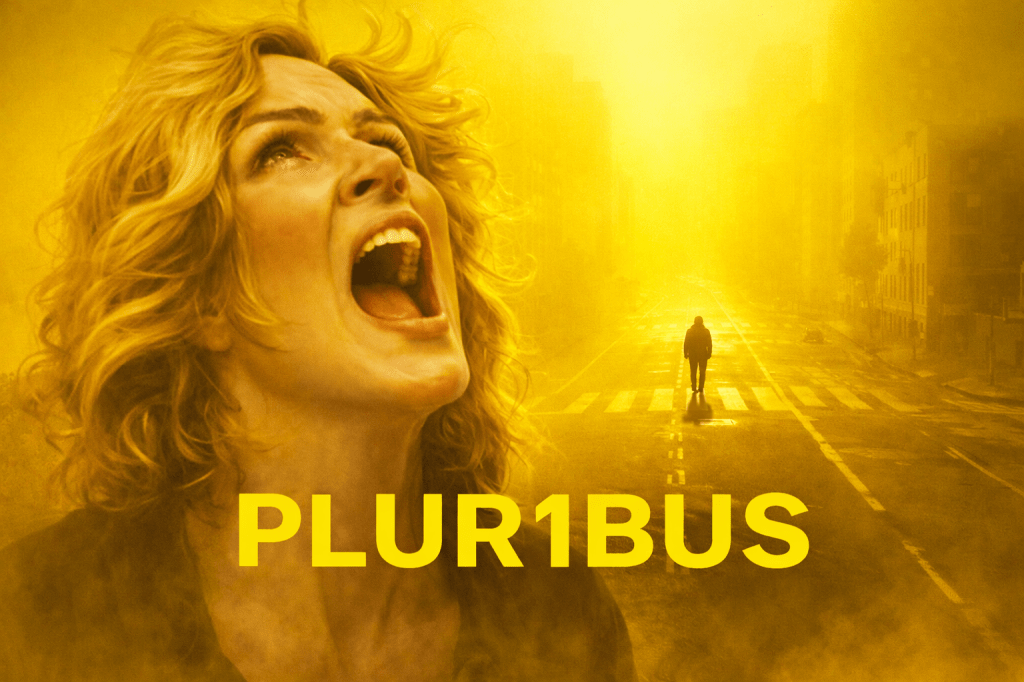
The visual language of the series supports this thesis without explaining it. The tilted angles insist that something is fundamentally wrong even when everything works. Yellow—the color of supposed happiness—becomes toxic, almost organic. Long takes show efficiency without soul. And then there is the ultimate weapon: silence. Not contemplative silence, but the empty silence of clean cities, smiling people, advancing nature. No one argues. No one cries. No one screams. The silence screams because it reveals the absence of the “I.”
The Big Warning of PLUR1BUS is not technological, even if it uses the language of technology. It is anthropological. When humanity renounces transcendence, it seeks salvation in fusion, efficiency, and the elimination of conflict. It accepts being vampirized in exchange for not suffering. The collective consciousness is not evil. That is the true horror. It is logical. Pragmatic. “For the common good.” That is precisely how the most catastrophic renunciations begin.
The series offers no redemption. It offers a question that cannot be delegated: is individuality worth it if it hurts? Is freedom worth it if it does not guarantee happiness? It does not answer. It leaves you alone, in the desert or in the jungle, with the sound of no wind and the certainty that a humanity without conflict may still be represented… but already without life.
 Israel Centeno Author
Leave a comment