
A brief note
Israel Centeno
This will be a brief note on my blog, likely the only explicit position I will take on this subject. It does not come from ideology or affiliation, but from lived experience—accumulated, embodied, and unresolved.
One of the hardest traumas to overcome—among many: beatings, persecution, exile—has not been exile itself, but the shouting.
The shouting of the shock brigades.
In Venezuela, we lived for years under that abuse. They didn’t just shout; they hit. They were present when we made political decisions, when we stood in line to vote, when we tried to file even the most basic complaint. I vividly remember going to the electoral council during the “flat signatures” episode, together with Pedro León Zapata, Mara Comerlati, Professor Manuel Bermúdez, Pompeyo Márquez, my wife, and others. When we walked out, the mob was waiting.
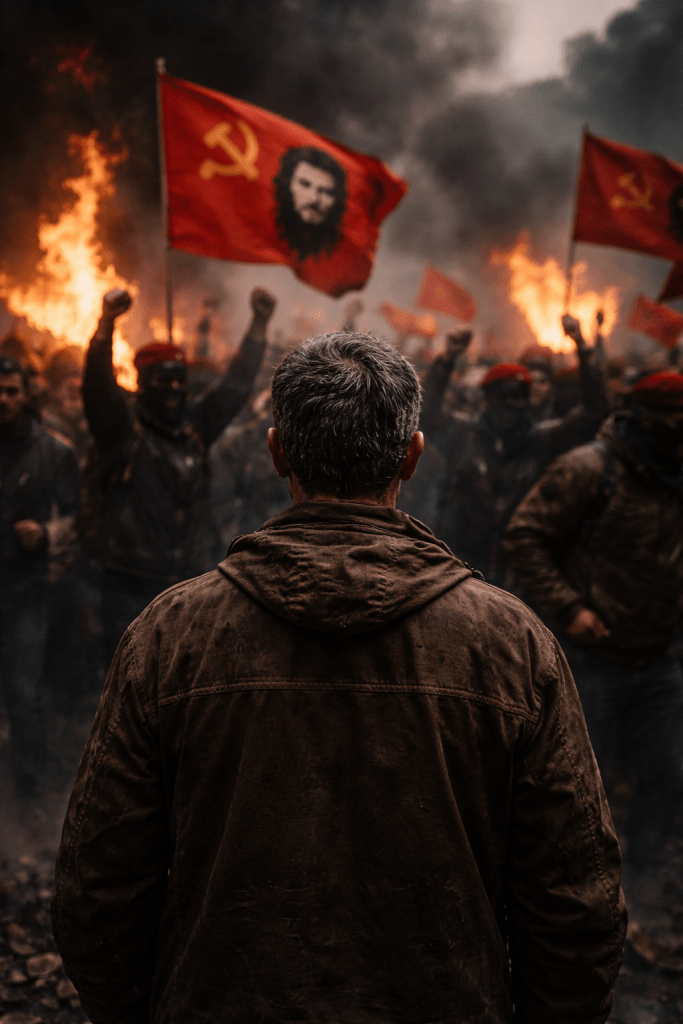
It was always the same imagery: the red star, the Che-style beret, raised fists, chants in unison—the people united will never be defeated—and above all, a level of aggression completely out of proportion. Pompeyo Márquez was beaten. Branded a traitor. That was not political debate. It was organized physical intimidation.
For more than two decades, anything that fell outside the government’s imposed framework encountered that shadow—the unofficial but very real arm of the dictatorship. There were murders in broad daylight. Students killed. Fear made routine.
We believed distance would cure it. Many of us left—Europe, the United States. But it didn’t. When I now see radical leftist brigades in the West—environmental, pro-Palestinian, or whatever the cause of the season may be—I recognize the exact same signs. The language changes. The setting changes. The logic does not.
Here they call themselves antifa. In Europe they go by other names. Sometimes they add contradictory symbols: the rainbow flag next to the image of Che Guevara—the same man who promoted the first concentration camps for homosexuals in Latin America. That contradiction is not accidental. It is selective memory at work.
Because of my experiences in Latin America, the swastika and the hammer and sickle provoke the same rejection in me. Extremist symbols are not abstract. They are saturated with fear and violence.
The color red, in particular, is a nightmare.
It was imposed for years—politically, visually, psychologically. So much so that later, in the United States, I struggled deeply with having to wear a red uniform while working in a hospital. The job itself was demanding, but that was never the issue. The issue was wearing that red—carrying again a mark I had not chosen, one associated in my country with coercion.
That is why the symbolism of extremes—pure red, red and black—remains deeply unsettling. Watching young protesters today in khaki shirts, chanting inherited slogans, displaying symbols they have never had to pay for in their own bodies, is frightening. These are people who have never spent a night without electricity, water, gas, or food; who have never queued outside a collapsed hospital; who have never felt the physical fear of a coordinated mob.
For some, this is political aesthetics.
For others—those of us who have lived it—it is trauma memory.
This is not a slogan. It is a warning.
Some symbols do not announce justice or liberation.
They announce repetition
 Israel Centeno Author
Leave a comment