
Israel Centeno
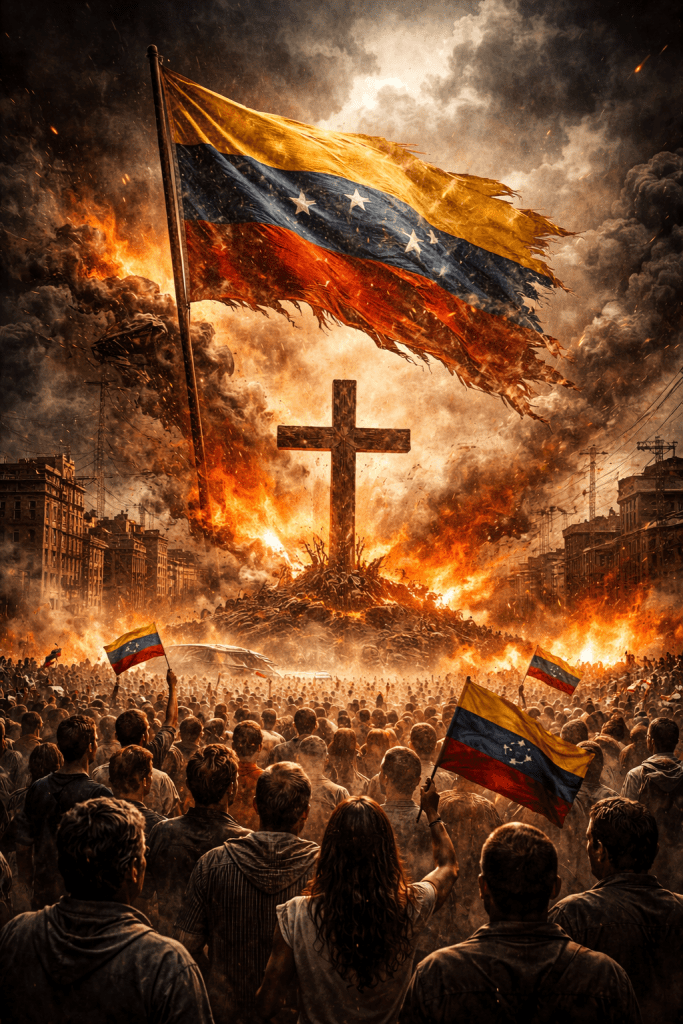
Although the statements made by President Donald Trump were harsh—almost violent to the ears of Venezuelans long accustomed to swallowing bitter truths—the diagnosis itself is not false: today, Venezuela’s opposition lacks a real structure of governance capable of leading an immediate political transition on its own.
Precision matters here. The dilemma is not whether there should or should not be an invasion. The United States has no invasion planned, and this must be stated clearly and repeatedly. The real question is different and far more complex: how can an opposition figure—rightfully and legitimately—lead a transition without actual governance structures, meaning without the backing of sectors of the Armed Forces and institutions that, in practice, either do not exist or remain fully captured?
What appears to be emerging from Washington is something far more troubling: an attempt to dismantle the dictatorship with the assistance of the dictatorship itself. This is where deep mistrust arises. Even if economic and geopolitical pressure has temporarily pushed Delcy Rodríguez and certain power centers to accept U.S. tutelage, these actors are not cornered between a sword and a wall, but—as someone aptly put it—between sword and sword.
Neither the Rodríguez siblings nor Vladimir Padrino López are political suicides. They are searching for a way out. The unresolved question is whether that exit leads to a negotiated withdrawal or to entrenchment, by making themselves progressively indispensable to the Trump administration. If Washington fails to impose clear, verifiable, and non-negotiable demands regarding public freedoms, these sectors may exploit the situation: releasing some political prisoners while keeping others, easing pressure in select areas while maintaining censorship and repression, and quietly advancing a third agenda—one aimed not at democratic transition, but at their own survival.
Compounding this is a factor often underestimated abroad: Chavismo is not a monolithic structure. The internal tensions now unfolding are deep and potentially irreconcilable. Here lies a critical point that Washington may be overlooking—or perhaps fully aware of: criminal pacts are inherently fragile. In organizations of a fundamentally criminal nature, such as the one sustaining the regime, agreements are not resolved institutionally but through dirty maneuvers, historically including betrayal, purges, and even assassination.
Even if U.S. policymakers believe there is room to sustain an arrangement with Delcy beyond the constitutional thirty-day window for calling elections due to presidential absence, it is difficult to imagine such pressure holding without internal explosions within Chavismo itself, with unpredictable consequences.
This brings us back to the central question: how can the opposition—the legitimate and appropriate actor—lead a transition when governance structures remain in the hands of the regime? The only plausible path would be a verifiable rupture within the Armed Forces, accompanied by concrete commitments: dismantling paramilitary groups, fully releasing political prisoners, restoring public freedoms, and guaranteeing citizens’ rights and safety.
The Venezuelan people are not waiting merely for economic relief. They are waiting for real political gains: freedom of expression, the safe return of the persecuted, the dismantling of the repressive apparatus, and guarantees of life and rights. Only then can genuine conditions emerge for new elections and institutional re-legitimation. In such a scenario, Edmundo González is already legitimate, but a truly free election would consolidate that legitimacy. Fragmentation now would be a serious strategic mistake, especially as Chavismo shows visible internal fractures.
Nothing about this process suggests a clean, linear, or predictable transition. If it occurs at all, it will be marked by turbulence, ruptures, and surprises, both negative and positive. No one can accurately foresee the outcome—not even those who believe they hold the strings.
One can only hope that the final result yields a real gain for the Venezuelan people, rather than merely the removal of Nicolás Maduro—a murderer, thief, corrupt figure, and narcotrafficker—while an oppressive regime survives under new names and faces. Because if reform is unlikely in prison, it is pure illusion to expect it in freedom and with power.
That is the heart of the matter. And it should be stated plainly.
 Israel Centeno Author
Leave a comment