
Israel Centeno
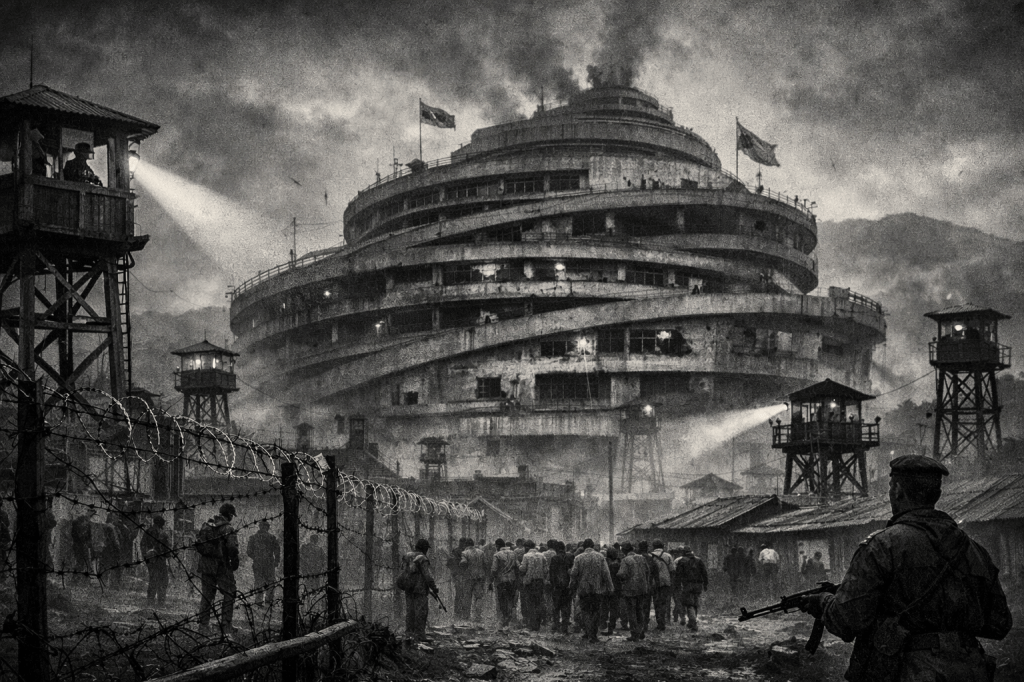
Some buildings are not just concrete. Some structures wait, in silence, for history to finish writing them. El Helicoide is one of them—not because it was left unfinished, but because it ended up revealing, with brutal clarity, the moral failure of an era.
Conceived in the 1950s as a futuristic shopping center—an audacious project meant to display prosperity and economic dynamism—El Helicoide was born as a symbol of modernity under the regime of Marcos Pérez Jiménez. This is not about absolving or condemning individuals; it is about reading the symbol. The architecture was designed for circulation, exchange, visibility—for a country that wanted to appear modern.
Then came democracy. Imperfect, yes—but democracy nonetheless. And with it, abandonment. El Helicoide was left halfway: neither completed nor reimagined. A historical waste. An urban void that already functioned as metaphor—promises no one knew, or chose, to fulfill.
The decisive turn arrived with chavismo and its final degradation under Hugo Chávez and Nicolás Maduro. The ruin became system. The building shifted from a frustrated promise of economic modernity to a center of detention, torture, and the annihilation of the human soul. There, the State ceased to be a guarantor of rights and became an executioner.
We are not speaking of isolated excesses. We are speaking of patterns: uninhabitable cells, planned humiliations, physical and psychological torment, methodical dehumanization. People reduced to less than things. A functional, bureaucratic hell. Horror not as accident, but as method.
The twentieth century gave names to such places: Gulag, Nazi extermination camps—spaces where power decided that certain human beings were disposable. The twenty-first century, so proud of its human-rights rhetoric, has its own. El Helicoide belongs to that lineage. Saying so is not exaggeration; it is historical honesty.
Here the symbol completes itself: what was built to display prosperity ended as a factory of horror. A postmodern gulag, wrapped in emancipatory language, administered by an ideology that promised justice and produced dehumanization.
But El Helicoide does not indict only the regime that used it. It indicts, above all, the failure of International Law. And the question is unavoidable: how is it possible that International Law is now invoked with solemnity when, for years, it was known that the Venezuelan people’s human rights were being systematically violated?
These were not rumors or marginal denunciations. It was known. It was documented. It was reported. And yet international mechanisms did not act with the necessary force. They failed to protect victims. They failed to impose real limits on power. They failed to stop a slide that moved from repression to the camp.
Let there be no confusion: it was not a single foreign administration, nor a single leader, who “destroyed” International Law. That law had been eroding for a long time. When it works, it does so selectively—for a portion of humanity. For those deemed, by an ideological narrative, to be on the “right side of history,” meaning aligned with the left side of the political spectrum in certain international forums.
In Venezuela, abuses were committed on a scale comparable to those of Argentina during its dictatorship. In Argentina, those crimes produced global shock, memory, judicial processes, and moral condemnation. In Venezuela, they did not. Why? Because it was cynically assumed that what happened there did not “count” the same way: the regime defined itself as left-wing. And the left, as we have known for decades, is forgiven the unforgivable.
This is not new. It goes back far. To the time of Jean-Paul Sartre, who looked away from the Soviet gulags and remained silent—if not complicit—during the early years of Nazism, following the political line of the moment. Ideology before man. Narrative before the victim.
The outcome, then, should surprise no one. When International Law fails systematically, when it becomes a catalogue of reports without consequences, the end point is force. The debate over a possible extraction of Maduro by U.S. troops—rather than a resolution achieved through international legal mechanisms—is the direct consequence of that prior failure. It is not the cause. It is the result.
Had international mechanisms functioned when they should have, we would not have arrived here. Horror would not have been normalized. A place like El Helicoide would not have operated for years. Reality would not have been pushed to a point of no return.
Do not complain now.
Do not invoke with outrage an International Law that was allowed to die through omission, selectivity, and hypocrisy.
El Helicoide is not only Venezuelan. It is universal. It is the uncomfortable mirror of the postmodern world when it loses fear of God and of man, when ideology replaces moral conscience, when law separates itself from justice.
To name it is an act of dignity. To think it through is a moral obligation. To silence it is to repeat it.
 Israel Centeno Author
Leave a comment