
AND HOW TO RECOGNIZE THEIR LOGIC TODAY
Israel Centeno
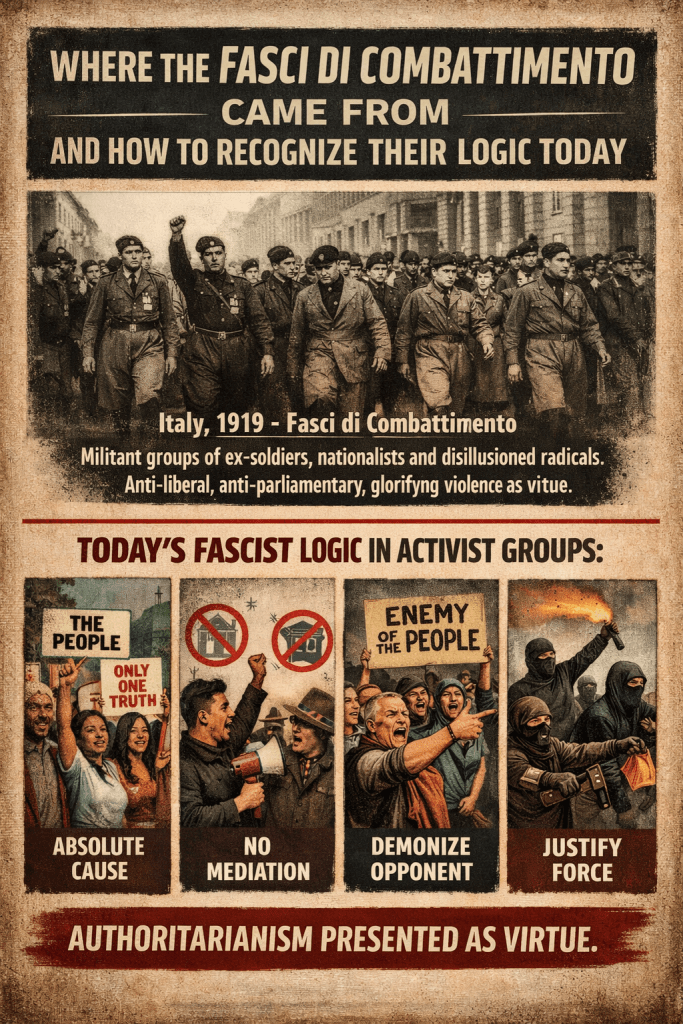
The Fasci italiani di combattimento did not emerge as a traditional conservative right, nor as a nostalgic reaction to the past. They were born in 1919 in a context of social disintegration, postwar frustration, and deep contempt for liberal parliamentarism. Their defining trait was not a coherent ideology, but a mode of action.
They were groups of permanent mobilization: anti-liberal, anti-parliamentary, anti-bourgeois in rhetoric, and deeply opportunistic in practice. They brought together disillusioned veterans, frustrated syndicalists, radical nationalists, and socially unanchored youth. They did not offer a detailed program, but a promise: action, belonging, and meaning.
Early fascism was defined less by what it defended than by what it destroyed. It despised institutional mediation, negotiation, the slowness of law, and the fragility of the individual. It believed violence was not only legitimate, but regenerative. Politics was conceived as combat, not deliberation.
This origin is essential to understanding why fascism does not reappear today with the same aesthetics, but with the same logic.
In postmodernity, the logic of the fasci reemerges in mobilized groups of social pressure that do not necessarily identify as fascist, right-wing, or even authoritarian. It appears wherever mobilization replaces thinking and moral pressure replaces law.
The first sign is the absolutization of a cause. The group organizes itself around an unquestionable truth: the people, the nation, identity, historical justice, science, security, care. That truth is not debated. It is obeyed. The concrete individual becomes subordinate to a moral abstraction that always stands above him.
The second sign is contempt for mediation. Parliaments, courts, procedures, guarantees, nuance—all are seen as obstacles. Moral urgency justifies skipping steps. The group views itself as more lucid than institutions, purer than law, more legitimate than any rule.
The third sign is the moralization of the adversary. The dissenter is not wrong; he is dangerous. He is not answered; he is exposed, canceled, expelled. Language ceases to be political and becomes clinical or judicial. One speaks of harm, toxicity, threat, cleansing.
The fourth sign is the justification of violence in some form. It is not always physical. It may be intimidation, harassment, symbolic destruction, silencing, social coercion. What matters is not the method, but the logic: violence is acceptable if exercised in the name of the good.
The fifth sign is the aesthetics of mobilization. Uniform slogans, repeated phrases, ritualized gestures, intense emotional belonging. The group does not seek to persuade; it seeks to demonstrate force. As with the original fasci, identity is built through action, not reflection.
These signs can appear in violent street leftism, when the cause justifies aggression and the individual becomes expendable. They can appear in supremacist right-wing movements, when identity becomes dogma and the other a structural threat. And they appear, most disturbingly, in movements that define themselves as antifascist and consider censorship, persecution, or silencing legitimate in order to prevent a greater evil.
History shows that the Fasci di combattimento did not seize power immediately. First they normalized pressure, intimidation, and “corrective” violence. The State came later. This is why the most common mistake is to look for fascism only in government and not in the street, the network, the moral climate.
Recognizing this logic does not mean equating everything or denying contextual differences. It means something more modest and more difficult: accepting that authoritarianism does not always present itself as oppression, but often as virtue.
Fascism does not begin when democracy is suspended. It begins when the individual is considered expendable in the name of a higher cause. That was the core of the fasci. And that core remains recognizable, if one is willing to look without slogans.
 Israel Centeno Author
Leave a comment