
Israel Centeno
In Philip Rostek’s work, Pittsburgh announces itself almost unintentionally. The city’s most recognizable feature—its bridges—appears repeatedly, yet never as a declaration. They function as background architecture, structural rather than symbolic, present without demanding attention. The bridges are not icons; they are givens. Like the city itself, they are absorbed into the visual logic of the work, operating as support rather than spectacle.
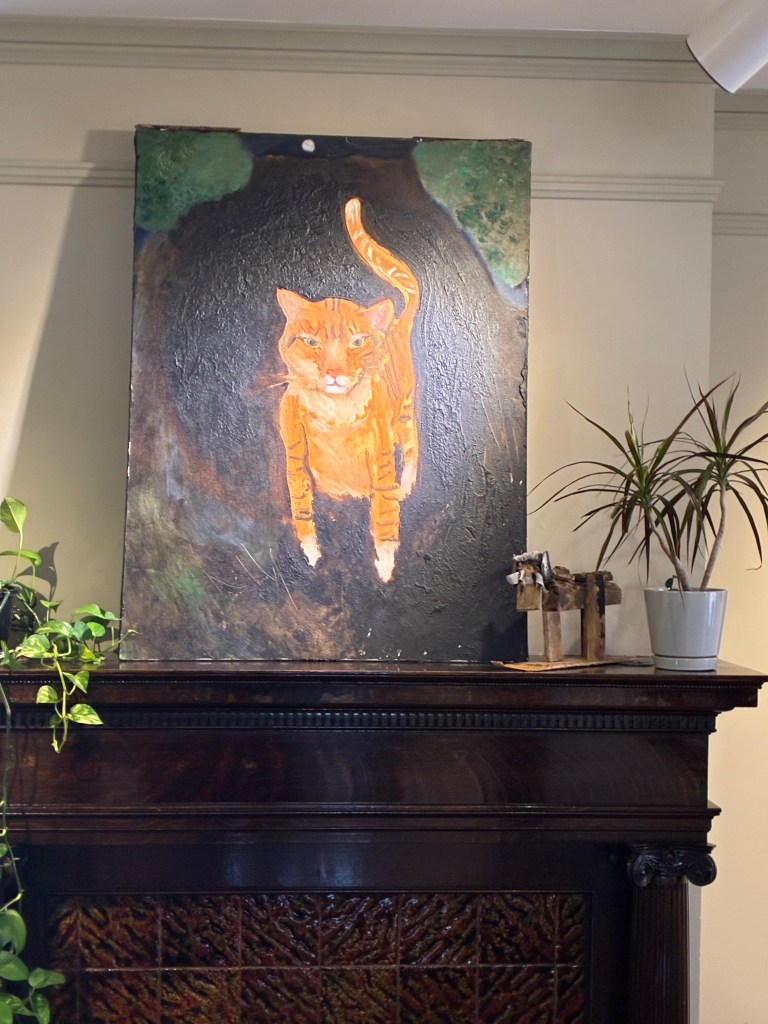
Technically, Rostek’s paintings are driven less by drawing than by gesture and layering. Line is secondary. Form emerges through accumulation, erosion, and the visible negotiation between pigment and surface. His brushwork is unapologetically present. Paint is dragged, pushed, sometimes scraped, leaving evidence of process rather than masking it in finish.
Spatially, many of the landscapes resist classical perspective. Roads, railways, and bridges suggest direction without offering resolution. The eye moves forward but never arrives. This refusal of a stable vanishing point creates a space that feels psychological rather than optical—built from memory, repetition, and lived familiarity rather than compositional rules.
The materiality of the paint reinforces this effect. In several works, especially those depicting infrastructure, the paint follows the direction of movement: horizontal strokes echoing tracks, vertical interruptions marking structures. The surface becomes active, reinforcing the sense that these places are traversed rather than contemplated.
When Rostek turns to animals—particularly the fantastical or costumed figures—the technique shifts subtly. Contours become more deliberate, though never academic. These creatures hover between figure and symbol. Their anatomy is intentionally unresolved, closer to masks than bodies. Color plays a psychological role here: eyes are exaggerated, whites unnaturally bright, tones slightly off, creating a sense of alertness and unease rather than whimsy.
One of the most striking aspects of Rostek’s practice is his abrupt chromatic shifts. He moves without warning from muted, earth-bound palettes to paintings that erupt in tropical color. These transitions are not thematic but internal. Color does not decorate the image; it interrupts it. In the more saturated works, pigment is applied thickly and decisively, sometimes verging on excess. Harmony is not the goal. Impact is.
In the works related to his heart transplant, technique becomes noticeably restrained. Layers thin out. Forms appear and recede. Edges fail to close. Figures seem partially present, as if held together provisionally. Here the painting does not dramatize experience—it records vulnerability through hesitation and incompleteness.
The works on paper—drawings and serigraphs—reveal a parallel discipline. Faces recur: saints, friars, public figures. They are rendered with economy and insistence. These are not preparatory sketches but autonomous works, testing how little information is needed to sustain presence. Reverence and irony coexist without hierarchy.
Across all these modes, Rostek avoids technical perfection. Imperfection is not tolerated; it is cultivated. Accidents remain visible. Corrections are not concealed. The paintings trust the process to carry meaning forward.
This technical posture aligns closely with the sensibility of Pittsburgh itself: a city defined by structure, labor, and endurance, but softened by familiarity and quiet persistence. In Rostek’s work, the city is not depicted so much as inhabited.
The paintings do not explain. They accumulate. Like the house-museum that held the exhibition—room by room, theme by theme—they ask to be walked through rather than decoded.
In that sense, Rostek’s work is less about representation than about continuity: between place and memory, surface and experience, fragility and construction. The bridges remain in the background, doing what bridges do—holding everything together without asking to be admired.
 Israel Centeno Author
Leave a comment