
What I Saw at the Bellevue Gallery
Israel Centeno
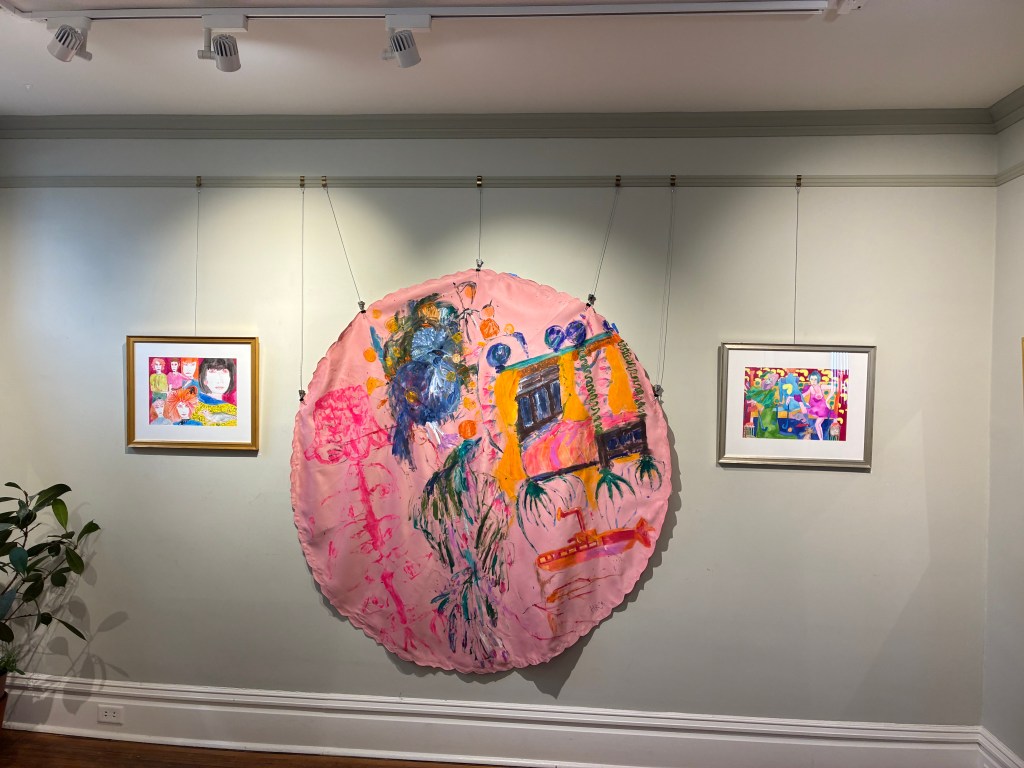
I went to the John A. Hermann Jr. Memorial Art Museum on a Sunday in February. The air was damp. Snow had collapsed into gray slush mixed with what the freeze had pushed to the surface. Coffee warmed somewhere nearby. Bellevue felt suspended between a winter that would not leave and a routine that kept moving anyway.
The exhibition was titled Live • Worship • Shop, taken from an old Route 65 sign. It was the seventh week of a nine-week series. I walked in without expectation.
Helen Bryant and Hilary Best shared the main room. The show was modest in size, but nothing in it felt minor.
Bryant works with a steady line and saturated color. Greens that hold, blues that settle deep, reds that take up space. Her figures do not soften for the viewer. They stand as they are—tense sprites, crowned women, animals that return your gaze. One painting showed a woman wrapped in red, surrounded by eyes and enclosing shapes. I stayed with it longer than I planned. It did not yield meaning quickly, and I stopped trying to extract one.
On another wall stood a full-length female figure. Bare-breasted, facing ahead, holding an apple. The erotic element was present, but it did not work as a display. There was no tilt of the hip, no invitation. The body was not arranged for desire. It was simply there.
I noticed my own hesitation before I understood why. I am used to reading the nude as either provocation or critique. This was neither. The artist avoided polishing the skin into an ideal. A bird moved across the background—a squirrel cut through the color. The figure did not resolve into myth or symbol. She did not explain herself. She did not seem interested in how she was being received.
That absence unsettled me more than a dramatic gesture would have.
Best’s work moved in a quieter register. Ink drawings suggested cells, branching systems, and interior structures opened to view. Circular forms expanded from dark centers. They belong to a microscope slide or to a diagram of thought. The artist-controlled line, but it never felt sterile.
A textile piece hung with gravity. Lace, cavities, strands of hair gathered inside. It did not demand attention. It asked for proximity. On a marble table, compact black forms pierced by white rods rested in clusters. I not decide whether they read as nests or as wounds. I stopped trying to decide.
At the center of the room, a suspended pink circle carried layers of marks and fragments. It felt worked through rather than designed. Nearby portraits placed young faces beside animals—a peacock, a monkey, a panda—without hierarchy. The pairings were not sentimental. They were matter-of-fact.
The exhibition did not comfort me. It did not shock me either. It stayed with the body—its exposure, its limits, its insistence. The nude figure, the porcelain mushrooms, the drawings that echoed neural structures, the dense surfaces of color—all returned to the body as ground. Not as a commodity. Not as a symbol. As something that precedes interpretation.
When I stepped back into the street, nothing dramatic had occurred. I did not feel enlightened. But something in me had shifted slightly, almost against my will. A small internal adjustment. The kind you notice later, when you realize you are looking at things differently.
I don’t know what opened in that room. I only know it hasn’t closed yet.
 Israel Centeno Author
Leave a comment